
What is a Native AI Autonomous Marketing Platform?
What is a Native AI Autonomous Marketing Platform?
Transforming Marketing from the C-Suite’s Largest Liability into its Most Valuable Asset
For the modern enterprise CEO, marketing represents a paradox. It is the engine of growth, yet it frequently manifests as the organization’s largest, most volatile liability in the $50M–$500M mid-market sector.
Companies are currently trapped in a “squeeze”—desperate to reduce operational expenses (OpEx) to improve margins, yet unable to sacrifice the growth required to satisfy investors.
The current operating model is broken. It relies on bloated internal teams, misaligned agencies, and legacy “dumb tools” that create data silos rather than actionable answers.
The industry is bifurcated between software that requires heavy human manual labor and “black box” services that bill for time rather than outcomes.
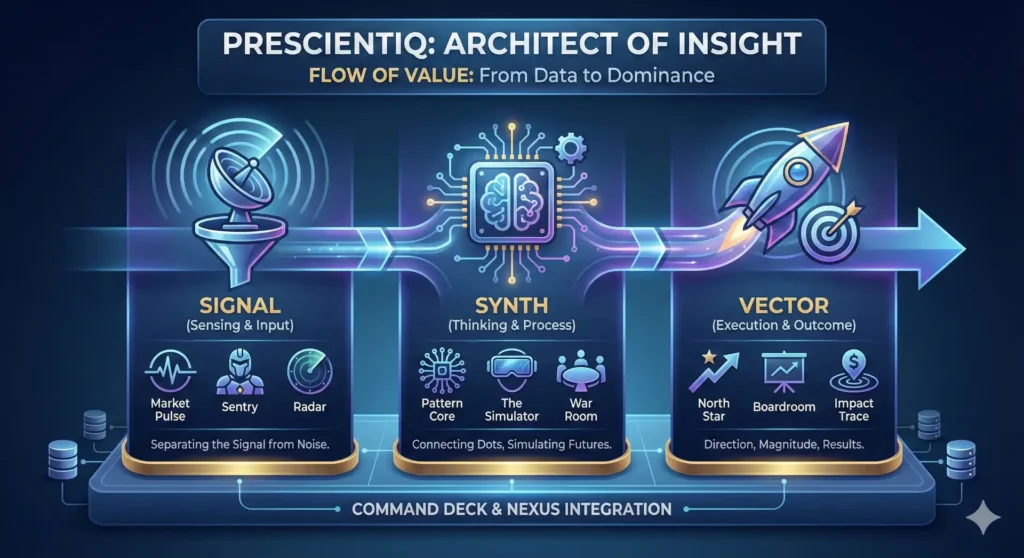
This article introduces the solution to this structural inefficiency: PrescientIQ, the world’s first Native AI Autonomous Marketing Platform.
Unlike traditional marketing automation, which acts as a “copilot” assisting humans, PrescientIQ functions as an “autopilot”—a system designed to replace manual execution functions entirely.
By leveraging Unified Causal Intelligence (UCI), pre-factual simulation, and a fleet of autonomous agents, PrescientIQ decouples revenue growth from headcount growth, offering financial certainty in an uncertain market.
Part 1: The Cost of Chaos
Why the Current Marketing Model is Failing the C-Suite
The traditional marketing department is built on an outdated, human-centric architecture that scales linearly with cost.
As a company grows from $50M to $100M in revenue, the marketing “line item” balloons disproportionately, driven by three compounding inefficiencies.
1.1 Internal Teams: High OpEx and Operational Latency
In a typical $100M enterprise, the marketing function employs 30 full-time employees (FTEs). These are talented individuals—copywriters, data analysts, media buyers—who are paid full salaries to perform manual tasks in isolation.
They are “musicians” playing instruments in separate rooms. The result is operational latency.
A campaign idea conceived on Monday often takes weeks to reach the market as it passes through strategy, copy, design, compliance, and ad operations.
By the time the campaign is live, market conditions have shifted.
Furthermore, these teams operate on static dashboards, making decisions based on what happened last month rather than what is happening this millisecond.
1.2 Agencies: The Misalignment of Incentives
To supplement internal teams, companies turn to agencies. However, the agency business model is fundamentally misaligned with client success.
Agencies bill for inputs (hours and headcount), not outputs (profitability and revenue). This model encourages “casting a wide net”—broad, generic strategies designed to retain the account rather than optimize efficiency.
Agencies lack the granular, real-time data access required to make micro-adjustments, and their reporting is often opaque, obscuring the true ROI of the spend.
1.3 Legacy Tech: The “Dumb Tool” Problem
The technology stack meant to solve these problems has only exacerbated them. Platforms like Salesforce and HubSpot act as massive databases—”dumb tools” — that store information but lack the brain to act on it.
They create data silos, forcing human workers to act as the middleware, manually moving data from a CRM to an email tool to an ad platform.
These tools require constant human supervision and rule-setting (e.g., “If X happens, do Y”), which creates rigidity and fails to adapt to the nuance of real-time customer behavior. When automation is not enough.
Part 2: Defining Native AI
From “Bolted-On” Features to Autonomous Architecture
To solve the “Cost of Chaos,” we must distinguish between Artificial Intelligence as a feature and Native AI as an architecture.
2.1 The “Copilot” vs. “Autopilot” Distinction
Most MarTech competitors are currently racing to add Generative AI features to their existing platforms.
They are building “copilots”—tools that help a human write an email faster or summarize a meeting. While this offers incremental efficiency, it does not change the operating model; the human is still the bottleneck.
PrescientIQ is a Native AI Autonomous Marketing Platform. This means AI is not a bolted-on feature but the foundation of the system. It is designed to function as an “autopilot.”
Just as a self-driving car navigates traffic without turn-by-turn instructions from the driver, PrescientIQ’s agents navigate the market without constant human supervision.
2.2 Key Characteristics of Native AI (Native AI Autonomous Marketing Platform)
- Autonomous Operation: The system executes complete workflows—from campaign setup to content creation and bid optimization—freeing human marketers from execution tasks.
- Continuous Learning: The platform tests, learns, and adapts strategies based on performance data, making thousands of micro-adjustments daily.
- Contextual Intelligence: It ingests data from every touchpoint (CRM, social, web, finance) to understand the full narrative of the customer journey, enabling hyper-personalization that human teams cannot execute at scale.
Part 3: The Technology of Certainty

Causal Intelligence and the Simulation Core
The defining failure of traditional AI in marketing is its reliance on correlation (pattern matching). Generative AI knows what words are likely to follow one another, but it does not understand why a customer buys. PrescientIQ replaces correlation with Unified Causal Intelligence (UCI).
3.1 Unified Causal Intelligence (UCI)
UCI allows the platform to understand cause-and-effect relationships. Instead of guessing that ad spend correlates with revenue, the system understands exactly how a specific budget allocation affects the P&L. This shift is critical for the CFO, as it transforms marketing spend from a gamble into a predictable financial instrument.
3.2 The Pre-Factual Simulation Core
PrescientIQ possesses a “Flight Simulator” for business. Before a single dollar of the client’s budget is spent in the real world, the system runs thousands of scenarios in a digital twin environment.
- Digital Twins: The system creates virtual replicas of the market, the customer base, and the business logic.
- MCMC Simulations: Using Markov Chain Monte Carlo models, the system runs 10,000 “pre-factual” simulations to stress-test strategies.
- De-Risking Decisions: This ensures that agents never “practice” with a live budget. They only execute strategies that have already been mathematically proven to have a high probability of success in the simulation.
3.3 Enterprise-Grade Infrastructure for Native AI Autonomous Marketing Platform
Built on Google Cloud Vertex AI, the platform utilizes Gemini-powered models for reasoning and Quantum-Inspired computing for complex scenario analysis. This ensures that the system is not only intelligent but scalable and secure, adhering to the strictest data privacy standards.
Part 4: The Agent Fleet
Orchestrating the Autonomous Workforce
PrescientIQ replaces the fragmented human hierarchy with a “Multi-Agent System” (MAS). This is a fleet of specialized AI agents that share a single “brain” (Unified Data) and work in concert to achieve business goals. Learn about the Global AI Content Agent.
4.1 The Agents
- The Strategist Agent: Scans CRM data, market trends, and competitor movements to identify high-intent opportunities and generate campaign briefs.
- The Media Buyer Agent: The most mathematically mature agent. It adjusts bids, allocates spend, and optimizes across channels 24/7 using Bayesian probability tuning. It eliminates waste by reacting to market changes in milliseconds.
- The Creator Agent: Capable of producing high-quality content at a velocity human teams cannot match. While a human team produces 2 assets a week, the Creator Agent produces 10+ assets, tailored to specific customer segments.
- The Analyst Agent: Continuously monitors performance, attributes success to causal drivers, and reports back to the human orchestration layer.
4.2 Orchestration: The Conductor Model
In this new operating model, the role of the human marketer shifts from execution to orchestration.
The human becomes the “Conductor,” defining the North Star metrics and brand guardrails, while the agents play the instruments.
This effectively decouples revenue growth from headcount growth, allowing a $100M company to scale to $200M without doubling its marketing team.
Part 5: The Business Case
/im
OpEx Replacement and Financial Impact
For a mid-market enterprise ($100M revenue), the business case for PrescientIQ is anchored in unit economics and OpEx replacement, not soft metrics like “brand awareness.”
5.1 The OpEx Arbitrage
A typical $100M company spends ~$3M annually on marketing labor (25 FTEs) and another ~$1.5M on agency fees. PrescientIQ is not a tool that costs $20k; it is a platform that costs ~$600k but replaces $2.5M in operational expenses.
- Headcount Efficiency: By automating execution, the company can reduce operational headcount by 40% (focusing remaining staff on strategy), saving $1.0M.
- Agency Consolidation: The Agent Fleet takes over the high-volume work previously outsourced to agencies, saving an additional $1.0M.
- Net Savings: The move to autonomous agents generates ~$1.5M in immediate annual net savings.
5.2 Velocity and Revenue Lift
Beyond savings, the platform drives growth through velocity and personalization.
- 500% Velocity Increase: Moving from 2 campaigns a week to 10+ increases market presence and testing capabilities.
- CAC Reduction: Causal optimization drastically improves Customer Acquisition Cost efficiency.
- Revenue Uplift: By personalizing outreach at scale, conversion rates improve, driving an estimated $3M in incremental revenue for a $100M enterprise.
Total Annual Business Value: ~$4.5M, with a payback period of less than 6 months.
Part 6: The Path to Autonomy
Speed-to-Value and The Wedge
The biggest barrier to adopting enterprise software is the implementation timeline. PrescientIQ overcomes this with a “Wedge Strategy” focused on speed-to-value.
6.1 The 14-Day Causal Audit
We do not ask for a blind commitment. PrescientIQ engages clients with a 14-day pilot.
During this period, the system ingests historical data and runs its 10,000 pre-factual simulations.
The output is a mathematical proof of value: a report showing exactly where OpEx is leaking and predicting the 6-month ROI of the Agent Fleet.
6.2 The 6-Month Guarantee
Because the system is built on Causal AI, PrescientIQ offers a 6-Month ROI Guarantee. This shifts the engagement from creative risk to financial certainty, aligning perfectly with the CFO’s and CEO’s priorities.
Part 7: Governance and Safety
Solving the “CEO Fear”
The transition to autonomous marketing raises valid concerns regarding brand safety.
PrescientIQ addresses these through “Human-on-the-Loop” governance.
7.1 The Confidence Threshold
Agents are empowered to draft and optimize, but they cannot publish high-stakes assets without human approval until they reach a 99% confidence score.
This “air gap” ensures that no hallucinated or off-brand content ever reaches the public.
7.2 Data Sovereignty
Utilizing Google Vertex AI’s private enterprise infrastructure, PrescientIQ ensures that a client’s proprietary customer data is isolated.
It is never used to train public models, protecting the company’s intellectual property and customer privacy.
Conclusion
The era of “dumb tools” and manual marketing execution is ending. For the C-Suite, the choice is clear: continue to invest in a model of linear costs and diminishing returns, or embrace the shift to Native AI Autonomy.
PrescientIQ represents the future of the marketing organization—an Autonomous Revenue Engine that slashes operational latency, scientifically engineers growth, and transforms the marketing department from a cost center into a scalable, high-margin asset.
By replacing the manual workforce with a fleet of intelligent agents, companies can finally achieve the speed, scalability, and financial certainty required to win in the modern economy.