

Learn About The Death of Copilots: Why Native AI is the Future of Enterprise Growth. Beyond Copilots – Native AI for Exponential Enterprise Growth: A deep dive into why an AI-first strategy is crucial for sustainable competitive advantage.
Executive Summary: Beyond Copilots – Native AI for Exponential Enterprise Growth
This article argues that while AI copilots offer augmentation, true exponential enterprise growth and sustainable competitive advantage stem from a native AI-first strategy.
PrescientIQ is built on unified causal intelligence and exemplifies this transformative future.
The technology backbone is Google’s Vertex AI, which provides enterprise-grade security and trust through robust data governance, built-in privacy controls, and adherence to strict compliance standards.
The enterprise AI landscape is shifting from human augmentation to autonomous, AI-native systems that integrate AI into core workflows, driving predictive growth, eliminating marketing chaos, and delivering quantifiable P&L impact.
This is crucial for CMOs, AI strategists, and B2B marketing leaders seeking transformative business outcomes beyond mere efficiency gains.
The target audience includes these leaders grappling with fragmented tech stacks, unpredictable marketing ROI, and the need for scalable, data-driven growth.
Introduction: The AI Paradox in the Boardroom
Enterprises are experiencing “AI everywhere,” but often remain in a “marketing velocity trap,” where increased efforts and data don’t yield predictable growth.
The promise of AI falls short, creating a “GenAI Divide” between basic efficiency and structural transformation.
PrescientIQ audits reveal a staggering “68% of content produces zero leads,” indicating organizations are underutilizing AI’s potential with human-gated, reactive solutions.
The article poses a hypothetical scenario of a marketing system that proactively simulates, decides, and executes actions for predictable, on-demand growth before investment, enabling anticipation and shaping of market trends. This is the promise of native AI.
The Problem: Limits of Augmentation – Why Copilots Aren’t Enough
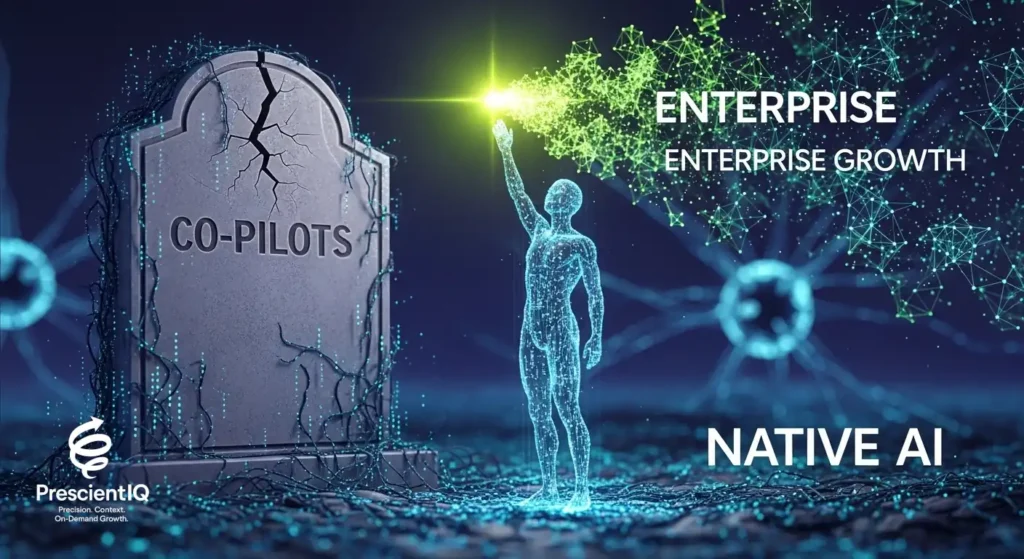
Current enterprise AI faces several pain points:
- Information Overload & Data Silos: Marketers are overwhelmed by data from fragmented tools (Salesforce, HubSpot, Adobe, etc.), hindering real-time insights and performance optimization.
- Automation Gaps & Inefficient Processes: Manual, repetitive tasks persist despite automation, impeding scalability and diverting human talent from strategic initiatives.
- Unpredictable ROI & Lack of Accountability: Marketing is often a “black box,” disconnected from the P&L or EBITDA, eroding confidence and budget justification.
The “Copilot Paradox” highlights that while AI copilots (e.g., “70% of Microsoft Copilot users report increased productivity”) augment existing workflows, they are “bolt-on” solutions that don’t fundamentally redesign the enterprise.
They often lack the deep contextual awareness, robust data infrastructure, and stringent security needed for enterprise-wide intelligence, limiting achievable gains despite their potential.
The Framework: Enter Native AI – The PrescientIQ Model
The “AI Agentic Shift” is driven by “Native AI,” exemplified by PrescientIQ. This is an “AI-native marketing operating system” founded on “Unified Causal Intelligence.”
PrescientIQ merges “AI automation with human strategic oversight” by integrating sales, marketing, and service data into a semantic data fabric.
PrescientIQ’s “Quantum AI Loop” and “4S Framework” (Streaming, Scrolling, Searching, Shopping) enable adaptive, nonlinear customer journeys that respond in real time to individual behaviors.
A key differentiator is “glass-box transparency” and a “composable architecture,” which allow customization and understanding of AI decision rationale, in contrast with opaque black-box predictions, and foster trust and ethical deployment.
Core Insights: From Reactive to Predictive – The Native AI Advantage

From Raw Data to Unified Causal Intelligence:
PrescientIQ enables organizations to move from “reacting to correlations to proactively simulating and shaping future outcomes.”
It uses real-time signal detection (RTSD) for “zero-touch CRM hygiene” and generates forecasts within 3–7% of actuals with AI risk signals, offering high predictive accuracy and efficiency.
PrescientIQ unifies fragmented data into a “single source of truth” for real-time, data-driven decisions, optimizing efforts across touchpoints for improved campaigns and customer engagement.
The Human-AI Collaboration Model – Redefining Human Roles:
Native AI liberates human marketers from mundane tasks, enabling them to focus on strategic guidance, ethical oversight, and deeper customer relationships.
This elevates human potential through creativity, empathy, and critical thinking.
PrescientIQ emphasizes “human-led, tech-powered approaches” and embeds ethical AI considerations into its design to enable responsible, ethical AI use with human oversight.
Scaling Authenticity and Trust with Predictive Engagement:
Native AI facilitates hyper-personalized, context-aware content delivery (E-E-A-T), consistent brand voice, and transparency at scale, fostering authenticity and trust.
PrescientIQ has achieved significant client results, including a “30–45% increase in marketing-sourced pipeline” for a Healthcare SaaS company and a “20% improvement in lead-to-opportunity conversion” for a Fintech Startup.

The PrescientIQ Solution in Action: Autonomous Marketing with PrescientIQ
From GenAI Content to Causal AI Strategy.
The first wave of Marketing AI was about generation—creating more content, faster. The second, and far more valuable wave, is orchestration.
CMOs don’t need more emails; they need a brain that knows exactly which email to send, when to send it, and what the financial outcome will be before the budget is deployed.
PrescientIQ is the world’s first Native AI Autonomous Marketing Platform. We are replacing fragmented toolstacks with a unified, autonomous marketing software or a self-driving engine for enterprise growth.
The Product: A Closed-Loop Enterprise AI Marketing Suite
PrescientIQ is not a copilot; it is the engine. Our platform serves as the central nervous system for modern marketing organizations, capable of planning, executing, and learning without constant human intervention.
- Automated GTM Strategy Platform: We ingest historical data, market trends, and competitor signals to build dynamic Go-to-Market strategies in real-time.
- AI Marketing Orchestration: Our agents autonomously manage campaigns across channels, adjusting bids, creative, and targeting segments instantly based on performance data.
- Self-Healing Workflows: When a campaign underperforms, PrescientIQ detects the anomaly, diagnoses the root cause, and automatically adjusts the parameters.
The Moat: Causal AI & Predictive Simulation
Current marketing tools rely on correlation (what happened?). PrescientIQ relies on Causal AI (why did it happen?). This allows us to move beyond analytics into accurate prediction.
“We don’t just guess. We wargame.”
PrescientIQ delivers concrete performance metrics, including a “33% bounce rate reduction in 90 days” (client example), “2–4 hours saved/rep/day” with zero-touch CRM updates, and “forecasts within 3–7% of actuals.”
Challenges and Considerations: Navigating the AI-Native Transformation
Challenges and ethical considerations of native AI include data bias, “hallucinations,” and the need for robust data governance.
The “unknown AI inventory” problem and integration complexity with legacy systems are significant hurdles.
Native AI still requires human strategic guidance, ethical guardrails, and management of exceptional cases, shifting the human role from execution to oversight.
PrescientIQ advocates for a symbiotic relationship, not complete automation.
Deploying native AI requires modular architectures, robust data management, and workforce upskilling, and organizations are encouraged to start with small-scale experiments.
The Future of Thought Leadership: The Agentic Enterprise
The future will see native AI, predictive modeling, and human creativity converge into an “agent-native” or “autonomous enterprise,” where AI agents perform complex, multi-step tasks across systems.
The article poses the question of what happens when a marketing system learns faster than the market and actively shapes it through autonomous, agent-led decision flows, raising profound questions about marketing’s future and the nature of the enterprise.
The Trap of the “Co-Pilot”
Sarah, the founder of Apex Digital, looked at her P&L statement and sighed.
On the surface, things looked fine. She had a bustling team of 15 talented creatives and account managers. They were “tech-forward,” heavily utilizing generative AI tools like ChatGPT and Midjourney.
But Sarah knew the dirty secret: they weren’t actually efficient. They were caught in the “Copilot Trap.”
The AI was helping them write faster, but not work smarter.
Her team spent hours engineering prompts, reviewing AI outputs, tweaking copy, and manually moving data between tools.
The overhead was massive—$1.5 million in payroll alone—and the operational drag was slowing them down. They were a “human-in-the-loop” agency, where the human was the bottleneck.
Sarah made a radical decision. She didn’t want AI that helped her staff; she wanted AI that could do the work.
She implemented a Native AI Autonomous Marketing Platform.
Unlike her previous stack, this wasn’t a tool that waited for a prompt. It was an agent.
- Old Way (Copilot): An employee prompts the AI to write an email, edits it, finds an image, and schedules it.
- New Way (Autonomous): The team sets a goal (“Increase Q3 leads by 20%”), and the Autonomous AI analyzes the data, generates the multi-channel campaign, A/B tests the creative, and executes the spend—only alerting the humans for strategic approval.
The Transformation
The transition was intense. The agency restructured from 15 generalists to 5 high-level strategists. The “doer” work—the drafting, scheduling, reporting, and optimizing—was handed over to the Autonomous AI.
Six months later, the silence in the office wasn’t empty; it was focused. The frantic clicking was gone, replaced by deep strategic discussions. The remaining five employees weren’t tired; they were empowered, managing vast campaigns that used to take three people each.
Sarah looked at the new P&L. The bloat was gone. The margins were healthy. The agency was no longer a factory; it was a command center.
Part 2: Mini Case Study

Executive Summary
Apex Digital, a mid-sized marketing agency, faced stagnating margins despite heavy adoption of Generative AI tools.
The reliance on “Copilot” models (human-assisted AI) maintained high labor costs and operational friction.
By transitioning to a Native AI Autonomous Marketing Model, the agency successfully restructured, reducing headcount by 66% while significantly increasing Revenue Per Employee (RPE) and operational efficiency.
The Challenge: The “Copilot” Plateau
- Headcount: 15 Employees.
- Labor Cost: $1.5M/year (Avg $100k/employee).
- Workflow: Staff spent 40% of their time prompting and correcting AI outputs.
- Metric: Revenue Per Employee stood at $275,000.
- Problem: The agency was unable to scale. Adding clients meant adding more humans to manage the AI tools, linearly increasing costs.
The Solution: Native AI Autonomous Marketing
Apex Digital replaced its fragmented stack of assistive tools with a centralized Autonomous Platform.
- From Creation to Execution: Instead of just generating content, the Native AI took over the full lifecycle: market analysis, content creation, media buying, and real-time optimization.
- Strategic Shift: The agency transitioned from “Service Delivery” (charging for hours/outputs) to “Outcome Delivery” (charging for performance).
- Workforce Restructuring: The team was consolidated into 5 key “AI Directors” who managed autonomous agents rather than performing manual work.
The Results
The shift to autonomous marketing fundamentally changed the agency’s unit economics.
| Metric | Previous State (Copilot Model) | Current State (Autonomous Model) |
| Headcount | 15 Employees | 5 Employees |
| Total Labor Cost | $1,500,000 | $500,000 |
| Role of Human | Prompter / Editor | Strategist / Approver |
| Rev Per Employee | $275,000 | $460,000 |

Key Takeaway
The “Copilot” model creates a faster horse; the “Autonomous” model builds a car.
By removing humans from the execution loop and placing them in the strategy loop, Apex Digital reduced overhead by $1M annually while increasing the revenue productivity of each remaining employee by 67.3%.
Conclusion: Stop Buying Marketing. Install a System for Predictable Growth.
The article summarizes the journey from the “Era of Marketing Chaos” and copilot limitations to the strategic imperative of native AI for predictable, on-demand growth.
This transition is a fundamental shift in mindset.
Key Metrics of Predictive Growth:
Native AI’s value can be quantified through metrics like:
- ROAS (Return on Ad Spend)
- CAC (Customer Acquisition Cost)
- Brand Lift
- LTV/CAC (Lifetime Value to Customer Acquisition Cost ratio)
“Unlock Autonomous Marketing with PrescientIQ” by scheduling a demo of PrescientIQ and learning to “Stop Predicting Growth. Start Executing It.”
PrescientIQ offers the “only native AI growth suite” for a resilient, future-proof revenue ecosystem. Unified Commercial Data Integration with PrescientIQ: A Strategic Framework for Intelligent Growth