

Moving Beyond Predictive Analytics to Autonomous Revenue Orchestration
Learn Why Your Industry is Moving Beyond Predictive Analytics to Autonomous Revenue Orchestration.
We are living through the “Prediction Paradox.”
Over the last decade, organizations have spent billions building data lakes and implementing predictive analytics dashboards. I know I lived it, starting with tools like ACT, Goldmine, and roving.com, which later became part of Constant Contact.
As a CEO or CFO, you have likely signed off on these investments. The promise was seductive: if we can predict customer behavior, revenue will follow.
But for many enterprises, the ROI hasn’t materialized. You have more reports than ever, yet your revenue teams are suffering from “analysis paralysis.”
Your dashboards might accurately predict that a key account is at risk of churning, or that a prospect is ready to buy—but those insights often sit in a queue, waiting for a human to notice, interpret, and act.
By the time the action is taken, the opportunity has evaporated.
The market is shifting. We are leaving the era of Predictive Analytics—which tells you what might happen—and entering the era of Autonomous Revenue Orchestration (ARO).
This is the shift from “Data Gathering” to “Data Doing.”
In this guide, we will explore why leading enterprises are adopting platforms like PrescientIQ to close the gap between insight and execution, ensuring that revenue operations are not just predicted, but autonomously engineered.
Part I: The Limits of Prediction

Why “Knowing” is No Longer Enough
To understand why the C-Suite is pivoting to Autonomous Revenue Orchestration, we must first audit the limitations of the current stack.
Predictive Analytics relies on correlation. It looks at historical data to assign a probability to a future event.
- Example: “Lead A has a score of 85. There is a high correlation between this score and a closed deal.”
This creates two critical bottlenecks for the modern enterprise:
- The Execution Gap: A prediction is passive. It requires a human to log in, read the report, decide on a strategy, and manually execute it. In high-volume industries like SaaS or Fintech, this latency is fatal to conversion rates.
- The “Black Box” Problem: Traditional AI gives you a score but rarely explains why. If a predictive model denies a loan application or flags a loyal customer as “high risk” but cannot explain the variables behind those decisions, a CFO cannot trust it, and a regulator will not accept it.
The Solution: Autonomous Revenue Orchestration (ARO)
ARO does not stop at the score. It uses Causal AI (understanding cause and effect) to determine the next best action, and AI Agents to execute it automatically.
- Predictive: “This customer might churn.”
- Autonomous: “This customer is churning because their usage of Feature X dropped. I have automatically sent them a re-engagement sequence and alerted the Account Manager.”
Part II: PrescientIQ and the “Glass-Box” Revolution

The transition to autonomy requires a new operating system. This is where PrescientIQ differentiates itself from the crowded AI market.
For the CEO and CFO, the hesitation to adopt AI often stems from a lack of control. You cannot afford to let an algorithm hallucinate a discount offer or mishandle a sensitive client interaction.
PrescientIQ addresses this with two foundational pillars designed for the enterprise: Unified Causal Intelligence and Glass-Box Transparency.
1. Unified Causal Intelligence: The “Why” Behind the Buy
Most machine learning models are correlational. They might notice that “People who buy umbrellas also buy ice cream,” without understanding the weather (the cause).
PrescientIQ utilizes Causal AI. It simulates counterfactuals—”What would happen if we changed price X?” or “What happens if we delay this email by two days?”
By understanding the causal mechanisms of your revenue, the platform moves from guessing to surgical precision.
2. Glass-Box Transparency: Trust, Verified.
For the CFO, the “Black Box” of AI is a liability. You cannot audit a neural network that hides its logic.
PrescientIQ operates as a “Glass Box.”
Every autonomous decision made by the system is transparent. The AI provides a natural-language explanation of its actions.
- The System: “I routed this lead to the Enterprise team.”
- The Explanation: “…Because the prospect viewed the API documentation page three times and holds a Director title, which causally correlates to a $50k+ ACV deal in 92% of cases.”
This transparency bridges the trust gap, allowing leadership to validate the logic before granting the AI full autonomy.
Part III: 5 Industries Ready for the Shift
Real-World Applications of Autonomous Orchestration
The move from predictive to autonomous is not theoretical; it is already reshaping the P&L of five key industries.
Here is how PrescientIQ applies to the specific financial and operational realities of these sectors.
1. B2B SaaS & Technology Have Moved Beyond Predictive Analytics to Autonomous Revenue Orchestration
The KPI: Net Revenue Retention (NRR) and Churn Reduction.
The Status Quo:
SaaS companies live and die by churn. Currently, Customer Success Managers (CSMs) rely on “Health Scores.”
These are lagging indicators.
By the time a health score turns red, the customer has likely already decided to leave. The CSM is merely acting as a coroner, conducting an autopsy on a lost account.
The PrescientIQ Application: Autonomous Churn Prevention.
PrescientIQ continuously monitors telemetry data for causal signals of dissatisfaction—not just login frequency, but specific friction points (e.g., a failed integration attempt or a support ticket that sat open for 48 hours).
Instead of waiting for a human, the AI acts:
- Scenario: A key user stops using a premium feature.
- Action: The AI agent autonomously sends a personalized “Help & Best Practices” guide relevant to that feature from the CSM’s email address.
- Escalation: If engagement doesn’t improve in 3 days, the AI schedules a “Strategic Business Review” on the CSM’s calendar.
The Financial Impact:
Shifting from reactive saves to proactive retention can stabilize NRR and reduce the Customer Acquisition Cost (CAC) payback period.
2. Financial Services & Fintech
The KPI: Lifetime Value (LTV) and Regulatory Compliance cost.
The Status Quo:
Banks have vast amounts of data, but are paralyzed by regulation.
Marketing teams want to personalize loan offers, but Risk teams block “Black Box” automation because of Fair Lending laws.
As a result, customers receive generic, irrelevant offers, and conversion rates plummet.
The PrescientIQ Application: Compliance-First Dynamic Cross-Selling in the financial services industry.
Because PrescientIQ is a “Glass Box,” it provides an audit trail for every automated decision.
- Scenario: A customer’s transaction history shows a pattern of spending at home improvement stores.
- Action: The AI orchestrates a Home Equity Line of Credit (HELOC) offer.
- The Guardrail: Before sending, the AI runs the offer against programmed regulatory constraints (ensuring no bias based on demographics). It logs the reason for the offer for future audits.
The Financial Impact: Increased share-of-wallet through hyper-personalization without increasing exposure to regulatory fines.
3. Manufacturing & Logistics
The KPI: Inventory Turnover and Margin Preservation.
The Status Quo:
In manufacturing, Sales and Supply Chain are often at war. Sales closes deals based on outdated inventory sheets; Supply Chain forecasts demand based on last year’s data.
The result is “The Bullwhip Effect”—either expensive overstock or revenue-killing stockouts.
The PrescientIQ Application: Dynamic Pricing & Inventory Orchestration.
PrescientIQ bridges the ERP and CRM.
It uses Causal AI to simulate how supply chain disruptions affect pipeline velocity.
- Scenario: A raw material shortage is detected in the supply chain data.
- Action: The AI agent automatically updates the CPQ (Configure, Price, Quote) system used by sales. It might apply a dynamic surcharge to low-margin items or temporarily hide products with long lead times from the catalog.
- Action: It simultaneously alerts the procurement team to the revenue at risk if stock isn’t replenished.
The Financial Impact: Protection of gross margins during volatility and prevention of “selling what you can’t deliver.”
4. Healthcare & MedTech
The KPI: Sales Efficiency and Provider Engagement.
The Status Quo:
Medical sales are high-stakes and high-cost. Field reps are expensive.
Sending a rep to a hospital that isn’t ready to buy is a massive waste of SG&A (Selling, General, and Administrative expenses).
Predictive models might identify a “good target,” but they don’t identify timing.
The PrescientIQ Application: Precision Provider Engagement.
PrescientIQ ingests HIPAA-compliant, anonymized data regarding procedure volumes or patient outcome trends.
- Scenario: A clinic shows a sudden uptick in a specific procedure where the MedTech company’s device improves recovery times.
- Action: The AI orchestrates a digital journey, sending clinical white papers and peer-reviewed studies to the relevant physicians.
- Trigger: Only when the physician engages with the clinical data does the AI alert the field rep to schedule a visit, providing the rep with the context of what the doctor read.
The Financial Impact: Drastic reduction in wasted sales visits and higher revenue per rep.
5. Retail & E-Commerce Have Moved Beyond Predictive Analytics to Autonomous Revenue Orchestration
The KPI: Conversion Rate and Average Order Value (AOV).
The Status Quo:
Cart abandonment is the silent killer of retail.
The standard industry response is a “blunt force” instrument: emailing a discount code to everyone who abandons a cart.
This trains customers to wait for coupons, destroying your margins.
The PrescientIQ Application: Causal Cart Recovery.
Causal AI determines why the cart was abandoned.
- Scenario A: The customer abandoned because they were price-shopping.
- Action: The AI sends a 10% discount code.
- Scenario B: The customer abandoned because shipping times were unclear.
- Action: The AI sends a purely informational email clarifying shipping speed—preserving the full price.
- Scenario C: The customer abandoned due to a lack of social proof.
- Action: The AI sends a digest of 5-star reviews for the specific items in the cart.
The Financial Impact: Recovering revenue without needlessly sacrificing margin.
Part IV: The Roadmap to Autonomy
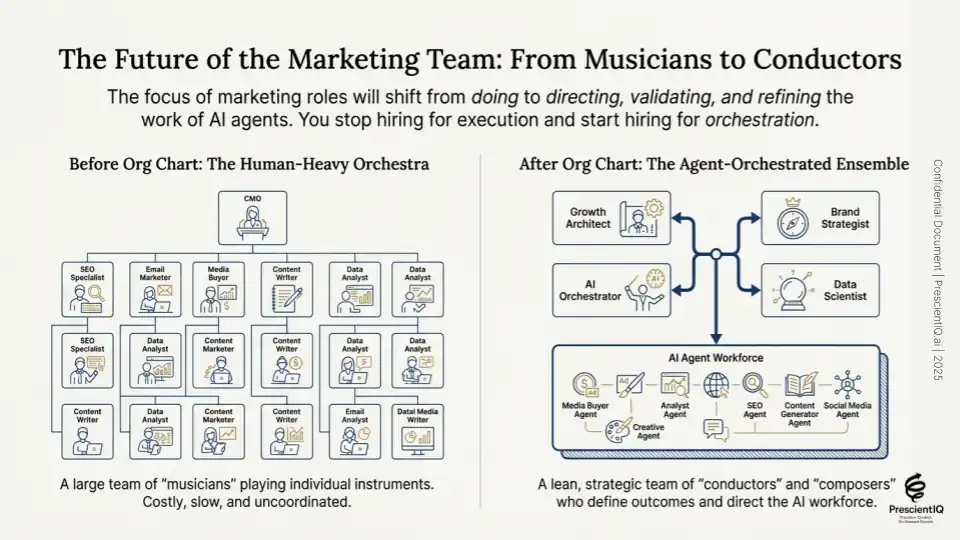
Implementation Strategy for the C-Suite
For a CEO or CFO, the prospect of “Autonomous” operations can sound risky.
It sounds like a “rip and replace” of current systems.
It is not.
Successful deployment of PrescientIQ follows a phased, risk-mitigated roadmap. We call this the Crawl, Walk, Run framework.
Phase 1: The Trust Phase (Shadow Mode)
You do not hand the keys to the AI on Day 1.
In this phase, PrescientIQ runs in “Shadow Mode.” It ingests your data and makes recommendations, but it does not execute them.
- Goal: Validation. The AI predicts an action, and your human teams review it. You compare the AI’s “Glass-box” logic against your best performers.
- Duration: 30–60 days.
Phase 2: The Co-Pilot Phase (Augmentation)
Once trust is established in the Causal logic, the AI moves to augmentation.
It drafts the email, queues the task, or suggests the pricing change—but a human must click “Approve.”
- Goal: Efficiency. Your team handles 10x the volume because the thinking and drafting are done; they only provide the final sign-off.
Phase 3: The Autonomy Phase (Orchestration)
For high-confidence, low-risk scenarios (e.g., standard renewals, top-of-funnel nurturing), the AI is granted permission to execute without human intervention.
The human team is elevated to handle exceptions and complex, high-value strategies.
- Goal: Scale. Revenue operations run 24/7/365.
Part V: Conclusion
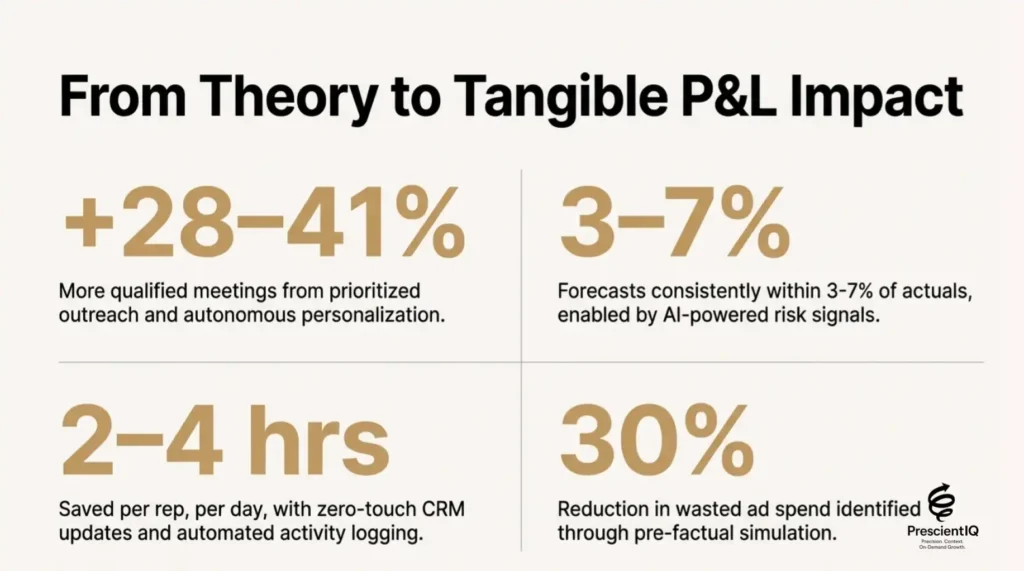
The Cost of Inaction if Businesses Stay with Predictive Analytics rather than moving to Autonomous Revenue Orchestration
We are currently at an inflection point similar to the adoption of Cloud Computing in 2010.
At that time, CFOs worried about the security and cost of the cloud. Today, no scalable company runs entirely on-premise. The same shift is happening with Revenue Orchestration.
The “Predictive” era was about giving your teams a map.
The “Autonomous” era is about giving them a vehicle that drives itself.
Organizations that stick to predictive analytics will continue to have the smartest dashboards in the graveyard—knowing exactly where they are losing money, but too slow to stop it.
Those who adopt Autonomous Revenue Orchestration with PrescientIQ will not just predict the future; they will engineer it.
The question for the C-Suite is no longer “What does the data say?”
The question is: “What is your data doing?”
Executive Summary & Key Takeaways
- The Problem: Companies are drowning in data but starving for action. Predictive Analytics offers insights but creates an “Execution Gap.”
- The Solution: Autonomous Revenue Orchestration (ARO) moves from passive scores to active execution using AI Agents.
- The Hero: PrescientIQ solves the enterprise trust issue with Glass-Box Transparency (explainable AI) and Unified Causal Intelligence (understanding why things happen).
- The Impact: Applications across SaaS, Fintech, Manufacturing, Healthcare, and Retail prove that ARO drives NRR, lowers compliance risk, and protects margins.
- The Next Step: Adoption is iterative. Start in “Shadow Mode” to validate the Causal AI before moving to full autonomy.
Ready to see your data take action?
Stop guessing and start orchestrating.
Request your Glass-Box Demo with PrescientIQ today and see how Causal Intelligence can transform your P&L.