
The Synthetic Expert: How PrescientIQ.ai AI Pods Are Bridging the Great AI Talent Gap with Industry Models
Learn about How PrescientIQ.ai AI Pods Are Bridging the Great AI Talent Gap with Industry Models.
Introduction: The Paradox of the AI Revolution
We are currently living through the greatest technological gold rush since the dawn of the internet. Artificial Intelligence—specifically generative and agentic AI—promises to rewrite the operating systems of every major industry.
From predicting supply chain fractures before they occur to personalizing healthcare protocols at scale, the potential ROI is staggering.
Yet, for the vast majority of the C-suite, this revolution feels just out of reach. A paralyzing paradox has emerged at the heart of enterprise transformation: the demand for AI implementation has exponentially outpaced the supply of human expertise required to execute it.
Companies are flushing billions down the drain attempting to build internal AI capabilities. They are engaged in bidding wars for scarce data scientists, machine learning engineers, and MLOps specialists—roles that command enormous salaries and are notoriously difficult to retain.
Furthermore, hiring a brilliant data scientist doesn’t guarantee success; a banking algorithm is useless to a pharmaceutical company, and an e-commerce recommendation engine fails miserably in manufacturing logistics.
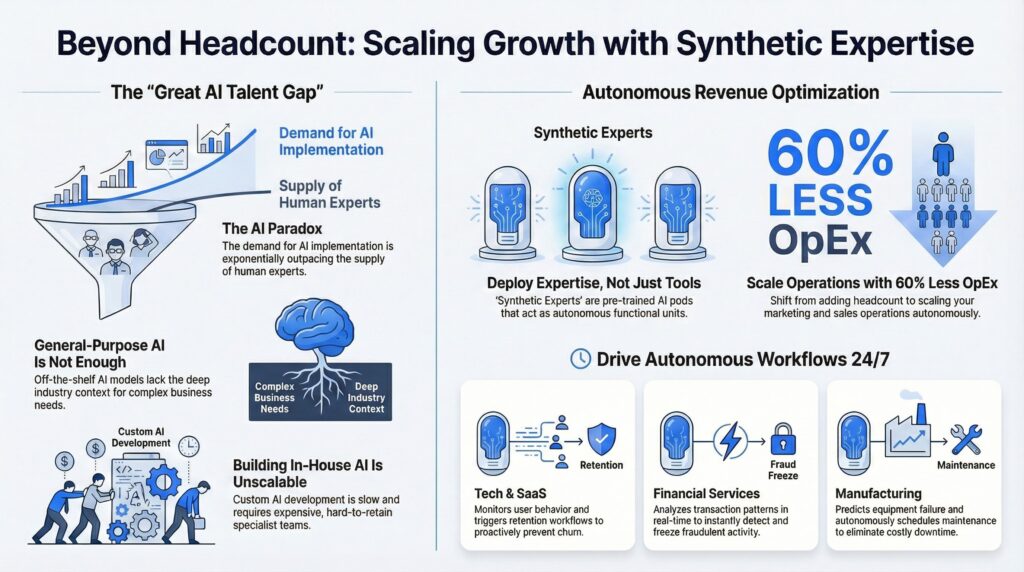
The market is awakening to a brutal reality: General-purpose AI (such as off-the-shelf LLMs) is insufficient for complex business needs, and bespoke, in-house AI development is unscalable due to a severe shortage of specialized human talent.
This is the “Great AI Talent Gap.” It is the primary bottleneck to innovation today.
Enter PrescientIQ.ai (developed by MatrixLabX) and a novel architectural approach:
What are Vertical Industry AI Pods?
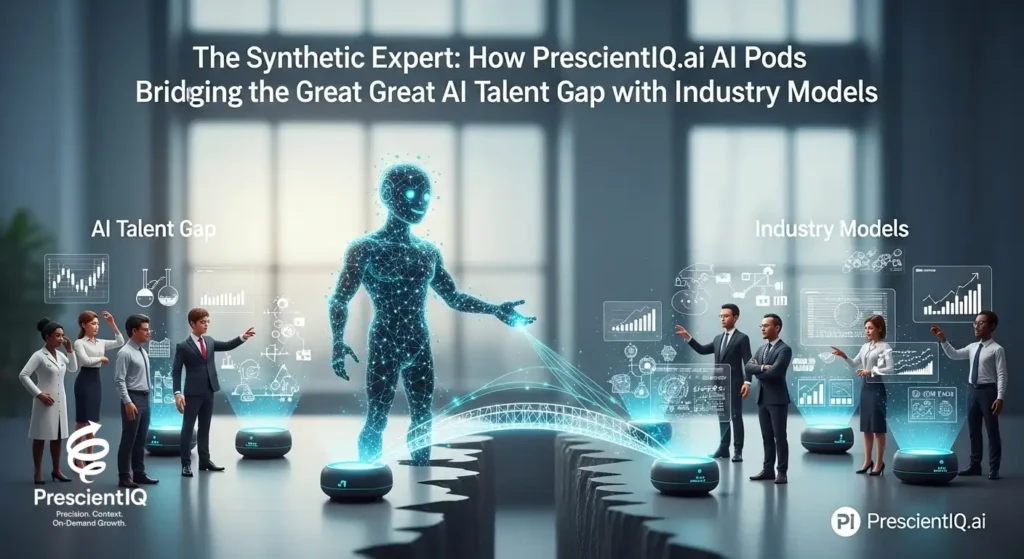
PrescientIQ suggests a radical re-thinking of how enterprises adopt AI, with over 200 LLMs available and 7 LAMs for deep domain experience.
Instead of trying to hire armies of human experts to build models from scratch, organizations can now deploy pre-trained, autonomous “pods” that contain “synthetic expertise.”
By packaging deep industry models with agentic workflows, AI Pods don’t just provide a tool for existing employees; they act as autonomous, functional units that bridge the talent gap, allowing organizations to achieve sophisticated AI outcomes without needing a sophisticated internal AI workforce.
PrescientIQ suggests a radical re-thinking of how enterprises adopt AI.
Instead of trying to hire armies of human experts to build models from scratch, organizations can now deploy pre-trained, autonomous “pods” that contain “synthetic expertise.”
By packaging deep industry models with agentic workflows, AI Pods don’t just provide a tool for existing employees; they act as autonomous, functional units that bridge the talent gap, allowing organizations to achieve sophisticated AI outcomes without needing a sophisticated internal AI workforce.
Section 1: The Anatomy of the Talent Gap and the Failure of Horizontal AI
To understand why AI Pods are necessary, we must first diagnose why current approaches to closing the talent gap are failing.
The Illusion of the “Generalist” AI
The initial wave of generative AI excitement was driven by “Horizontal AI”—massive, general-purpose models trained on the entire internet.
While impressive at writing poems or basic code, these models lack the necessary context for an enterprise application.
A generalist model does not know the difference between FDA 21 CFR Part 11 compliance in Pharma and SOX compliance in Finance.
It doesn’t intuitively understand the nuances of SaaS churn metrics versus retail inventory shrinkage.
To make a horizontal model useful, it requires significant fine-tuning, rigorous guardrailing, and integration with proprietary data—all tasks that require the very talent companies cannot find.
The Data Scientist Shortage
The traditional path to enterprise AI involves hiring a team of data scientists to build bespoke models. This approach is currently facing a severe supply crisis.
True domain expertise in data science—finding someone who understands both advanced Bayesian statistics and the complexities of commercial insurance underwriting—is incredibly rare. When companies do find this talent, they face high turnover rates as tech giants poach top performers.
Furthermore, the “build it yourself” model is slow. By the time an internal team has cleaned the data, selected the model, trained it, and navigated internal governance, the market reality may have already shifted.
The Gap is Operational, Not Just Technical
The most overlooked aspect of the talent gap is not just building the model, but running it.
Turning a predictive insight into a business action requires another layer of expertise: MLOps (Machine Learning Operations) and business process integration.
Many organizations have built a pilot model, only to watch it languish in a sandbox because they lack the talent to integrate it into their live CRM, ERP, or marketing automation stacks in a way that is secure, scalable, and autonomous.
The industry is crying out for a solution that bypasses the need for this entire specialized human supply chain—from model training to deployment.
Section 2: Enter PrescientIQ.ai: The Rise of the Industry Models AI Pod
PrescientIQ.ai addresses the talent gap by changing the unit of delivery for AI.
It moves away from being a “platform for developers” toward being an “autonomous pods for business outcomes.”
Defining the AI Pod
An AI Pod by PrescientIQ is not merely a piece of software or a chatbot assistant. It is best understood as a self-contained, autonomous functional unit—a “synthetic employee” designed for a specific vertical purpose.
Each pod consists of three integrated layers designed to replicate human expertise:
- The Brain (The Industry Model): Unlike generic models, these are pre-trained on vast, vertical-specific datasets. A Healthcare industry model AI Pod already “knows” medical ontology and privacy regulations. A Manufacturing industry model already “understands” sensor telemetry patterns and OEE (Overall Equipment Effectiveness) calculations.
- The Hands (Agentic Workflow): Crucial for bridging the talent gap. The pod doesn’t just spit out a probability score; it can autonomously take action. Using agentic AI, it can execute multi-step workflows—such as updating a CRM record, sending a personalized alert to a high-risk client, or adjusting ad spend—without human intervention.
- The Interface (Glass-Box Transparency): To replace human effort, trust is required. PrescientIQ uses “Glass-Box” AI to provide explainable insights. It doesn’t just say “Customer X is a churn risk”; it says “Customer X is a churn risk because their usage dropped 20% following the recent pricing update, and their support ticket sentiment has turned negative.” This allows existing business leaders to trust the pod’s autonomous actions.
The Core Differentiator: Pre-Factual Simulation
Where most AI focuses on predictive analytics (what will happen based on the past), PrescientIQ focuses on prescriptive simulation (what would happen if we did X?).
This “pre-factual simulation” engine is the ultimate talent multiplier. It allows a marketing director with no data science training to run thousands of complex Monte Carlo simulations on their budget allocation.
They can ask, “What happens to our Q3 pipeline if we shift 30% of our budget from Google Ads to LinkedIn, assuming a recessionary environment?”
The AI Pod runs these complex scenarios autonomously and presents the best path forward. Previously, this level of analysis required a team of financial analysts and data scientists working for weeks. The pod democratizes this strategic foresight instantly.
Section 3: How AI Pods Bridge the Talent Gap
The deployment of PrescientIQ AI Pods directly addresses the shortage of human AI talent through three primary mechanisms: substitution, augmentation, and acceleration.
Mechanism 1: Substituting the Need for Rare “Domain-Specific Data Scientists”
The hardest roles to fill are those that require the intersection of technical AI skills and deep industry knowledge. A PrescientIQ Industry Pod acts as a substitute for this specific persona.
The knowledge that a pharmaceutical company would usually have to teach a generalist data scientist over the course of a year—understanding clinical trial phases, patient recruitment bottlenecks, and regulatory reporting formats—is already “baked in” to the Pharma Industry Model.
The models are pre-trained on the right vernacular, data structures, and compliance requirements.
By deploying an Industry Model that already understands the vertical, the organization skips the arduous “teaching phase” of AI development. It immediately deploys expertise that would otherwise take months to hire and train.
Mechanism 2: Augmenting Existing Business Teams into “AI Operators”
AI Pods are designed to be operated by business experts, not technical experts. This effectively expands the AI talent pool to include existing employees.
Through intuitive interfaces like the AISearchPad or AICRMPad, a seasoned Sales VP in a SaaS company can leverage sophisticated churn modeling without writing a line of Python.
A manufacturing floor manager can utilize predictive maintenance algorithms without understanding sensor data fusion.
The Pod handles the data ingestion via a Semantic CDP (Customer Data Platform), runs the complex industry models, and presents actionable, explainable insights.
This elevates existing staff, turning domain experts into AI-empowered decision-makers and removing reliance on a centralized, overburdened data science team.
Mechanism 3: Accelerating Deployment via MACH Architecture (No MLOps Team Required)
Often, the talent gap isn’t in building the model, but in deploying it securely at scale. This requires specialized DevOps and MLOps engineers who understand containerization, API orchestration, and cloud security.
PrescientIQ is built on MACH principles (Microservices, API-first, Cloud-native, Headless).
The “Pods” are designed to plug directly into existing enterprise technology stacks (Salesforce, HubSpot, SAP, Oracle, etc.).
This means an organization does not need to hire a new team of cloud architects to figure out how to integrate the AI into its workflow.
The AI Pods arrive ready to connect, ingest data, and begin autonomous operations. This turns AI deployment from an 18-month infrastructure project requiring dozens of engineers into a rapid configuration process.
Section 4: Vertical Industry Model AI Pods in Action
The true power of this model is realized when applied to specific industries.
Here is how PrescientIQ’s Vertical Pods provide “synthetic talent” across key sectors.
A. Technology & SaaS: The Autonomous Growth Engine
The Talent Problem: SaaS companies are drowning in telemetry data but lack the analysts to connect usage patterns to real-time financial outcomes (churn, upsell).
The AI Pod Solution: A SaaS Industry Pod is pre-trained on subscription lifecycle dynamics.
- Autonomous Churn Prevention: Instead of a human analyst manually pulling a monthly churn report, the industry model uses AI to monitor user behavior continuously. If it detects signals indicating a high-value customer is disengaging, it doesn’t just flag it—it autonomously triggers a retention workflow in the CRM, perhaps alerting a Customer Success Manager and offering a tailored incentive based on that customer’s specific friction points.
- Pricing Simulation: The AI Pod enables product leaders to simulate pricing changes before rolling them out, predicting their impact on acquisition and retention using historical elasticity data. This task previously required a PhD in economics.
B. Financial Services: The Automated Risk & Compliance Officer
The Talent Problem:
Banks and FinTechs face immense regulatory pressure. Hiring enough human compliance officers to manually review every transaction and communication for fraud or regulatory breach is impossible.
The AI Pod Solution: A Financial Services Vertical Industry Model AI Pods is engineered with deep knowledge of SEC, FINRA, and banking regulations.
- Real-Time Fraud Detection: The Pod analyzes transaction patterns at speeds and with levels of nuance that humans cannot match. It identifies anomalies based on financial-specific models, freezing suspicious activity instantly while reducing false positives that frustrate customers.
- Regulatory Sandbox Simulation: Before launching a new financial product, executives can use pre-factual simulation to stress-test it across various market conditions and regulatory frameworks, ensuring resilience before exposure.
C. Healthcare Services & Pharma: accelerating Outcomes, Ensuring Compliance
The Talent Problem: The healthcare sector handles highly unstructured data (e.g., physician notes, lab results) and strict privacy laws (e.g., HIPAA).
Generalist AI models are often too risky or inaccurate for clinical environments.
The AI Pod Solution: These pods are built with a “security-by-design” infrastructure compliant with healthcare standards.
- Clinical Trial Optimization (Pharma): The Pod can simulate patient recruitment scenarios across different geographies and demographics, identifying potential bottlenecks in trial design before they occur. This replaces weeks of manual analysis by clinical operations teams.
- Patient Engagement Agents (Healthcare): Pods can autonomously manage post-discharge follow-ups, understanding medical vernacular to interpret patient responses and triage issues to human staff only when necessary, vastly extending the reach of care teams.
D. Manufacturing & Supply Chain: The Predictive Operations Manager
The Talent Problem: Manufacturers are embracing Industry 4.0 and IoT, generating terabytes of sensor data.
Yet, they lack the reliability engineers and data scientists needed to turn that noise into predictive maintenance signals.
The Industry Model AI Pod Solution:
- Predictive Maintenance: The Pod ingests data from vibration sensors, thermography, and PLC logs. Because it is pre-trained on manufacturing equipment failure modes, it can accurately predict that a bearing on Line 3 will fail in 48 hours. It then autonomously interacts with the ERP system to order the part and schedule maintenance during planned downtime.
- Supply Chain Resilience Simulation: When a global event occurs (e.g., a port strike), supply chain leaders can use the pod to simulate the cascading impact on their raw materials and production schedules, allowing them to activate backup suppliers hours or days before competitors proactively.
E. Consulting & Marketing Agencies: Scalable Strategy and Execution
The Talent Problem: Agencies rely on human billable hours for strategy and content creation, severely limiting scalability. Clients demand data-driven strategies, but agencies often lack the internal analytics talent to deliver them.
The Industry Model AI Pod Solution:
- Strategy as a Service: Consultants can use Pre-factual Simulation to back their recommendations with hard data. Instead of presenting a “gut feeling” strategy, they present a simulation showing a 92% probability of achieving the client’s goal under specific conditions.
- AISearchPad for Content Visibility: Marketing agencies can deploy SEO and content pods that autonomously analyze shifts in the search engine landscape, identify content gaps, and even generate expert-level, optimized content drafts at a scale that human copywriters cannot achieve.
Conclusion: The shift from Buying Talent to Buying Outcomes with Industry Models
The narrative that “AI will replace humans” is fundamentally flawed. The reality is that companies using AI will replace companies that don’t. But the companies that win won’t necessarily be the ones that manage to hire the most PhDs.
The winners will be the organizations that recognize the AI talent gap for what it is—a structural limitation of the current labor market—and adopt a different strategy.
PrescientIQ.ai’s Vertical Industry AI Pods represent a maturation of the AI market. We are moving past the experimental phase of generic tools and into the deployment phase of specialized, autonomous solutions. By leveraging Industry Models and agentic workflows, these pods act as synthetic expertise, plugging the critical gaps in human capital.
For enterprise leaders, this means a shift in focus. The challenge is no longer “How do we hire a team to build this AI?” The challenge is now “Which autonomous pods do we deploy first to secure our competitive advantage?”
In a world constrained by talent, the ability to deploy pre-packaged, industry-proven AI expertise is the ultimate force multiplier.
What is the difference between a “Vertical AI Pod” and a standard AI chatbot like ChatGPT?
A standard chatbot (Horizontal AI) is trained on general internet data and lacks a specific business context. A PrescientIQ Vertical AI Pod is trained on deep, industry-specific datasets (e.g., FDA regulations for Pharma, sensor telemetry for Manufacturing). It is designed to execute autonomous workflows, not just answer questions.
How do AI Pods specifically solve the AI talent gap?
AI Pods act as “synthetic experts.” Instead of hiring a team of data scientists to build, train, and maintain custom models—a process that takes months and requires rare talent—companies can deploy pre-trained Pods that already possess the necessary industry expertise. This allows existing business teams to leverage advanced AI without needing technical engineering skills.
What is “Pre-Factual Simulation”?
Unlike predictive analytics, which forecasts what will happen based on the past, Pre-Factual Simulation allows users to test “what-if” scenarios. It simulates future outcomes based on potential decisions (e.g., “What happens to revenue if we raise prices by 5%?”), allowing leaders to test strategies in a risk-free environment before implementation.
Can PrescientIQ AI Pods integrate with my legacy systems?
Yes. PrescientIQ is built on a MACH architecture (Microservices, API-first, Cloud-native, Headless). This ensures the Pods can securely plug into existing enterprise stacks—such as Salesforce, SAP, Oracle, and HubSpot—without requiring a “rip and replace” of your current infrastructure.
Is my proprietary industry data safe within a Pod?
Absolutely. PrescientIQ uses a “Semantic CDP” (Customer Data Platform) to unify your data for the model to use, while maintaining strict enterprise-grade security and governance. The Pods are designed with “Glass-Box” transparency, ensuring you always know how and why decisions are being made, complying with industry regulations like HIPAA and GDPR.
Which industries are currently supported by PrescientIQ Industry Models?

PrescientIQ currently offers specialized Industry Models for Technology & SaaS, Financial Services, Healthcare & Pharma, Manufacturing & Supply Chain, E-commerce & Retail, and Consulting & Marketing Agencies.