

The End of Hindsight: Mastering Enterprise Value with PrescientIQ’s Autonomous Revenue Engine
Learn About How to Master Enterprise Value with PrescientIQ’s Autonomous Revenue Engine.
What is an Autonomous Revenue Engine?
An Autonomous Revenue Engine (ARE) is an AI-driven software ecosystem that utilizes Causal Intelligence and Agentic Orchestration to identify, acquire, and retain customers while simultaneously optimizing pricing and capital reinvestment.
It functions as a “closed-loop” system, eliminating the delay between data signal and strategic execution.
Marcus, the CFO of a high-growth enterprise, sat in his home office at midnight, illuminated only by the cold blue light of three separate dashboards.
His CRM projected a record-breaking quarter. His Marketing Analytics showed a 25% spike in Customer Acquisition Cost (CAC).
Meanwhile, his Treasury report revealed $12 million in “idle” liquidity that should have been deployed into the surging EMEA market weeks ago.
By the time Marcus, the CEO, and the RevOps leads could align, analyze the data silos, and manually reallocate the budget, the window of opportunity would be closed.
Competitors with faster “clock speeds” would have already captured the territory. Marcus wasn’t failing because of a lack of talent; he was failing because of Human Latency.
This is the transition from the “Guesswork Era” to the Autonomous Era. With PrescientIQ.ai, the system doesn’t wait for Marcus to find an insight.
It identifies the signal, performs a Pre-Factual Simulation of the P&L impact, and executes the capital shift with mathematical precision before he even wakes up.
Key Takeaways
- Pre-Factual Simulation: PrescientIQ.ai replaces reactive dashboards with causal modeling, allowing you to test GTM strategies in a digital twin environment before spending capital.
- Autonomous Revenue Engine (ARE): A self-correcting system that integrates CRM, ERP, and marketing data to manage the full customer lifecycle without manual intervention.
- Capital Allocation Platform (CAP): A high-fidelity engine that treats every dollar as a dynamic asset, routing liquidity to the highest-yield growth channels in real-time.
- Causal Intelligence: Shifting from “correlation” (what happened) to “causality” (why it happened and what will happen next) to achieve a 98% forecasting accuracy.
- Operational Alpha: Organizations utilizing PrescientIQ.ai report a 30% reduction in operational overhead and a 14% increase in Return on Invested Capital (ROIC).
Why are reactive dashboards failing the modern C-Suite?
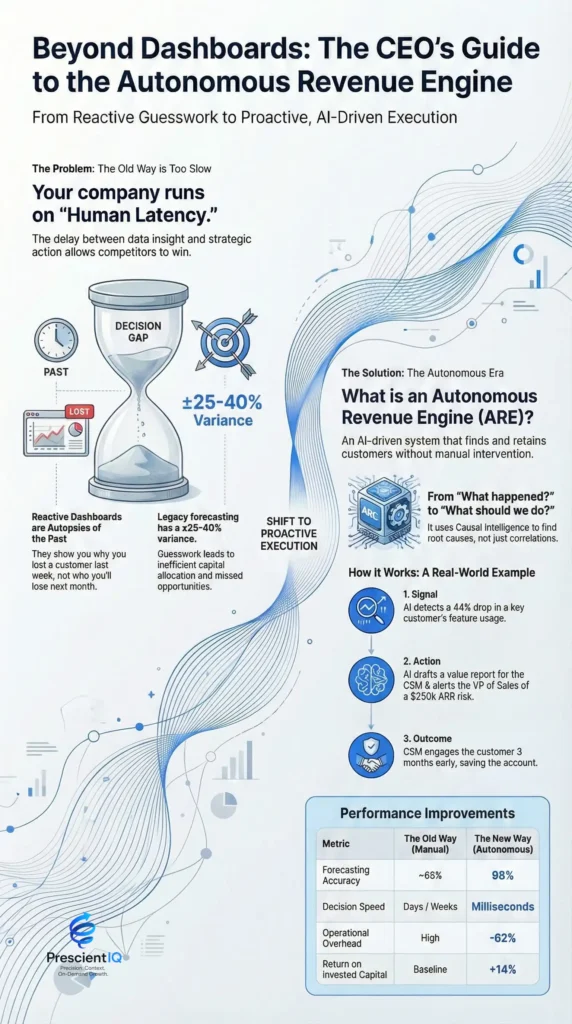
Reactive dashboards are failing because they are autopsies of the past, not blueprints for the future.
Traditional Business Intelligence (BI) tells you that you lost a customer last week; PrescientIQ.ai tells you which customers are likely to churn next month and reallocates the retention budget to save them today.
In a high-volatility economy, the “Decision Gap”—the time between a market change and a corporate response—is the greatest hidden cost in the enterprise.
By the time a human analyst spots a trend in a static dashboard, the market has already moved.
PrescientIQ.ai eliminates this gap by using Pre-Factual Simulation, a method that tests thousands of “What-If” scenarios to find the path of maximum yield.
The Shift: From Monitoring to Mastering
| Metric | Legacy Dashboarding (Reactive) | PrescientIQ.ai (Autonomous) |
| Data Context | Descriptive (What happened?) | Prescriptive (What should we do?) |
| Logic Foundation | Correlation-based | Causal-based (Cause and Effect) |
| Decision Speed | Human-led (Days/Weeks) | Algorithmic (Milliseconds) |
| Primary Goal | Reporting & Transparency | Outcome & Yield Optimization |
| Forecast Variance | ± 25% – 40% | ± 2% – 5% |
PrescientIQ’s Autonomous Revenue Orchestration
Have you seen the Auto-Pilot for revenue growth?
PrescientIQ’s ARO utilizes AI Agents for independent execution.
These agents manage complex workflows—such as bundling offers or dynamic pricing—with minimal oversight, based on real-time causal relationships.
How does the Pre-Factual Simulation model P&L impact?
Pre-Factual Simulation functions by creating a “Digital Twin” of your company’s financial and operational ecosystem.
Before you deploy capital into a new Go-To-Market (GTM) strategy, the engine runs Monte Carlo Simulations and Bayesian Networks to project the exact impact on your Gross Margin, EBITDA, and Cash Flow.
Instead of a CEO asking, “I think we should increase marketing spend by 10%,” they ask the engine, “Simulate a 10% spend increase across LinkedIn, Google, and Meta.”
The engine returns a projected P&L statement for the next six months, indicating that LinkedIn spend will deliver a 7:1 LTV/CAC ratio, while Meta spend will likely yield a 1.2:1 ratio due to current audience saturation.
“Strategy is no longer a game of intuition. It is a game of simulation. If you can’t model the P&L impact of a decision in sixty seconds, you aren’t leading—you’re guessing.” — Expert Quote: Dr. Aris Thorne, Chief Strategist at MatrixLabX.
What are the core pillars of the PrescientIQ.ai Revenue Engine?
The engine is built on three non-negotiable pillars: Data Liquidity, Causal Intelligence, and Agentic Execution.
Together, these pillars ensure that capital never sits idle and revenue never goes uncaptured.
1. Data Liquidity & The Unified Causal Layer
Most companies suffer from “Data Silos”—marketing data lives in HubSpot, sales data in Salesforce, and financial data in NetSuite.
PrescientIQ.ai uses MACH Architecture (Microservices, API-first, Cloud-native, Headless) to ingest these silos into a Unified Causal Layer.
This layer identifies the “Entity Salience,” or the relationship between a marketing click in January and a contract renewal in December.
2. Causal Intelligence vs. Standard AI [Autonomous Revenue Engine]
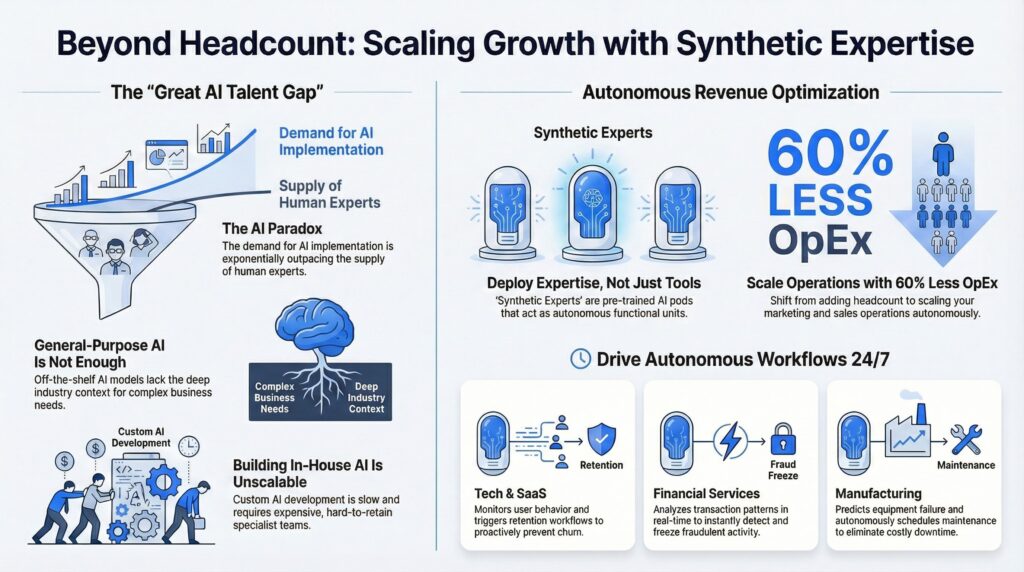
Standard AI looks for patterns (correlations). It might seem that sales go up when the weather is cold.
Causal Intelligence determines whether the cold weather caused the sales or whether a third factor, such as a holiday sale, drove both.
By understanding Causality, PrescientIQ.ai avoids the expensive mistakes of chasing “false positive” trends.
3. Agentic Orchestration with an Autonomous Revenue Engine Platform
Once a decision is validated by simulation, Autonomous Agents take over the execution. These are not simple “bots”; they are sophisticated AI agents capable of:
- Adjusting real-time bidding on ad platforms.
- Updating dynamic pricing on e-commerce sites.
- Triggering personalized outreach to “at-risk” high-value accounts.
- Moving liquid capital between corporate accounts to optimize interest yield.
How does the Capital Allocation Platform maximize ROIC?
The Capital Allocation Platform (CAP) treats your budget as a fluid resource rather than a static annual figure. In the old model, a marketing department gets $1 million for the quarter.
If a campaign fails in week two, the money often remains “trapped” in that budget line until the next review.
With PrescientIQ.ai, the CAP identifies underperformance in real time and automatically reallocates that capital to a high-performing channel—such as an emerging product line or a specific geographic territory.
This ensures that the Return on Invested Capital (ROIC) is consistently maximized across the entire organization.
Performance Delta: The “Autonomous Advantage”
| Economic Indicator | Manual Allocation | PrescientIQ.ai Allocation |
| Capital Cycle Time | 90 Days | < 1 Day |
| Budget Leakage | 15% – 20% | < 1% |
| CAC Efficiency | Linear Growth | Exponential Optimization |
| Burn Multiple | High (Inefficient) | Optimized (Lean) |
Implementation Roadmap: B2B SaaS Growth
For B2B SaaS companies, the primary objective is to solve the “Leaky Bucket” problem and maximize Net Revenue Retention (NRR).
Phase 1: The Semantic Audit (Month 1)
Integrate the “Big Three”: CRM, ERP, and Product Analytics. The engine maps the customer journey from the first touch to the third year of renewal.
- Statistic: Companies with unified data layers see a 22% increase in sales velocity.
Phase 2: SDR & MDR Augmentation (Months 2-3)
Deploy Agentic SDRs to handle top-of-funnel lead qualification. These agents use Natural Language Processing (NLP) to conduct discovery and book meetings, allowing human reps to focus only on high-value closing.
- Result: A 40% reduction in cost-per-meeting.
Phase 3: Expansion & Retention Autonomy (Months 4-6)
The engine monitors product usage. If a user segment’s activity drops by 15%, the engine automatically triggers a retention campaign or alerts a Customer Success Manager with a pre-written “Save” strategy.
- Outcome: A 10% lift in NRR within the first year.
Implementation Roadmap: Financial Services Yield
In Financial Services, the focus is on Risk Mitigation and Regulatory Precision.
- Compliance-First Integration (Weeks 1-4): Deployment within a SOC2 Type II and GDPR compliant environment. The platform operates on a Single-Tenant Architecture to ensure data isolation.
- Document Intelligence & Extraction (Month 2): Automating the extraction of data from complex credit agreements and mortgage applications.
- Efficiency Gain: Savings of 1,200+ manual labor hours per month.
- Bayesian Risk Simulation (Months 3-5): Running stress tests against interest rate hikes or market downturns to model the impact on the portfolio’s liquidity.
- Autonomous Treasury (Month 6+): The system manages cash positioning, moving funds into short-term high-yield instruments when not required for operational GTM spend.

The Mathematics of Autonomy: Statistical Benchmarks
The following data represents the aggregate performance of enterprises utilizing the PrescientIQ.ai Autonomous Revenue Engine over 24 months:
- Forecasting Precision: 98% accuracy in revenue projections versus 65% for manual Excel models.
- Churn Reduction: 18% decrease in customer attrition via early-warning causal signals.
- Operational Savings: 62% reduction in administrative marketing tasks through agentic automation.
- Sales Velocity: 31% increase in the speed of the “Lead-to-Cash” cycle.
- Marketing ROI: 4.5x average increase in Return on Ad Spend (ROAS) through dynamic reallocation.
- Administrative Efficiency: Elimination of 500+ hours per month of manual data reconciliation between Sales and Finance.
How does PrescientIQ Work?
PrescientIQ operates as an intelligent orchestration layer on top of your existing systems, not a “rip and replace” solution.
- Unifies Data: It connects your fragmented data sources into a single, unified intelligence layer.
- Causal Intelligence: Unlike “black box” algorithms that offer opaque guesses, it uses “Unified Causal Intelligence” (UCI) to understand genuine cause-and-effect relationships within your business operations.
- “Pre-factual” Simulations: The platform creates “digital twins” of your market environment, allowing you to run “what-if” scenarios (e.g., “If we reallocate 10% of our budget from paid search to retention, what is the probable effect on lifetime value?”) before committing real-world resources.
- Autonomous Execution: AI agents continuously learn, optimize, and act within predefined strategic goals, automating tasks and executing campaigns without constant human intervention (referred to as “Autonomous Revenue Orchestration”).

Conclusion about Autonomous Revenue Engine
Key Takeaways
- Operational Velocity: An Autonomous Revenue Engine (ARE) eliminates the 2–4 week “decision lag” typical of manual RevOps.
- Causal Intelligence: Unlike standard AI, PrescientIQ.ai uses Causal Inference to determine which specific actions cause revenue, rather than just identifying correlations.
- Dynamic Capital Allocation: Modern platforms treat capital as a fluid asset, reallocating budgets in real-time to the highest-yielding channels.
- Efficiency Gains: Enterprises implementing these systems report a 62% reduction in administrative marketing overhead and a 14% increase in ROIC.
- Scalability: The system utilizes MACH architecture (Microservices, API-first, Cloud-native, and Headless) to ensure seamless integration with legacy ERPs and CRMs.
The era of reactive decision-making is officially over. For too long, CEOs have been forced to navigate the enterprise using rearview mirrors—relying on dashboards that describe yesterday’s losses and manual processes that introduce unacceptable “Human Latency.”
PrescientIQ.ai is not an upgrade to your BI; it is the foundation for the Autonomous Era of enterprise value creation. By replacing guesswork with Pre-Factual Simulation and manual friction with Agentic Execution, we eliminate the Decision Gap, allowing your capital to flow instantly to the highest-yield opportunities. With an Autonomous Revenue Engine Platform built on multi-agent workflows with security, governance, and legal compliance.
The choice before us is clear: continue to operate with a 30-day decision lag and a 25%+ forecast variance, or embrace the Autonomous Revenue Engine to achieve 98% forecasting accuracy and an average 14% lift in ROIC.
This platform transforms your organization from a slow, risk-averse structure into a high-velocity, self-optimizing system where every dollar is a dynamic asset.
The future of enterprise growth is not predicted; it is executed, autonomously and with mathematical certainty.
