
Why PrescientIQ Bridges Execution and Intelligence with Autonomous AI
Why PrescientIQ Bridges Execution and Intelligence with Autonomous AI.
Key Takeaways for Intelligence with Autonomous AI
- The Execution Gap: Traditional platforms like Palantir and Anaplan separate “planning” from “doing,” creating a latency typically measured in weeks. PrescientIQ closes this by embedding intelligence directly into execution workflows.
- Pre-Factual Simulation: Unlike historical reporting, PrescientIQ utilizes “pre-factual” causal AI to simulate GTM outcomes with confidence intervals before the budget is committed.
- Autonomous Agency: While competitors offer “copilots” that wait for prompts, PrescientIQ’s agents proactively reallocate budget and orchestrate campaigns based on real-time revenue physics.
- Unstructured Data Advantage: Built natively on Google Vertex AI, PrescientIQ leverages Gemini’s massive context window to ingest qualitative strategy docs (slides, emails), not just quantitative rows and columns.
- Glass-Box Usability: The platform democratizes high-end data science for commercial leaders (CROs/CMOs), removing the need for “Forward Deployed Engineers” or “Model Builders.”
What is the PrescientIQ advantage?
PrescientIQ bridges the gap between strategic intelligence and operational execution by using autonomous, pre-factual simulation agents.
Unlike Palantir (which builds ontologies) or Anaplan (which connects planning grids), PrescientIQ functions as a “Flight Simulator” for commercial growth, using causal AI to predict revenue outcomes and autonomously orchestrate actions across Salesforce and HubSpot without heavy engineering.
Why do traditional enterprise platforms fail to bridge strategy and execution?
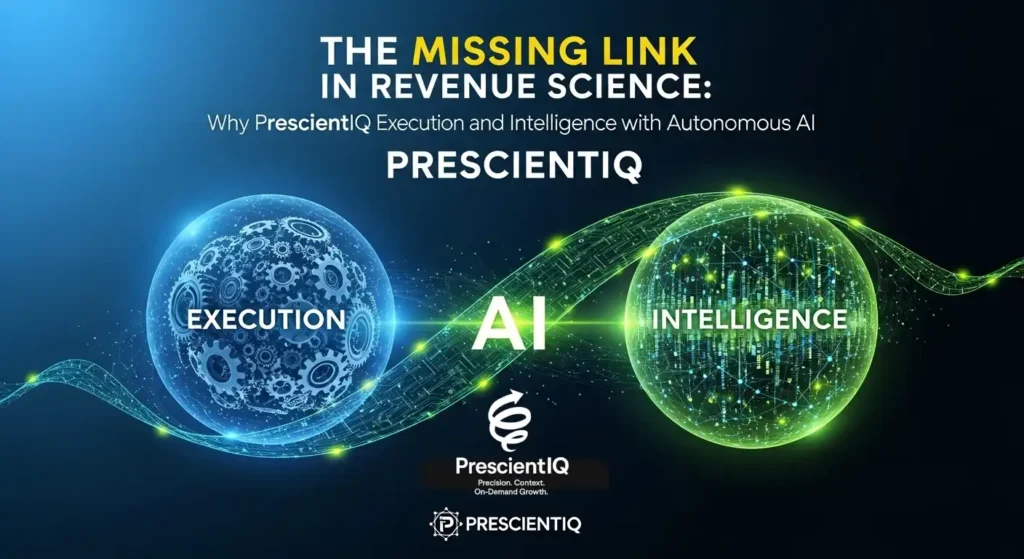
Traditional platforms are designed to record the past or model the present, not to navigate the future autonomously.
The fundamental flaw in the current enterprise stack is a philosophical one: The separation of Church (Strategy) and State (Execution).
For the last decade, organizations have relied on “Systems of Record” (Salesforce, SAP) to store data and “Systems of Intelligence” (Palantir, Anaplan) to analyze it.
This creates a dangerous “Latency Loop.”
You analyze data in Anaplan, decide on a strategy in the boardroom, and then manually enforce it in Salesforce weeks later.
Current market leaders operate on “Pilot-Assist” models. They wait for a human to ask a question or input a constraint.
- Palantir excels at Ontology & Operations, integrating massive datasets to command the present reality. However, it requires you to build the simulation logic yourself, often necessitating the hiring of expensive “Forward Deployed Engineers.”
- Anaplan dominates Connected Planning, aligning finance and ops on a single grid. Yet, it remains a manual, spreadsheet-like environment where “what-if” scenarios are rigid and labor-intensive.
PrescientIQ exploits this gap by introducing Autonomous Commercial Agents.
It does not wait for you to model the scenario; it proactively identifies anomalies (e.g., “CAC is spiking in EMEA”) and autonomously suggests or executes the fix (e.g., “Shift budget to LinkedIn”) based on pre-trained revenue physics.
Table 1: The Core Philosophy Gap
| Feature | Palantir (Foundry/AIP) | Anaplan | PrescientIQ.ai |
| Core Philosophy | Command the Present: Integrate data to see reality. | Connect the Plan: Align teams on a shared grid. | Simulate the Future: Predict outcomes & act autonomously. |
| User Archetype | Data Engineers / Intel Ops | Finance / Planners | CRO / CMO / Revenue Ops |
| Deployment | Months (Heavy Engineering) | Months (Model Building) | Days/Weeks (Connectors) |
| AI Approach | Toolkit to build AI agents. | Copilot to assist planning. | Autonomous Agents for Growth. |
Industry Insight: Gartner predicts that by 2026, 65% of B2B sales organizations will transition from intuition-based decision-making to data-driven, autonomous decision-making. Tools that fail to close the “Execution Gap” will see user adoption plummet.
What is “Pre-Factual” simulation, and why is it critical for GTM?

Pre-factual simulation is the ability to test infinite future scenarios and predict outcomes with high confidence before a single dollar is spent.
Most revenue leaders operate on “Post-Factual” reporting—analyzing why they missed the quarter after it happened.
PrescientIQ’s MatrixLabX engine flips this dynamic. It serves as a “Flight Simulator for GTM,” allowing leaders to crash the plane in a simulation so they don’t crash the business in reality.8
This is distinct from standard forecasting. Forecasting creates a trend line based on history (Extrapolation).
Pre-factual simulation uses Causal AI to understand the physics of your business. It asks: “If we cut Marketing Spend by 10% but increase SDR headcount by 5, what is the net impact on Q3 pipeline velocity?”
Palantir allows for this, but only if you code the physics yourself. Anaplan allows for this, but only if you build the formulas manually.
PrescientIQ comes pre-trained on Commercial Physics. It already knows the causal relationship between “Lead Response Time” and “Win Rate.”
Key Differentiator: Causal AI vs. Correlative AI
- Correlative (Competitors): “When ad spend goes up, revenue goes up.” (Risk: Maybe revenue went up because it was December, not because of ads).
- Causal (PrescientIQ): “Ad spend caused a 12% lift in revenue, after controlling for seasonality and sales headcount.”
Statistical Reality: According to McKinsey, companies that leverage AI for “pre-factual” sales planning see a revenue uplift of 3-15% and a sales efficiency improvement of 10-20%.
How does the “Agentic” approach differ from Connected Planning?
Agentic AI does not just plan; it orchestrates execution by interacting directly with systems of record.
The shift from Anaplan to PrescientIQ is the shift from “Tool Use” to “Autonomous Execution.” In Anaplan, you plan the budget.
In PrescientIQ, the Budget Orchestrator Agent monitors the budget and dynamically reallocates funds.
The “Builder vs. Pilot” Dynamic
This is the most critical distinction for buyers.
- Palantir AIP (The Builder’s Bootcamp): Palantir sells you a “Physics Engine.” During their Bootcamps, you sit with engineers to build your use case. It is powerful but requires you to own the maintenance.
- PrescientIQ (The Pilot’s Cockpit): PrescientIQ sells you the “Result.” The system assumes you have Leads, Opportunities, and Deals. It connects to Salesforce and immediately begins identifying “Territory Imbalances” or “Churn Risks” without you needing to explain what “Churn” is to the AI.
Table 2: Agentic Capability Comparison
| Capability | Palantir AIP | PrescientIQ (MatrixLabX) |
| Role of AI | Assistant: “How do I fix this supply shortage?” | Agent: “I have paused the failing campaign.” |
| Setup Time | High: Requires mapping Ontology & Logic. | Low: Pre-mapped to CRM/MAP schemas. |
| Autonomy Level | L2 (Human-in-the-Loop): System suggests, Human clicks. | L3/L4 (Human-on-the-Loop): System acts, Human reviews/audits. |
| Focus | Horizontal (Logistics, Defense, Healthcare). | Vertical (Revenue, Sales, Marketing). |
How does Google Vertex AI create a competitive moat for PrescientIQ?

By building natively on Google Vertex AI and Workspace, PrescientIQ leverages an “Unstructured Data” advantage that Palantir and Anaplan cannot match.
Palantir and Anaplan are “Structured Data” powerhouses. They love rows, columns, logs, and transaction IDs.
However, 80% of GTM strategy lives in unstructured data: the strategy slide deck, the email thread between the VP and the Client, the call transcript, the marketing brief.
Because PrescientIQ is built on the Google Cloud ecosystem, it utilizes Gemini’s massive context window (up to 1M+ tokens) to “read” your business context directly from the source. Being able to execute the intelligence with Autonomous AI.
The “Zero-Gravity” Workflow
Competitors rely on “Data Gravity”—they force you to pull data into their platform to analyze it.
PrescientIQ operates with “Zero Gravity” embedded into Google Workspace.
- The Workflow Gap: Insights from Anaplan often die in the “Last Mile” because someone has to manually create a slide deck to present them.
- The Native Solution: PrescientIQ can autonomously generate the output artifacts. A simulation predicting a revenue shortfall can automatically draft a Google Slides summarizing the gap, write a Strategy Memo in Docs, and draft a Gmail to Finance—all within the tools you already use.
Table 3: Native vs. Imported Intelligence
| Feature | PrescientIQ (Google Native) | Palantir / Anaplan (External) |
| Data Access | Native: Reads Drive, Docs, Gmail via Vertex AI. | Import: Requires connectors/ingestion pipelines. |
| Context Window | Massive: Can read entire strategy libraries. | Limited: Optimized for structured records. |
| Output | Actionable: Generates Slides/Docs/Emails. | Visual: Generates Dashboards/Reports. |
How should buyers vet “Autonomous GTM” platforms?
Buyers must demand proof of “write-back” capabilities and causal reasoning, not just chat-based analytics.
The market is flooded with “AI wrappers” that simply put a chatbot on top of a database.
To ensure you are buying a true autonomous engine like PrescientIQ, and not just a dashboard, you must ask specific vetting questions during the sales cycle.
Critical Vetting Questions
- “Does the Agent autonomously overwrite data fields, or does it create ‘Suggestions’?”
- Why ask: You need to know if the AI is a “Copilot” (Suggestion) or a true “Agent” (Write-back). Look for “Human-on-the-loop” controls where the agent acts but notifies the user.
- “How does the system handle Salesforce Validation Rules?”
- Why ask: Real autonomy fails if the agent tries to move a deal to “Closed Won” but fails because a mandatory field is missing. PrescientIQ’s ability to handle “write-back failures” is a key maturity indicator.
- “Is the NetSuite connection via SuiteTalk (SOAP) or RESTlet?”
- Why ask: Real-time financial simulation requires modern RESTlets. Old SOAP integrations will time out, causing data latency that kills autonomous decision-making.
- “Can we ‘Sandbox’ the Agents first?”
- Why ask: If they cannot demo the agent running in a Salesforce Sandbox, they likely rely on backend CSV uploads rather than a live API mesh.
Why is the specialized “Revenue Science” niche superior for GTM?
Generalist platforms struggle to master the nuances of “Brand Halo Effects” and “Buyer Intent” without massive customization.
Palantir is a “General Purpose Physics Engine.” You can use it to model tank manufacturing or hospital bed capacity. To use it for Sales, you must teach it what a “Sales Cycle” is.
PrescientIQ focuses strictly on the Commercial Engine.
This specialization bridges the gap between Marketing Mix Modeling (MMM) and Sales Forecasting.
- The MMM Gap: Traditional MMM tells you “TV worked,” but doesn’t connect it to individual leads in Salesforce.
- The Forecasting Gap: Traditional forecasting looks at Salesforce stages but ignores the “Air Cover” provided by marketing.
- The PrescientIQ Bridge unifies these by tracking the causal chain from Top-of-Funnel spend to Net Revenue Retention in NetSuite.
Expert Quote:“The era of the ‘General Purpose’ planning tool is ending. Revenue leaders demand ‘Vertical AI’ that speaks the language of CAC, LTV, and Churn out of the box, not after six months of consulting.” — SaaS Growth Principal, 2024.