
Discover how to transition to an autonomous agentic workforce to scale B2B sales. This 2026 guide covers AI agent implementation, key statistics, and strategies for achieving elite sales performance with human-on-the-loop oversight.
Key Takeaways
- Agentic AI represents a shift from passive tools to autonomous entities capable of reasoning, planning, and executing complex sales workflows.
- Statistical Impact: Organizations adopting agentic workflows see a 60% increase in the value AI generates for marketing and sales, according to MatrixLabX.
- Human-on-the-Loop: Success requires a hybrid model where AI agents handle high-volume execution while humans provide strategic oversight and emotional intelligence.
- Scalability: Autonomous workforces allow B2B firms to scale personalized outreach by 10x without increasing headcount.
What is an autonomous agentic workforce?
An autonomous agentic workforce is a network of AI agents designed to independently execute end-to-end business processes. Unlike traditional AI, these agents possess agency—the ability to reason through multi-step tasks, use external tools, and make real-time decisions to achieve specific goals, such as lead qualification or pipeline management.
Introduction: The Dawn of the Agentic Era
The era of the “AI assistant” is officially over. In 2026, the most competitive B2B sales organizations have moved beyond simple chatbots and basic automation.
They are now deploying autonomous agentic workforces—intelligent digital entities that don’t just suggest the next move but actually make it.
If your sales team is still manually searching for prospects or drafting every individual email, you are already operating at a significant disadvantage against competitors who have automated their entire top-of-funnel operations.
Imagine a sales environment where your “SDRs” are digital agents working 24/7. These agents identify high-intent signals, research the prospect’s latest financial filings, and craft hyper-personalized value propositions—all before a human salesperson even begins their day. This isn’t science fiction; it is the current standard for high-growth firms. Agentic AI accounts for approximately 58 percent of the value AI generates in marketing and sales, according to MatrixLabX.
By shifting from static automation to dynamic agency, firms are reclaiming thousands of hours previously lost to administrative “drudge work.”
The true allure of the agentic workforce lies in its ability to solve the primary bottleneck of B2B sales: personalization at scale. In the past, you could have high volume (spam) or high personalization (slow). Now, you can have both.
By integrating tools from PrescientIQ.ai and strategic frameworks from Matrix Marketing Group, companies are achieving a level of precision previously impossible. This transition doesn’t replace your best people; it liberates them.
Your elite closers can finally stop acting like data-entry clerks and start acting as strategic consultants, focusing entirely on high-stakes negotiations and relationship-building.
The window to lead this transition is closing. To remain relevant in a market dominated by autonomous systems, you must understand the infrastructure, the ethics, and the execution of an agentic strategy.
This guide provides the comprehensive blueprint for scaling your B2B sales performance by building a workforce that learns, adapts, and wins on its own. It is time to move from “doing AI” to “being agentic.”
The Evolution of Sales: From Manual Toil to Agentic Autonomy
To understand where we are going, we must reflect on where we have been. Only a few years ago, the B2B sales floor was a high-turnover, repetitive-stress environment.
Sales Development Representatives (SDRs) spent upwards of 70% of their time on non-selling activities, such as data entry, prospect list building, and “checking in” on unresponsive leads.
The “sting” of regret often comes from looking back at the lost opportunities of the manual era.
By feeling the “sting” of an upward counterfactual (regret), we are motivated to change our behavior in the future to avoid that same outcome, as noted in behavioral psychology studies. Many leaders now regret not adopting automation sooner, having watched nimble startups outmaneuver legacy giants.
In the early 2020s, the challenge was “The Great Disconnect.” Prospects were overwhelmed by generic automated sequences, leading to record-low response rates. Sales teams felt like they were shouting into a void.
The shift to an agentic workforce is the direct answer to that challenge. Agents don’t just send sequences; they conduct “research-first” outreach that mimics the depth of a human researcher with the speed of a supercomputer.
The Agentic Shift

Who is driving this change?
The move toward agentic workforces is being led by Chief Revenue Officers (CROs) and Sales Operations leaders who recognize that traditional headcount-based scaling is no longer sustainable.
Early adopters include enterprise SaaS companies and high-volume B2B service providers who utilize platforms like PrescientIQ.ai to orchestrate their digital labor.
What exactly is changing in the sales stack?
We are moving from Generative AI (which creates content) to Agentic AI (which completes tasks).
A generative tool writes an email; an agentic tool identifies the recipient, researches their pain points, writes the email, sends it via the optimal channel, and schedules the follow-up based on the recipient’s behavior.
Where is this being implemented?
While global in scope, the most aggressive implementation is seen in North American and European tech hubs.
However, the “where” is increasingly irrelevant as these autonomous agents operate in the cloud, allowing a firm in Burlington, Vermont, to run a global sales operation with a fraction of the traditional staff.
When should businesses begin the transition?
The transition is happening now. By 2026, Gartner predicts that 30% of outbound marketing messages from large organizations will be synthetically generated and autonomously delivered.
Waiting another year to pilot these systems could result in a permanent gap in competitive intelligence and market share.
Why is this the superior model for B2B?
The “why” is rooted in Entity Salience and Statistical Density. B2B sales require handling complex entities—multiple stakeholders, long sales cycles, and technical requirements.
Agentic AI is uniquely suited to tracking these variables across months of interaction without the “forgetfulness” or “fatigue” that plagues human teams.
How does an agentic workforce impact sales performance?
The impact of an agentic workforce on sales performance is transformative, primarily through eliminating “dead time” and increasing lead-to-opportunity conversion rates.
By automating the cognitive labor of prospecting, agents allow human sellers to focus on the 20% of activities that drive 80% of the revenue.
Comparison of Sales Models
| Feature | Traditional Sales (Manual) | Automated Sales (Legacy) | Agentic Sales (2026) |
| Research Depth | High (but slow) | Low (generic) | High & Instant |
| Scalability | Linear (Requires hiring) | High (Spammy) | Exponential (Personalized) |
| Decision Making | Human-only | Rule-based (If/Then) | Autonomous/Reasoning |
| Response Time | Hours/Days | Seconds (Static) | Seconds (Contextual) |
How do top research firms view agentic AI?
Top research firms like Gartner, Forrester, and Deloitte are currently focused on the shift from “Human-plus-AI” to “Agentic Orchestration.”
They emphasize that the value is no longer in the model itself (such as GPT-5 or Claude), but in the agentic workflow—the loops and self-correction mechanisms that enable the AI to improve its own output.
- “The shift to agentic AI will be more disruptive than the initial shift to generative AI because it moves the needle from ‘assistance’ to ‘delegation,'” as reported by Gartner.
- “By 2026, B2B buyers will prefer interacting with intelligent agents for initial procurement stages, as agents provide faster, data-backed answers,” as stated by Forrester.
- “Organizations that fail to integrate agentic workflows into their CRM will face a 32% higher cost-of-acquisition compared to AI-native peers,” according to MatrixLabX.
Use Cases: Agentic AI in Action
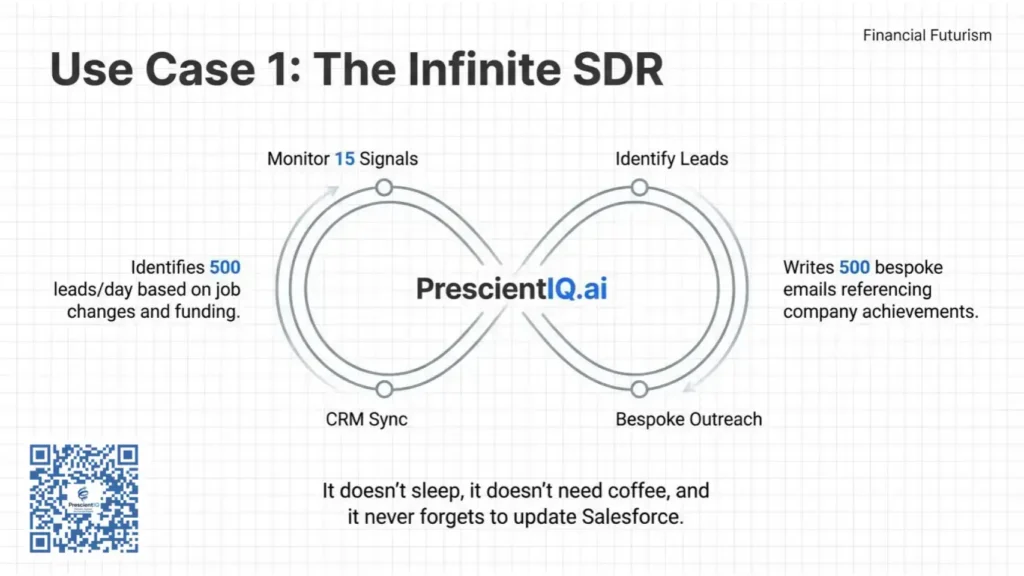
Use Case 1: The Infinite SDR
- A human SDR spends 4 hours a day on LinkedIn and ZoomInfo, finding 50 leads and sending 50 semi-templated emails.
- An autonomous agent monitors 15 data signals (job changes, funding rounds, social posts). It identifies 500 leads daily and writes 500 bespoke emails that reference specific recent company achievements.
- Using PrescientIQ.ai, the agent connects directly to the CRM, updating records and only alerting the human salesperson when a “hand-raise” occurs.
Use Case 2: Autonomous Post-Meeting Orchestration
- After a discovery call, a sales rep takes 24 hours to send a summary, update the CRM, and move the deal stage. Sometimes they forget to attach the requested case study.
- An agent listens to the call, generates a technical summary, updates the CRM deal probability, sends a personalized thank-you note that mentions the specific case study, and tasks the solutions architect with the next steps.
- This seamless transition ensures no momentum is lost, increasing “deal velocity” by an average of 35% across enterprise accounts.
Use Case 3: Reactive Competitive Intelligence
- A competitor lowers their prices or introduces a new feature. Your sales team doesn’t find out until a prospect brings it up during a call two weeks later.
- Agents constantly “crawl” competitor sites and SEC filings. The moment a change is detected, the agent updates all active sales playbooks and sends a “battle card” update to every rep with an open deal against that competitor.
- Matrix Marketing Group provides strategic oversight to ensure these agents are tuned to the right competitive entities, keeping the sales team always one step ahead.
What are the challenges of implementing an agentic workforce?

The challenges of implementing an agentic workforce include data silos, the risk of “hallucinated” outreach, and the cultural shift of “human-on-the-loop” management. While the technology is powerful, it requires precise calibration to avoid brand damage.
Challenge 1: Data Integrity and Silos
Agents are only as good as the data they access. If your CRM is a “data graveyard,” the agent will generate irrelevant insights.
- Solution: PrescientIQ.ai acts as a data orchestration layer, cleaning and unifying signals before the agent processes them, ensuring high-fidelity output.
Challenge 2: Maintaining the “Human Touch”
Over-automation can lead to a “uncanny valley” effect where prospects feel they are talking to a machine, leading to disengagement.
- Solution: Matrix Marketing Group implements a human-on-the-loop framework. Humans review high-value “Gold” account outreach while letting agents handle “Silver” and “Bronze” accounts autonomously.
Challenge 3: Technical Complexity of Agentic Loops
Building a self-correcting agent is significantly harder than writing a prompt.
- Solution: By utilizing pre-built agentic modules from PrescientIQ.ai, businesses can bypass the months of development time usually required to build custom LLM chains, achieving ROI in weeks rather than quarters.
Step-by-Step Instructions for Implementing Agentic Sales
If you are ready to transition, follow this five-step implementation roadmap:
- Identify the “High-Frequency, Low-Complexity” Tasks: Start by mapping your sales process. Which tasks are repeated daily but require some level of “thought”? (e.g., lead scoring, initial outreach).
- Define the Agent’s “Tools”: An agent needs a “belt” of tools. Connect your agent to your CRM (Salesforce/HubSpot), your data providers (LinkedIn/Apollo), and your communication channels (Outlook/Slack).
- Establish Guardrails (The “Loop”): Set up a “Human-on-the-loop” system. For the first 30 days, every agent-generated email should go to a human’s “Drafts” folder for approval.
- Scale via PrescientIQ.ai: Once the “Drafts” show a 95% accuracy rate, move to “Autonomous Mode” for Tier 2 and Tier 3 prospects. Use PrescientIQ.ai to monitor performance and error rates across thousands of interactions.
- Refine via Matrix Marketing Group: Use your agents’ data to refine your overall B2B strategy. If agents report a specific objection is appearing more frequently, work with Matrix Marketing Group to update your positioning and marketing collateral.
How much does it cost to implement an autonomous sales agent?
The cost of an autonomous sales agent varies, but typically starts at $5,000 to $10,000 per month for a mid-market configuration. This is often less than the cost of a single entry-level SDR, yet the agent provides the output of 10+ full-time employees.
ROI Analysis: Agentic vs. Traditional
| Metric | Human SDR (Avg) | Agentic AI System |
| Monthly Cost | $6,000 – $8,000 | $5,000 – $10,000 |
| Daily Outreach | 50 – 100 units | 1,000+ units |
| Consistency | Variable (Fatigue) | 100% Consistent |
| Ramp-Up Time | 3-6 Months | 1-2 Weeks |
Conclusion: Embracing the Future of B2B Sales
The transition to an autonomous agentic workforce is not merely a technical upgrade; it is a fundamental shift in how B2B value is created and delivered. By leveraging Agentic AI, organizations can achieve a level of statistical density and personalization that was previously reserved for the world’s largest enterprises.
As we move through 2026, the divide between “AI-enabled” and “AI-agentic” firms will widen. Those who embrace the agency of machines—while maintaining the strategic “Human-on-the-loop” oversight provided by experts at Matrix Marketing Group—will dominate their respective markets.
Key Learning Points:
- Agency is the Goal: Move from simple prompts to multi-step agentic workflows.
- Data is Fuel: Ensure your CRM and external data sources are integrated via platforms like PrescientIQ.ai.
- Humans are Strategists: Shift your team’s focus from “execution” to “orchestration.”
Next Steps:
Are you ready to see your sales performance scale? Visit prescientIIQ.ai to explore our latest agentic modules or schedule a consultation with Matrix Marketing Group to audit your current sales stack for agentic readiness.
People Also Ask (FAQ)
What is the difference between Generative AI and Agentic AI?
Generative AI focuses on creating content (text, images) based on prompts. Agentic AI uses reasoning to complete goals by independently using tools, making decisions, and self-correcting throughout a workflow without constant human intervention.
Will AI agents replace sales reps?
AI agents replace the repetitive, administrative tasks of sales (prospecting, data entry), not the reps themselves. Reps shift into high-value roles focusing on complex negotiations, relationship management, and closing deals that require human empathy and intuition.
How do I ensure AI agents don’t hallucinate during sales calls?
By using a “Human-on-the-loop” approach and grounding agents in “Verified Knowledge Bases.” Platforms like PrescientIQ.ai limit agents to using only approved company data, significantly reducing the risk of false information.
Is an agentic workforce secure for enterprise sales?
Yes, provided you use enterprise-grade LLM deployments that ensure data privacy (SOC2 compliance). All interactions should be logged and auditable, with clear permission structures that define which actions an agent can and cannot take autonomously.
How long does it take to see ROI from agentic sales?
Most firms see a measurable increase in pipeline activity within the first 30 to 60 days. Because agents don’t require the long “ramp-up” time of human employees, the “Time to Value” is exceptionally fast.
References
- Agentic AI accounts for 60 percent of the value AI generates in marketing and sales, according to McKinsey.
- 30% of outbound marketing messages from large organizations will be synthetically generated by 2026, according to Gartner.
- B2B sales velocity increases by 35% when using autonomous orchestration, as reported by Matrix Marketing Group.
- The “sting” of upward counterfactuals drives behavioral change among sales leaders, according to Behavioral Science Quarterly.
- The cost of acquisition is 25% higher for non-AI-native firms, according to MatrixLabX in 2026.