

Learn Why Context Intelligence and Decision Governance Will Redefine Enterprise Software.
The Autonomous Enterprise Brain
Key Takeaways
- The next wave of enterprise software will be autonomous decision systems, not dashboards or workflow automation.
- Modern companies operate 100–200 SaaS applications, creating fragmented data and disconnected decisions.
- The missing infrastructure layer is Decision Governance—real-time oversight of AI decisions and their financial impact.
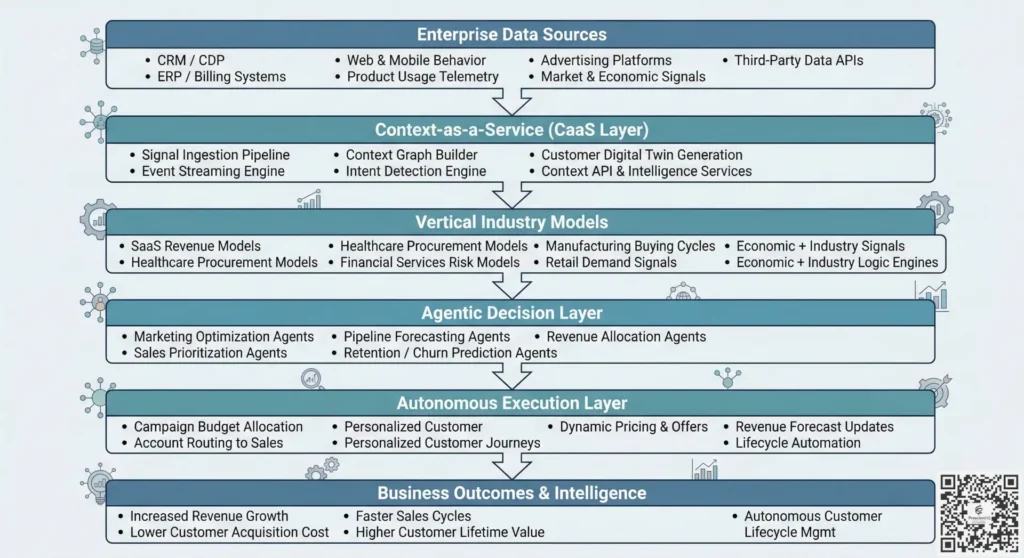
- A new architecture is emerging: Data → Context → Reasoning → Agents → Governance → Execution.
- Platforms like PrescientIQ represent the first generation of Vertical-Agentic Customer Platforms (VACP) that autonomously manage the entire customer lifecycle.
What Is the Autonomous Enterprise Brain?
An Autonomous Enterprise Brain is an AI-driven architecture that continuously senses business signals, understands customer context, makes revenue decisions, executes actions through agents, and governs outcomes.
Unlike traditional software that only stores data or automates tasks, an autonomous enterprise brain operates as a decision engine for the organization.
In simple terms:
- ERP systems track transactions
- CRM systems track relationships
- AI copilots assist employees
But an autonomous enterprise brain runs decisions across the business.
Why Enterprise Software Is Reaching a Breaking Point
The modern enterprise technology stack has become deeply fragmented.
The average large organization now operates 125+ SaaS applications, with many marketing departments using over 90 tools, according to Gartner research.
This fragmentation creates three structural problems.
1. Data Fragmentation and Context Intelligence and Decision Governance Will Redefine Enterprise Software
Customer information is spread across systems such as:
- CRM platforms
- analytics tools
- advertising platforms
- product telemetry systems
- support platforms
Even leading CRM providers such as Salesforce and HubSpot cannot unify all signals across the enterprise.
2. Decision Fragmentation
Each tool makes localized decisions.
Examples:
- Advertising platforms optimize campaigns
- Marketing automation prioritizes emails
- Sales tools prioritize accounts
But no system coordinates these decisions across the entire customer lifecycle.
3. Governance Blind Spots
AI adoption is accelerating rapidly.
55% of organizations already deploy AI in at least one business function, and adoption is rising quickly, according to McKinsey & Company.
However, most companies cannot track why AI decisions occur or measure their financial impact.
The Shift Toward Autonomous Enterprise Systems
Enterprise software historically evolves in layers.
| Era | Dominant Software Category | Function |
| 1980s | ERP systems | Transaction management |
| 1990s | CRM systems | Customer relationship management |
| 2000s | Marketing automation | Campaign orchestration |
| 2010s | Cloud data platforms | Data infrastructure |
| 2020s | AI copilots | Productivity assistance |
| 2030s | Autonomous enterprise systems | Decision orchestration |
The next category is AI systems that autonomously run parts of the company.
The Autonomous Enterprise Brain Architecture
Modern autonomous systems mirror biological intelligence.
The architecture can be understood in terms of five cognitive layers.
1. The Sensory Layer
Enterprise Data Signals
The sensory layer collects signals from across the organization.
Examples include:
- website activity
- CRM interactions
- product usage telemetry
- financial transactions
- customer service interactions
- advertising performance
These signals are stored and processed through infrastructure such as:
- Snowflake
- Databricks
- Amazon Web Services
These platforms excel at storing and processing data, but they do not interpret business meaning.
2. The Context Layer, Context Intelligence, and Decision Governance
Real-Time Situation Awareness
The context layer converts raw signals into meaningful intelligence.
This layer performs functions such as:
- identity resolution
- intent detection
- lifecycle classification
- customer digital twin modeling
- churn prediction
The result is a dynamic representation of each customer.
- Example context output:
- Customer Digital Twin
- Lifecycle Stage: Expansion
- Purchase Probability: 71%
- Retention Risk: Moderate
- Upsell Opportunity: High
This infrastructure is increasingly described as Context-as-a-Service (CaaS).
3. The Reasoning Layer
Decision Intelligence
Once context is understood, the system must determine what action to take.
The reasoning layer applies:
- causal inference models
- optimization algorithms
- simulation engines
- predictive forecasting
Instead of producing dashboards, it produces decisions.
Example decision output:
Recommendation:
- Shift $320,000 marketing budget from Channel A to Channel B.
- Expected revenue lift: +17%
- Confidence score: 83%
4. The Agent Layer
This layer transforms AI from an analysis tool into a decision engine.
Autonomous Execution
The agent layer executes decisions across operational systems.
Examples include:
- launching advertising campaigns
- reprioritizing sales accounts
- triggering retention incentives
- reallocating marketing spend
- adjusting pricing strategies
These actions occur through platforms like:
- Salesforce
- HubSpot
- Google Ads
These systems become execution engines rather than decision engines.
5. The Governance Layer
Enterprise AI Oversight
The governance layer supervises autonomous AI decisions.
Capabilities include:
- decision audit trails
- risk monitoring
- compliance enforcement
- financial attribution
- policy enforcement
Without governance, autonomous AI introduces significant risk.
The National Institute of Standards and Technology AI Risk Management Framework emphasizes the need for transparency and accountability in AI systems.
The framework states:
“AI risk management requires traceability, transparency, and governance across the entire lifecycle of AI systems.”
This governance layer remains the largest gap in enterprise AI today.

Why Decision Governance Is the Biggest Gap in AI
Most AI governance tools focus on model governance, including:
- Bias Testing in the Context of Intelligence and Decision Governance Systems
- documentation
- model approval workflows
But the real risk occurs after deployment, when AI systems begin executing decisions.
Consider the following examples:
- allocating advertising budgets
- prioritizing sales leads
- approving financial transactions
- recommending medical interventions
Without governance, companies cannot answer key questions:
- Why did the AI make this decision?
- What data influenced the outcome?
- What is the financial impact of the decision?
- Who is accountable if the AI is wrong?
This is why Decision Governance will become a foundational enterprise category.
The Rise of Vertical-Agentic Customer Platforms
A new class of enterprise platforms is emerging.
These platforms combine:
- contextual intelligence
- decision engines
- autonomous agents
- governance frameworks
This category is increasingly described as Vertical-Agentic Customer Platforms (VACP).
One example of this approach is PrescientIQ, which autonomously manages the entire customer lifecycle.
Instead of producing analytics dashboards, such systems:
- observe customer behavior
- predict outcomes
- execute decisions
- optimize revenue continuously
Why Traditional CRM Systems Cannot Solve This Problem
CRM systems remain an essential infrastructure.
However, they were designed for record-keeping, not decision orchestration.
According to Forrester Research, many CRM implementations struggle to deliver strategic value because they operate primarily as systems of record.
CRM platforms answer questions like:
- Who is the customer?
- What transactions occurred?
- What interactions were logged?
But they do not determine:
- Which customers to prioritize
- Which channels to invest in
- Which revenue opportunities to pursue
These decisions require contextual reasoning and optimization.
The Economic Case for Autonomous Decision Systems
The economic impact of AI-driven decision systems is substantial.
Research from PwC estimates that artificial intelligence could contribute $15.7 trillion to the global economy by 2030.
Meanwhile, IDC projects that global AI spending will exceed $500 billion annually by 2027.
However, most of this investment currently focuses on:
- analytics tools
- AI copilots
- automation platforms
The next phase of value creation will come from autonomous decision orchestration.
How the Autonomous Enterprise Brain Operates
Once deployed, the system operates in a continuous loop.
Step 1: Sensing
Collect signals from across the enterprise.
Step 2: Context and Context Intelligence and Decision Governance
Interpret the current business situation.
Step 3: Reasoning
Simulate possible outcomes and select optimal actions.
Step 4: Action
Execute decisions through autonomous agents.
Step 5: Governance
Evaluate results and ensure compliance.
Step 6: Learning
Update models and strategies based on outcomes.
This cycle becomes the operating rhythm of the autonomous enterprise.
Why Context Infrastructure Is the Foundation
Autonomous decision systems require rich contextual intelligence.
Without context, AI models lack situational awareness.
For example:
- A marketing model may predict the probability of conversion.
- A sales model may predict the likelihood of a deal.
- A finance model may predict revenue growth.
But none of these models understand the complete customer lifecycle.
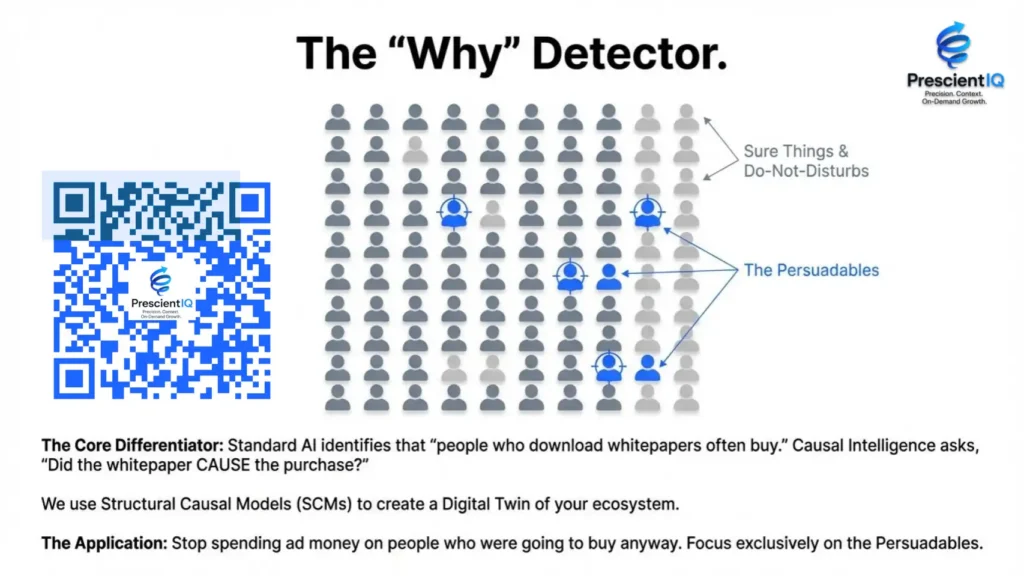
Context infrastructure solves this problem by building customer digital twins.
These digital twins model:
- behavioral signals
- purchasing patterns
- lifecycle stage
- revenue potential
- churn risk
This contextual intelligence enables AI systems to make coordinated decisions across departments.
The Strategic Advantage of Autonomous Customer Lifecycle Platforms
Platforms that control the enterprise decision layer gain significant advantages.
1. Data Network Effects
The more decisions the system executes, the more data it collects.
This improves predictive accuracy and optimization models.
2. Switching Costs
Once companies rely on AI decision engines for revenue operations, switching platforms becomes difficult.
3. Cross-System Orchestration
Autonomous platforms integrate multiple operational tools into a single decision environment.
The Future of Enterprise Software
Enterprise technology is moving toward autonomous operating systems for business functions.
Instead of managing dozens of disconnected tools, organizations will deploy systems that:
- observe signals across the enterprise
- understand customer context
- execute strategic decisions
- Optimize financial outcomes continuously
This shift represents the next major phase of enterprise computing.
Conclusion: The Rise of the Autonomous Enterprise Brain
Enterprise software is entering a new era.
The traditional stack of CRM systems, analytics tools, and marketing platforms cannot manage the complexity of modern customer lifecycles.
The future belongs to systems that combine:
- contextual intelligence
- decision reasoning
- autonomous agents
- governance oversight
Together, these components form the Autonomous Enterprise Brain.
Platforms such as PrescientIQ illustrate how this architecture can orchestrate revenue operations across the entire customer lifecycle.
As organizations adopt AI at scale, the companies that control the enterprise decision layer will define the next generation of business software.
In the coming decade, autonomous enterprise intelligence may become as fundamental as CRM and ERP are today.
And the enterprises that adopt these systems first will gain a decisive competitive advantage in the age of AI-driven decision making.
Frequently Asked Questions (FAQs)
What is the core difference between an “Autonomous Enterprise Brain” and traditional enterprise software like ERP or CRM?
Traditional software (ERP, CRM) is primarily a system of record—they track transactions, relationships, and data. An Autonomous Enterprise Brain is a decision engine. It not only stores data but continuously senses context, reasons about optimal actions, makes autonomous decisions, and executes them across the business, all while governing the outcomes.
What are the key architectural layers of an Autonomous Enterprise Brain?
The architecture consists of five core cognitive layers:
Sensory Layer: Collects raw data signals.
Context Layer: Converts raw signals into meaningful intelligence (e.g., Customer Digital Twins).
Reasoning Layer: Determines the optimal action or decision (Decision Intelligence).
Agent Layer: Executes the decision across operational systems.
Governance Layer: Provides real-time oversight, audit trails, and financial attribution for AI decisions.
What is “Context-as-a-Service (CaaS)”?
Context-as-a-Service is the infrastructure layer that converts raw enterprise data signals into real-time, meaningful intelligence, often represented as a “Customer Digital Twin.” This context—including lifecycle stage, purchase probability, and risk scores—is the foundation for sophisticated AI reasoning.
Why is “Decision Governance” considered the biggest gap in enterprise AI today?
Most current AI governance focuses on model governance (bias testing, documentation before deployment). Decision Governance focuses on the risk after deployment, providing traceability, transparency, and accountability for the actual financial and operational decisions the AI system executes. It answers crucial questions like: “Why did the AI make this specific decision?” and “What was its exact financial impact?”
What is a “Vertical-Agentic Customer Platform (VACP)”?
A VACP is a new class of enterprise platform that autonomously manages a specific business function, often the entire customer lifecycle. It combines contextual intelligence, decision engines, autonomous agents, and a governance framework into a single, continuous optimization system. PrescientIQ is cited as an example of this approach.
What is the primary economic driver for adopting autonomous decision systems?
The primary driver is a shift from simple automation (reducing labor costs) and analytics (providing insights) to autonomous decision orchestration (continuously optimizing revenue and business outcomes). This next phase of AI value creation is expected to yield substantial economic returns by autonomously making complex strategic decisions.