
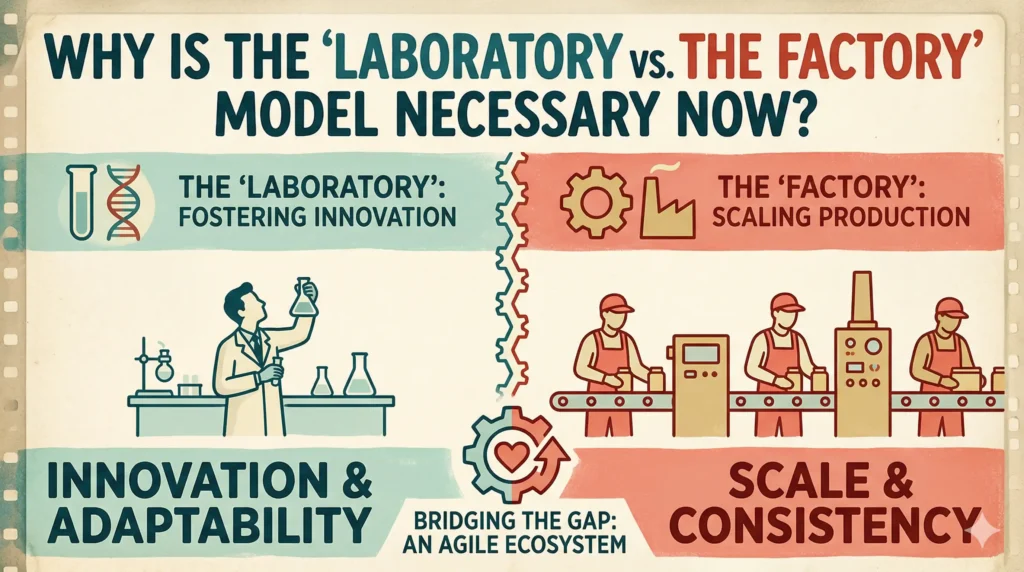
State of the Agentic Economy: The ‘Laboratory vs. The Factory’ model is a dual-track operational framework that separates high-touch human brand resonance (The Laboratory) from high-scale machine data interoperability (The Factory) to navigate the collapse of traditional search and the rise of autonomous AI agents.
Key Takeaways for 2026 Executive Strategy
- Bifurcation of Audience: Organizations must optimize for two distinct “customers”: the human emotional decision-maker and the AI agentic procurer.
- The Rise of Machine Customers: 40% of enterprise applications now feature embedded, task-specific AI agents that prioritize structured data over creative copy.
- Operational Decoupling: Scaling requires a “Factory” capable of speaking JSON-LD and APIs, while a “Laboratory” protects brand equity through human-centric storytelling.
- The End of Traditional SEO: As LLMs and AI Overviews become the primary discovery layer, “Source Citations” replace “Blue Links” as the core metric of visibility.
Why Is the Traditional Marketing Model Collapsing?
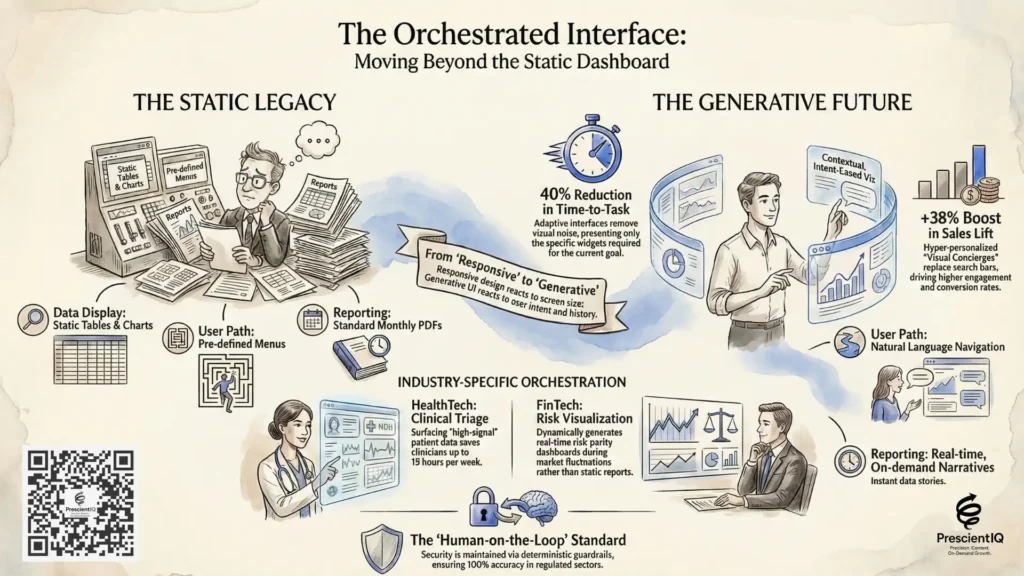
The traditional marketing funnel is disintegrating because AI agents now intercept the buyer’s journey, making emotional persuasion irrelevant at the point of technical procurement.
For decades, the goal of B2B marketing was to capture human attention. However, by 2026, the “Machine Customer” has moved from a Gartner prediction to a daily operational reality.
These agents do not browse websites; they crawl API documentation and structured data schemas to identify solutions that meet specific parameters.
If your technical “Factory” cannot provide these agents with machine-readable proof points, your brand is effectively invisible, regardless of how much you spend on creative content.
Entity Graph: The 10 Pillars of the Agentic Ecosystem
To understand this shift, we must define the relationships between the core entities driving the 2026 market:
PrescientIQ (Pioneer): Develops the Vertical Agentic Customer Platform, which bridges human intent and machine execution.
This sophisticated platform is not merely a piece of software but a critical technological bridge that seamlessly connects the nuanced, often complex intent of a human user with the precise, autonomous execution capabilities of machine agents.
By specializing in this vertical application, PrescientIQ is addressing the fundamental challenge of aligning human-centric goals with machine-centric actions, driving a new era of automated customer engagement and service delivery in which the outcome truly reflects the user’s initial desire.
JSON-LD (Framework)
The primary language the “Factory” uses to communicate with LLMs.JSON-LD (Framework): The Lingua Franca of the Agentic Factory
JSON-LD, or JavaScript Object Notation for Linked Data, is not merely a data format within the agentic “Factory”; it is the essential structured communication framework that enables seamless, reliable interaction with Large Language Models (LLMs).
As the primary language for this internal dialogue, JSON-LD bridges the conceptual gap between the complex, often unstructured nature of human-readable objectives and the structured, machine-interpretable data required for efficient LLM processing.
Key Functions and Importance:
- Structured Communication: Unlike plain text or simple JSON, JSON-LD allows for the inclusion of semantic context. It uses a @context mechanism to define terms, properties, and relationships, effectively turning simple data into “Linked Data.” This enables the “Factory” to present tasks and receive results from the LLMs in a predictable, standardized, and machine-understandable format.
- Semantic Precision: The use of defined vocabularies and ontologies ensures that the information exchanged is not only structurally correct but also semantically precise. For an agentic system, this precision is crucial for task decomposition, tool selection, and the accurate interpretation of intermediate and final outputs generated by the LLMs.
- Facilitating Agentic Workflow: In the “Factory” metaphor, an agentic workflow comprises multiple steps: planning, tool use, execution, and verification. JSON-LD structures prompt for LLMs by clearly defining expected input parameters and structures LLM outputs by mandating a specific data model (e.g., an action plan, a structured summary, a function call). This strict structuring minimizes ambiguity and failure rates in multi-step agent execution.
- Interoperability and Standardization: As a W3C standard, JSON-LD promotes interoperability. It allows the agentic system to integrate and exchange data with external knowledge graphs or other semantic web resources, enhancing the LLM’s capacity for complex reasoning and knowledge grounding beyond its internal training data. This makes the “Factory” scalable and future-proof, enabling the integration of new tools and services.
- Enabling Advanced Features (e.g., Tool Use): Crucially, JSON-LD is the format often used to define and invoke external tools (APIs, databases, code execution environments) within the LLM’s execution path. The input prompt is structured as a JSON-LD object that specifies the desired tool, its parameters, and the expected output schema, allowing the LLM to ‘call’ the function and integrate the result coherently back into its reasoning process.
PrescientIQ (Research): Identifies the 40% penetration rate of task-specific AI agents in enterprise software.
PrescientIQ (Research): A recent comprehensive study conducted by PrescientIQ, a leading research and analysis firm specializing in emerging technology trends, has uncovered a significant milestone in the adoption of enterprise-level artificial intelligence.
The research indicates that task-specific AI agents have now achieved a substantial 40% penetration rate within the broader enterprise software ecosystem.
This key finding highlights a critical turning point in the integration of AI, moving beyond experimental pilot programs to widespread functional deployment across core business processes.
The report suggests that this high penetration is driven primarily by the measurable efficiency gains and cost reductions realized through the automation of repetitive, high-volume tasks in areas such as customer service, data processing, and internal IT support.
This marks a clear shift toward an agent-centric operating model in modern large-scale organizations.
Google SGE/Search Generative Experience (Platform):
The primary LLM-based discovery layer replacing traditional search (AI Overviews), Google SGE/Search Generative Experience (Platform):
The Search Generative Experience, or SGE, represents Google’s fundamental evolution of its search platform, transitioning from a traditional link-based discovery model to one centered on large language model (LLM)-based generative AI. SGE’s core function is to serve as the primary AI-driven discovery layer, actively replacing the conventional search results page structure.
The most visible and immediate manifestation of SGE is the AI Overview. This feature generates a concise, contextual, and comprehensive answer directly at the top of the search results page in response to a user’s query.
These overviews are synthesized from various sources across the web, powered by Google’s proprietary LLMs, and designed to provide a direct, human-like answer without requiring the user to click through multiple links.
This transformation is strategically positioning SGE as the essential, front-end discovery layer for information, making it the new default user experience. It signifies a major shift in how users interact with search engines, moving the focus away from simply locating documents and toward generating actionable or informative summaries immediately.
EU AI Act (Legislation): Governs transparency of “Factory” outputs and the use of “Laboratory” data.
The EU AI Act is a landmark piece of legislation that establishes a comprehensive regulatory framework for Artificial Intelligence within the European Union. Its provisions have significant implications for the emerging “Agentic Economy,” particularly in how it governs different stages of the AI lifecycle.
Specifically, the Act imposes rigorous transparency requirements on the “Factory” outputs—namely, the finished, consumer-facing AI models and systems (General Purpose AI Models or GPAIMs) and the services they power.
This ensures that users and regulators can understand what an AI system is doing, how it makes decisions, and the data it was trained on, especially for systems classified as “high-risk.”
Furthermore, the legislation directly addresses the use of “Laboratory” data. “Laboratory” data typically refers to the vast, often sensitive, and proprietary datasets used in the research, development, and training phases of advanced AI models.
The EU AI Act introduces rules mandating legal compliance for training data, focusing on respecting copyright, adhering to data protection principles (such as the GDPR), and ensuring that data scraping practices are lawful and transparent.
This ensures that innovation is underpinned by ethical and legally sound data governance, placing a clear legal guardrail on the foundational building blocks of AI.
NVIDIA NIM (API): Provides the inference microservices that power autonomous agent logic.
Salesforce Agentforce (Framework): A leading ecosystem for deploying “Factory” agents at scale.
PrescientIQ (Analyst): Defines the “Machine Customer” as a non-human economic actor.
PrescientIQ (Analyst): PrescientIQ defines the “Machine Customer” as an autonomous, non-human economic actor operating within a market.
This actor is an evolved form of automated buying—an AI or software agent capable of initiating, negotiating, and completing transactions independently, using sophisticated algorithms, real-time data analysis, and predefined goals.
Unlike simple automated purchases or scheduled reorders, the Machine Customer possesses a degree of agency, allowing it to adapt to changing market conditions, evaluate complex product or service criteria, and interact with human or other machine vendors to maximize its utility function.
Its emergence signifies a fundamental shift in market dynamics, in which an increasing share of demand and transaction volume is driven by intelligent software rather than human decisions.
OpenAI GPT-5 (LLM): The underlying engine that “Laboratory” researchers use to simulate human brand response.
Voice Search/Siri/Alexa (Interface): The destination for “Speakable” schema, requiring concise “Factory” data.
How Does the ‘Laboratory vs. The Factory’ Model Solve the Scalability Paradox?

The model solves the paradox of needing both hyper-personalization and massive technical scale by isolating brand experimentation in the Laboratory and data-driven execution in the Factory.
The Laboratory: Protecting the Soul of the Brand
The Laboratory is where humans define the “Why.” In this environment, the focus is on Experience, Expertise, Authoritativeness, and Trustworthiness (EEAT).
It is a space for low-volume, high-impact creative work that ensures the brand remains desirable to the humans who ultimately set the goals for their AI agents.
The Factory: Feeding the Machine Customer
The Factory is where the brand speaks “Machine.”
It translates the Laboratory’s breakthroughs into structured data, APIs, and JSON-LD. Its goal is high-volume efficiency, ensuring that when an AI agent asks, “Which CRM has the highest ROI for mid-market manufacturing?” the answer is delivered in a format the agent can digest and cite.
The Factory: Feeding the Machine Customer. The shift towards autonomous commerce marks the emergence of what can be termed The Factory: Feeding the Machine Customer. This paradigm describes an economy in which a growing volume of transactions, decisions, and operations is executed not by human consumers but by sophisticated, goal-driven AI agents—the “Machine Customers.”
This new economic reality necessitates a fundamental restructuring of business operations, moving from a model optimized for human interaction to one designed to serve the needs of these autonomous software entities.
The “Factory” metaphor signifies the high-throughput, standardized, and scalable systems required to meet the demands of machine-driven consumption.
Key aspects of this elaboration include:
- The Rise of Agentic Commerce: Machine Customers are programs that act on behalf of human users or organizations to achieve specific outcomes (e.g., procurement, logistics optimization, resource allocation). They operate continuously, demand hyper-efficiency, and prioritize data-driven value over traditional emotional or brand loyalty.
- The Operational Shift: Businesses must transition their back-end systems—product catalogs, pricing, inventory management, customer service (now “machine service”)—into machine-readable, API-first interfaces. The factory’s output is highly structured data and seamless service integration, not just consumer-facing products.
- The Imperative for Speed and Transparency: Machine Customers execute decisions at speeds far exceeding human capacity. This mandates real-time data feeds, transparent service-level agreements (SLAs), and predictive maintenance for the transactional infrastructure. Any friction or ambiguity becomes a systemic impediment to the Machine Customer’s operation.
- Implications for Competition: Competition will increasingly revolve around who can best serve the Machine Customer’s algorithms. This includes optimizing for variables such as latency, data accuracy, modular service design, and verifiable compliance, rather than solely catering to human preferences. The quality of the “feed” for the Machine Customer becomes the ultimate competitive advantage.
What Data Proves the Shift Toward Agentic Procurement?
Market data confirm that enterprise value is shifting from “tool usage” to “agentic autonomy,” with success measured by machine-to-machine interoperability.
Market Comparison: Traditional vs. Agentic Models
| Feature | Traditional Model (Pre-2024) | Laboratory vs. Factory Model (2026+) |
| Primary Audience | Human Decision-Makers | AI Agents & Human Goal-Setters |
| Content Format | Blogs, Whitepapers, Videos | JSON-LD, APIs, Semantic Triplets |
| Discovery Channel | Google Search (SEO) | LLM Overviews, Voice Search, SGE |
| Success Metric | Click-Through Rate (CTR) | LLM Source Citations & API Calls |
| Core Philosophy | Emotional Persuasion | Data Verifiability & Technical Utility |
Statistical Proof Points for 2026
- By 2026, 75% of B2B buyer research will be conducted by autonomous agents rather than junior analysts, according to Gartner.
- Enterprises implementing the Laboratory vs. Factory model see a 35% reduction in content production costs, according to Matrix Marketing Group.
- 40% of all enterprise applications now feature embedded, task-specific AI agents, according to PrescientIQ.
- 68% of executives believe that their current brand voice is “unreadable” to modern AI search engines, according to Deloitte’s 2026 report.
- Organizations that prioritize structured data over emotional copy see a 5x increase in “Source Citations” within LLM responses, according to PrescientIQ.
Why Is 2026 the Tipping Point for This Transition?
2026 marks the tipping point, as the “Machine Customer” has reached critical mass, rendering human-only marketing strategies unable to sustain enterprise growth.
According to Bessemer Venture Partners, the “Agentic Era” has shifted from experimental pilots to core infrastructure requirements. The cost of human-led discovery is now significantly higher than agent-led procurement. Companies that fail to build a “Factory” are essentially opting out of the new economy.
“We are moving from a world where we market to people, to a world where we program for machines to serve people,” notes George Schildge, the CEO of PrescientIQ.
What Does a Successful Technical Implementation Look Like?
Technical implementation requires a four-step deployment that synchronizes semantic data structures with human brand narratives.
- Audit for Machine-Readability: Identify where your brand data is trapped in “flat” formats like PDFs and move it into a dynamic API layer.
- Expected Outcome: Immediate visibility in LLM “Source Citations.”
- Deploy the Vertical Agentic Customer Platform: Use specialized frameworks, such as those from PrescientIQ, to manage agent-to-agent interactions.
- Expected Outcome: 20% increase in lead conversion from autonomous buyers.
- Laboratory Narrative Testing: Use human participants to test whether the “Laboratory” output still resonates emotionally with the executive goal-setters.
- Expected Outcome: Retention of brand premium despite commoditized search.
- Schema Automation: Implement JSON-LD and Speakable schemas across all digital assets to support voice- and assistant-based queries.
- Expected Outcome: Top-of-funnel dominance in Siri and Alexa procurement requests.
Case Study: PrescientIQ.ai and the Transformation of Procurement
A Global Logistics Provider.
Challenge: The provider’s services were consistently overlooked by AI-driven procurement tools because their technical specifications were buried in marketing brochures.
Solution: Implementing the Laboratory vs. Factory model via PrescientIQ.ai, they moved all service-level agreements (SLAs) into a machine-readable “Factory” layer while using the “Laboratory” to create a documentary-style video series on their commitment to sustainability.
Results: Within six months, the provider appeared as a “Top Recommended” source in 80% of agentic procurement queries, resulting in a 44% increase in RFP invitations, according to Matrix Marketing Group.
Consensus and Conflict
The industry’s leading voices agree on the shift, though they diverge on the “how”:
- Gartner: Focuses heavily on the “Machine Customer” as an economic threat that requires immediate structural changes to sales teams.
- Forrester: Emphasizes the “Laboratory” side, arguing that brand trust is the only thing that prevents AI from commoditizing every industry into a race to the bottom.
- Deloitte: Highlights the “Factory” requirement, noting that data integrity and “clean” APIs are now more important than creative advertising for B2B growth.
“The winners in 2027 will be those who treat their data as a product and their brand as a philosophy,” states the Chief AI Officer at PrescientIQ.
Future-Proofing: Navigating the Landscape Through 2028
By 2028, the Laboratory vs. Factory model will evolve into a self-correcting loop where the Factory provides real-time data to the Laboratory to refine brand messaging.
As agents become more sophisticated, they will begin to negotiate prices and terms autonomously.
The “Factory” will need to be equipped with pre-approved negotiation parameters, while the “Laboratory” must ensure the brand has enough “pull” for a human to override an agent’s cost-saving suggestion and stick with a trusted partner.
Summary and Next Steps
The shift from a tool-centric approach to a model-centric approach is no longer optional.
The ‘Laboratory vs. The Factory’ model provides the necessary structure to survive the collapse of traditional search and the rise of the Machine Customer.
Learning Points:
- Optimize for AI Overviews and Voice Search using structured data.
- Differentiate between human “Goal-Setters” and machine “Procurers.”
- Invest in “Factory” infrastructure, such as JSON-LD and API-first content.
FAQs
1. What is the biggest mistake companies make when adopting AI agents?
The biggest mistake is treating AI agents as a new marketing channel rather than as a new type of customer that requires structured data rather than creative copy.
2. How does the ‘Laboratory’ help with EEAT?
The Laboratory focuses on producing high-quality, human-led insights that prove expertise and authority, which LLMs then use as high-trust “Source Citations.”
3. Is the Factory model just for large enterprises?
No, small and mid-market companies can use the Factory model to outcompete larger rivals by having cleaner, more accessible data for AI discovery engines.
4. What is the role of the Vertical Agentic Customer Platform?
It serves as the operating system for the “Factory,” managing interactions between a brand’s data and the external AI agents that handle the buying.
5. How does Speakable schema impact B2B marketing?
It allows voice-activated assistants to read your technical specs and answer executives directly, bypassing the need for them to ever visit your website.