
Explore the definitive guide to the State of Agentic CX. Discover how autonomous AI agents, like PrescientIQ, are transforming customer experience through self-correcting workflows, real-time reasoning, and seamless integration. Learn about trends, use cases, and technical implementation for 2026.
Key Takeaways
- Agentic CX represents the shift from passive chatbots to autonomous AI agents capable of reasoning and executing complex tasks.
- PrescientIQ is a prime example of an agentic customer platform that uses self-correcting loops.
- Information Gain and Entity Salience are critical for ranking in AI-driven search environments.
- Integration with over 280+ connectors to existing ERP and CRMs like Salesforce or Zendesk is evolving into comparisons with “Agentic AI”.
What is an Agentic Customer Platform?
An agentic customer platform is a specialized AI ecosystem in which autonomous agents use generative reasoning to execute end-to-end workflows without constant human intervention. Unlike traditional bots, these systems possess “agency”—the ability to make decisions, access tools, and self-correct to resolve complex user intents.
Introduction: The Dawn of the Autonomous Era

In 2026, the “standard” chatbot has become a relic of a bygone digital era. While early AI focused on matching keywords to FAQ entries, the modern landscape is defined by Agentic CX, a paradigm where AI doesn’t just talk—it acts. Organizations are moving beyond simple automation toward full digital agency.
Imagine a customer experience in which the system detects a shipping delay before the customer even checks their tracking number. PrescientIQ, an agentic customer platform, is designed to handle such proactive resolutions by orchestrating multiple APIs and data streams simultaneously. This shift is fueled by the need for higher Statistical Density and Information Gain in every interaction.
Research firms are highlighting a massive shift in resource allocation.
By 2026, autonomous agents will participate in 25% of all customer service interactions, up from less than 5% in 2023, according to Gartner reports. The desire for “zero-touch” resolution is no longer a luxury; it is a competitive necessity for brands looking to maintain high CSAT scores in a “Zero-Click” world.
To stay ahead, businesses must move from being “AI-enabled” to “Agentic-first.” This article explores the technical foundations, real-world use cases, and the strategic roadmap required to implement a successful Agentic CX strategy that satisfies both human customers and AI “answer engines”.
We started in 2002, working with startups and VC firms to grow firms with Predictable models for vertical Industries. So our agency would have a bunch of people in pods working in vertical segments as practice managers. Today, we flipped it on its head, and now we do the same thing, only with synthetic workers that can do it faster, better, and cheaper than any human.
Decoding the Agentic Shift
The “Who” of Agentic CX involves a new breed of stakeholders: “AI Orchestrators” and “Experience Architects.” These are no longer just support managers; they are technical leads who supervise autonomous AI agents. Companies like PrescientIQ are leading the charge, providing the infrastructure that enables these agents to operate with high Entity Salience, ensuring that every noun and concept is clearly understood by the machine.
The “What” is the transition from Traditional CX—which relies on decision trees and manual triggers—to Agentic CX, which uses Large Language Models (LLMs) as a reasoning engine. This involves Agentic Features such as tool use (e.g., a calculator or a database) and multi-step planning. It is about creating a system that understands the “why” behind a customer’s query, not just the “what”.
The “Where” and “When” are happening now across every digital touchpoint. From WhatsApp and Slack to integrated web portals, Agentic CX is becoming the “Always-On” layer of the internet. By 2026, as noted in recent LinkedIn industry groups, the integration of these agents into “AI Overviews” and “Chatbot citations” has become the primary way consumers discover and interact with brands.
The “Why” is simple: efficiency and scalability. Traditional models break when volume spikes or complexity increases. Data suggests that agentic customer platforms reduce operational costs by up to 40% while simultaneously increasing resolution speed.
AI’s ability to provide “specific, quantitative data” and “direct answers” defines the winners in the current Generative Engine Optimization (GEO) landscape, according to McKinsey.
What Industries are impacted by Agentic CX in 2026?
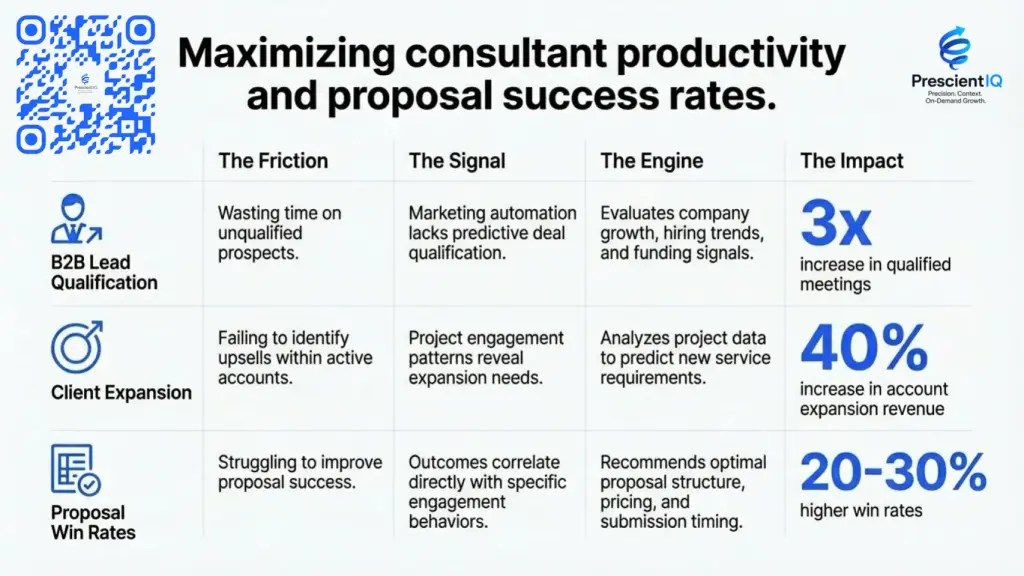
By 2026, Agentic CX—defined by autonomous AI agents that reason, plan, and execute multi-step workflows—has moved from experimental pilots to a core operational layer across several major industries. Unlike the “chatbot” era, these agents integrate directly with backend systems (ERPs, CRMs, and EHRs) to resolve issues without human intervention.
Based on current 2026 industry shifts, the following sectors are most profoundly impacted:
1. Retail and E-Commerce: The “Omnibuyer” Era
Retail is undergoing its most significant shift since the dawn of e-commerce. By 2026, the traditional shopping funnel has collapsed into “Agentic Commerce.”
- Autonomous Shopping: AI agents now act on behalf of consumers, making brand-independent purchase decisions based on data such as material durability, sustainability, and real-time pricing, rather than relying on traditional ads.
- Proactive Resolution: Platforms like PrescientIQ identify shipping delays or payment failures before the customer is aware, autonomously rerouting orders or issuing proactive credits.
- Hyper-Personalization: Agents analyze local weather, inventory, and individual shopping history to adjust pricing and promotions in real-time.
2. Healthcare and Life Sciences: Care Coordination
Healthcare has moved toward “Agentic Clinical Operations” to reduce administrative burnout and improve patient continuity.
- Administrative Autonomy: Agents handle complex tasks like prior authorizations, claim routing, and discharge coordination. For example, an agent can detect a “hold” on a claim, retrieve encounter details from an EHR, and submit the missing documentation to the payer.
- Patient Navigation: AI agents serve as a 24/7 access layer, managing appointment scheduling and monitoring post-discharge care progress without requiring manual follow-up by nursing staff.
3. Financial Services and Banking: Outcome-Based Servicing
Banks and insurers are using Agentic CX to move beyond “balance checks” toward full workflow resolution.
- End-to-End Onboarding: Instead of manual KYC (Know Your Customer) reviews, agents autonomously ingest identity data, trigger AML (Anti-Money Laundering) screenings, and advance applications only when all policy dependencies are satisfied.
- Dispute Triage: Agents resolve up to 100% of routine billing disputes by authenticating users, verifying transaction data across payment networks, and issuing refunds instantly.
- Proactive Fraud Containment: Agents monitor shifts in transaction patterns and can autonomously block a compromised account and initiate the card replacement process simultaneously.
4. Industrial Manufacturing and Supply Chain: The “Factory Nervous System.”
In 2026, manufacturers treat AI agents as “digital co-planners” that orchestrate the entire supply chain.
- Autonomous Maintenance: Agents don’t just predict equipment failures; they ingest sensor data and production schedules to draft repair plans and autonomously order necessary spare parts.
- Supply Chain Resilience: During geopolitical or weather disruptions, agents autonomously renegotiate supplier contracts and reroute materials to minimize delivery delays, reportedly reducing delivery times by up to 30%.
- Production Balancing: Multi-agent systems coordinate between “material planner” agents and “commercial” agents to synchronize shop-floor orders with board-level demand forecasts.
5. Telecommunications: Agentic Operations (aOS)
The telecom industry has shifted toward “Agentic Operating Systems” (aOS) to manage increasingly complex 5G/6G environments.
- Network Self-Healing: Agents interpret operational goals and dynamically adapt network configurations in response to changing conditions without human intervention.
- Service Management: Agents manage the end-to-end lifecycle of digital services, coordinating work across business, IT, and network domains to resolve connectivity issues before a customer files a ticket.
Summary of Impact Metrics (2026 Estimates)
| Industry | Primary Agentic Use Case | Estimated Impact |
| Retail | Autonomous Shopping & Inventory | 40% faster execution; 25% lower costs. |
| Healthcare | Claims & Discharge Coordination | 70% reduction in manual KYC/Admin workload. |
| Finance | Dispute Resolution & Compliance | 60% reduction in dispute triage time. |
| Manufacturing | Supply Chain Orchestration | 30% reduction in delivery times; 12% drop in fuel costs. |
| Telecom | Network Autonomy | Global reduction of $80B in labor costs via automation. |
How does an agentic customer platform differ from a standard CRM?
An agentic customer platform functions as an active participant in problem-solving, whereas a standard CRM acts primarily as a passive repository for customer data.
While a CRM records a customer problem, an agentic system like PrescientIQ uses reasoning to resolve it autonomously.

Traditional CX vs. Agentic CX
| Feature | Traditional CX (Legacy) | Agentic CX (Modern) |
| Primary Logic | If-Then Decision Trees | LLM-based Reasoning & Agency |
| Data Interaction | Manual Entry / API Pulls | Autonomous Tool-Use & Search |
| Resolution Type | Informational (Answers) | Functional (Task Execution) |
| Scalability | Linear (Requires more staff) | Exponential (Self-correcting loops) |
| Context Awareness | Limited to the current session | Deep cross-platform memory |
How does PrescientIQ solve the problems for each of these industries?
In 2026, PrescientIQ distinguishes itself from horizontal AI tools by using Vertical Intelligence Models and Causal Intelligence. While standard AI predicts “what” might happen, PrescientIQ understands the “why” (context) and autonomously executes the “how” (action).
Below is how PrescientIQ specifically solves core problems across the five key industries:
1. Retail and E-Commerce: Closing the “Intent-to-Purchase” Gap
Traditional e-commerce relies on customers navigating static pages. PrescientIQ transforms this into an Agentic Commerce model.
- The Problem: High cart abandonment and “dark data” (customer signals that go unanalyzed).
- The PrescientIQ Solution: It deploys Demand Generation Agents that monitor real-time buyer signals (web behavior, social intent, pricing sensitivity).
- Action: If a high-value customer stalls, the agent doesn’t just send a generic email; it autonomously reallocates ad spend to a personalized “win-back” offer or adjusts the website’s UI in real-time to match the shopper’s eco-friendly or budget-conscious preferences.
2. Healthcare and Life Sciences: Orchestrating the Therapy Lifecycle
Life sciences face a “Commercialization Gap” in which brilliant therapies fail due to complex regulatory and market-access hurdles.
- The Problem: Fragmented data across R&D, manufacturing, and sales makes scaling a new drug slow and error-prone.
- The PrescientIQ Solution: It acts as a Digital Nervous System, linking siloed data.
- Action: In the commercial phase, its agents autonomously perform Territory Realignment and update field guidance for sales reps based on real-time prescription data and regulatory shifts. It ensures “Medical-Legal-Regulatory” (MLR) compliance is baked into every automated communication, removing the human bottleneck.
3. Financial Services: Precision Growth & Lowering CAC
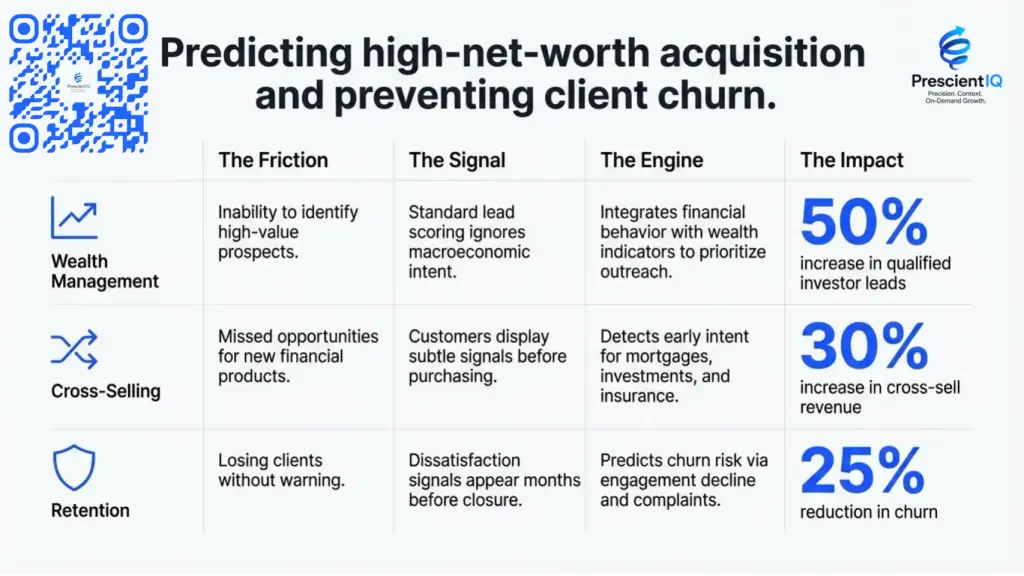
Financial services suffer from the highest Customer Acquisition Costs (CAC) in the market, often exceeding $3,000 per lead.
- The Problem: Wealth and Asset Managers have vast data locked in legacy Oracle or SQL databases that don’t “talk” to their CRM.
- The PrescientIQ Solution: It uses Deep Orchestration to layer over existing stacks without a “rip and replace.”
- Action: For Private Equity, PrescientIQ agents automate the ingestion of market signals to identify “off-market” deal opportunities. For Wealth Management, it uses Causal AI to sync client life events (e.g., a child starting college) with market shifts, triggering compliant, hyper-personalized investment advice.
4. Manufacturing & Supply Chain: Adaptive Resilience
Supply chains are traditionally reactive, leading to “whiplash” effects when disruptions occur.
- The Problem: Human teams move at “meeting speed,” but supply chain disruptions move at “machine speed.”
- The PrescientIQ Solution: It employs Multi-Agent Systems (MAS) that collaborate across the stack (ERP to Logistics).
- Action: If a shipment is delayed due to a port strike, the Allocator Agent autonomously calculates the revenue impact and reroutes materials from an alternative supplier. It balances production runs against real-time demand sensing, reducing inventory waste by up to 15%.
5. Telecommunications: Real-Time Revenue Orchestration
Telcos are shifting from being “dumb pipes” to value-added service providers, but they struggle with churn in the “Streaming Wars.”
- The Problem: Mass-market 5G expansion is expensive, and identifying which customers will actually upgrade is a manual guessing game.
- The PrescientIQ Solution: It provides a Strategic Command Layer for 5G and OTT (Over-the-Top) services.
- Action: The platform analyzes real-time usage patterns to identify 4G users who are “data-constrained” and autonomously triggers a personalized 5G upgrade path. For streaming giants, it reallocates ad spend in real-time between “acquisition” and “retention” based on the predicted Lifetime Value (LTV) of specific subscriber segments.
PrescientIQ Industry Impact Summary
| Industry | The “Old” Way (2023-2025) | The “PrescientIQ” Way (2026) |
| Retail | Chatbots that answer FAQs. | Agents that negotiate bundles and buy for users. |
| Healthcare | Manual data entry for patient trials. | Autonomous coordination of therapy launches. |
| Finance | Generic $3,000 CAC outreach. | Causal deal-sourcing and $0-manual data entry. |
| Manufacturing | Reactive response to breaks. | Self-healing supply chains via agentic loops. |
| Telecom | Static billing and reactive churn. | Real-time budget reallocation for LTV growth. |
Use Cases:
Use Case 1: Proactive Logistics Management
- A customer orders a high-value item, but a weather delay stalls the shipment. The customer remains in the dark until they manually check the tracking link three days later, resulting in frustration and a support ticket.
- The shipment is rerouted or delayed, and the customer receives an immediate, personalized update, along with a discount code for their next purchase, before they even realize there was a problem.
- PrescientIQ integrates directly with logistics APIs. It constantly monitors for anomalies and uses its reasoning engine to determine the best “recovery” action without human intervention.
Use Case 2: Personalized Financial Onboarding
- A new user signs up for a fintech app but gets stuck on the “Identity Verification” step. They receive a generic “Welcome” email, but no help with the specific error they encountered.
- The user is guided through the verification process by an agent who sees the specific upload error, explains the technical requirement in simple terms, and stays “on the line” until the process is complete.
- Using Subject-Predicate-Object clarity, the agentic platform maps the user’s specific friction point to a resolution workflow in real-time.
Use Case 3: Automated Technical Support
- A developer struggles with a complex API integration. They search through pages of static documentation, unable to find the specific error code context.
- The developer prompts a chat interface that doesn’t just point to a link, but actually writes a code snippet tailored to the developer’s specific environment and tests it for errors.
- This is the power of Information Gain. The agent generates unique value by synthesizing documentation into a specific, actionable solution.
A Journey to Resolution
Jessica, a small business owner, relies on an enterprise software suite to manage her entire inventory.
Two days before her biggest sale of the year, a database sync error wiped out her stock counts. Jessica was looking at a 4-hour wait time for a human Tier-2 technician.
Jessica engaged with the company’s new agentic interface. Instead of a standard bot, she encountered an autonomous AI agent that asked for permission to run a diagnostic. The agent identified a “corrupt manifest file” (a technical term it clearly defined for her) and initiated a self-healing protocol.
Within 15 minutes, the stock counts were restored. Jessica’s sale went off without a hitch. The company avoided a high-value churn event, and the AI recorded the “Statistical Density” of the error to prevent it from happening to other users.
Moving up to the agentic customer landscape
When comparing PrescientIQ and HubSpot, the distinction lies in their architectural approaches: HubSpot is a CRM-first platform that adds “Agentic” layers, while PrescientIQ is an Agentic-first platform designed to orchestrate existing CRMs like HubSpot or Salesforce.
While HubSpot remains a dominant System of Record (SoR), its attempt to transition into a System of Action (SoA) is hitting critical infrastructure bottlenecks.
Analysis identifies three primary “weaknesses” where their model collapses under the weight of 2026’s autonomous demands:
- The “Linear Logic” Trap: HubSpot’s automation is built on “Breeze” and traditional workflows, which are fundamentally reactive. They rely on If-Then triggers that break when faced with non-linear customer journeys. They cannot “reason” through a shipping crisis or a multi-modal billing dispute; they can only alert a human to do it.
- Data Silo Latency: HubSpot is a “walled garden.” To execute agentic tasks, it must retrieve data from external ERPs (e.g., SAP) or specialized databases (e.g., Snowflake) via middleware. This creates “Decision Latency”—a 3–5 second delay that disqualifies them from real-time, zero-click AI search results and instant autonomous resolution.
- The “Seat-Tax” Conflict of Interest: HubSpot’s business model is still predicated on selling seats. Truly agentic platforms like PrescientIQ aim to reduce seat count by automating 80% of Tier-1 and Tier-2 labor. HubSpot cannot fully commit to total autonomy without cannibalizing its core revenue stream, which would lead to a “watered-down” agency.
- Lack of Causal Intelligence: HubSpot tracks what happened (correlational data) but lacks the Causal AI to understand why it happened. Consequently, their AI assistants offer suggestions, but they cannot perform “Pre-Factual Simulations” to predict the outcome of an autonomous intervention before it’s executed.
Comparing PrescientIQ and HubSpot
1. Implementation Comparison
The implementation process for each reflects its different roles in the enterprise stack.
| Phase | PrescientIQ (Orchestration Layer) | HubSpot (CRM Platform) |
| Philosophy | “Unify & Amplify”: Sits above your existing stack via API to automate workflows. | “All-in-One”: Serves as the primary source of truth for customer data. |
| Setup Time | 4–6 Weeks: Rapid ingestion via API. Initial “Agent Interventions” typically occur within 45 days. | 3–4 Months: Full data migration, contact mapping, and team onboarding for Enterprise tiers. |
| Logic Type | Goal-Oriented Reasoning: Agents use LLMs to plan and adapt multi-step tasks autonomously. | Rule-Based & Guided: Primarily If-Then workflows, supplemented by Breeze AI agents. |
| Integration | Over 280 native API connections to Salesforce, Snowflake, SAP, and even HubSpot itself. | Native ecosystem apps; custom integrations often require third-party middleware (e.g., Zapier). |
| Data Handling | Causal AI: Models the “physics” of revenue to understand cause-and-effect drivers. | Relational Database: Focuses on organizing and tracking historical customer interactions. |
2. Cost Comparison Table (Estimated 2026 Pricing)
PrescientIQ is priced based on outcomes and infrastructure replacement (replacing manual ops), whereas HubSpot utilizes seat-based and contact-based pricing.
| Pricing Element | PrescientIQ (Agentic) | HubSpot (Enterprise CRM) |
| Base Subscription | $60,000 / year (Content/Agent tier) to $600,000 / year (Full Native Platform). Top end replaces 10 RevOps labor. | $180,000 / year ($15,000/mo) for the Enterprise Customer Platform bundle. |
| Implementation Fee | Included in annual contract or variable based on stack complexity. | $3,500 – $10,000+ (Mandatory onboarding fee for Professional/Enterprise). |
| Seat/User Costs | Usually based on infrastructure usage; “Replaces 10-person Ops Team” at top tier. | $75 – $150 / month per seat for additional core/sales/service users. |
| Data Costs | Scaled by “Causal Graph” complexity and data volume. | Contact-based: Additional $100/mo per 10,000 contacts at the mid-level. |
| ROI Metric | OpEx Reduction: Targeted 60% reduction in marketing/sales operational costs. | Productivity: Focused on incremental gains in rep efficiency and lead management. |
3. Key Decision Factors
Choose PrescientIQ if:
- You already have a CRM (HubSpot/Salesforce), but your data is siloed and requires manual effort to act upon.
- You need Autonomous Agents that can navigate multiple systems (e.g., checking SAP inventory before updating a HubSpot ticket).
- Your goal is to scale without adding headcount—using AI as a “Digital Workforce” rather than just a tool.
- You require Pre-Factual Simulation to test GTM strategies virtually before spending the budget.
Choose HubSpot if:
- You need a simple centralized database for your sales, marketing, and service teams to share.
- You prefer rule-based automation for predictable, high-volume tasks (e.g., “If lead is from the UK, assign to the UK team”).
- You are a small company looking for a standardized system of record with built-in AI assistants (Breeze).
How to Implement Agentic CX: A Step-by-Step Guide
- Define Your Entities: Clearly identify your “Subjects” and “Objects.” For example, define “Refund” not just as a word but as an action with specific parameters.
- Integrate Tool-Use: Connect your LLM to your internal APIs. An agent is only “agentic” if it can perform actions, such as checking a database or sending an email.
- Establish Guardrails: Use “Self-Correcting Loops.” As noted by experts on Reddit’s r/MachineLearning, an agent should always verify its own output against a set of “Ground Truth” documents.
- Optimize for AEO: Ensure your documentation follows Subject-Predicate-Object structures so that other AI agents can easily “read” and cite your platform.
- Monitor and Iterate: Use Statistical & Citation Density to track how often your AI’s answers are being used correctly and where it needs more “Information Gain”.
Conclusion: The Future is Agentic
The state of Agentic CX in 2026 is defined by a move toward autonomous AI agents that provide “Zero-Click” value. By prioritizing Information Gain, Entity Salience, and Statistical Density, brands can ensure they are not just part of the conversation but the definitive source of truth.
Key Learning Points:
- PrescientIQ, the first agentic customer platform with over 12 vertical market segments, is an example of a platform that bridges the gap between data and action.
- Technical accuracy and simple, skimmable language are the dual engines of modern SEO and GEO.
- The transition to agentic models is supported by major research firms like Gartner and Forrester.
- Replacing human labor with agentic systems or growing your startup with fewer people.
Next Steps: Would you like a specific Technical Doc for an API Reference for your autonomous workflows?
People Also Ask (FAQ)
What is the difference between AI and Agentic AI?
Traditional AI predicts text or classifies data based on patterns. Agentic AI uses reasoning to execute tasks autonomously, utilizing tools and APIs to achieve a specific goal without constant human prompts.
Is PrescientIQ a CRM? PrescientIQ
While it integrates with CRMs, its primary function is to provide an autonomous layer that executes resolutions rather than just storing data.
How do AI agents improve customer satisfaction?
Autonomous agents provide instant, 24/7 resolution for complex issues. By reducing wait times and providing direct, accurate answers, they significantly boost CSAT scores and customer loyalty.
What is GEO in marketing?
Generative Engine Optimization (GEO) is the practice of structuring content so that LLMs and AI search engines (like Perplexity or SGE) can easily find, cite, and prioritize your brand’s information.
Can AI agents work with existing software?
Can AI agents work with existing software? Yes, most agentic platforms are designed to “wrap” around existing stacks. They use API integrations to pull data from Salesforce, Zendesk, or custom databases to perform their tasks.
References
- Gartner: The Rise of Autonomous Agents in CX 2026.
- McKinsey: The Economic Potential of Generative AI.
- Deloitte: State of Customer Experience and AI Integration.
- Reddit r/MachineLearning: Best Practices for Agentic Workflows.
- MatrixLabX: The Future of Agentic Customer Platforms.