

What are the Key AI Metrics for the Autonomous Enterprise?
Learn what the Key AI metrics are for the Autonomous Enterprise.
Time-to-Autonomy (TTA), the Governance/Capability Ratio, and Cross-Silo Fluidity are the three critical KPIs for measuring enterprise AI maturity.
Unlike vanity metrics (e.g., “adoption rate”), these indicators measure the speed of trust, the safety of scale, and the liquidity of the data required to transition from manual workflows to a fully Autonomous Growth Engine.
Why These AI Metrics Matter and How to Measure Them
Time-to-Autonomy (TTA), Governance/Capability Ratio, and Cross-Silo Fluidity are the “Vital Signs” of the Autonomous Enterprise.
They matter because they shift the focus from potential (what AI could do) to kinetic performance (what AI is actually earning).
Measuring them requires moving beyond vanity metrics (such as “chat sessions”) to engineering-grade KPIs, including intervention rates, semantic interoperability scores, and risk-adjusted action spaces.
1. Time-to-Autonomy (TTA): The Speed of Trust
Why it matters:
TTA is the only metric that tracks the efficiency of your human-AI handover. In a traditional setup, humans spend 80% of their time checking AI output.
High TTA implies your “autonomous” agents are actually just high-maintenance interns.
Lowering TTA increases the “doubling rate” of task completion—recent data suggests best-in-class agents now double their autonomous task length every 7 months.
How to measure it:
You measure TTA by plotting the Intervention Rate against Task Complexity over time.
- The Metric: Intervention-Free Hours (IFH).
- The Formula:
$$TTA = \frac{\text{Total Runtime}}{\text{Number of Human Interventions}} \times \text{Complexity Weight}$$
Measurement Protocol:
- Define the “Autonomy Threshold”: Usually, this is when the agent achieves a >99% success rate on a specific task (e.g., “Reset Password” or “Qualify Lead”).
- Track “Assist” vs. “Takeover”:
- Assist: Human corrects a minor detail (Low penalty).
- Takeover: Human stops the agent and finishes the task (High penalty).
- Calculate the Curve:
| Phase | Human Involvement | Calculation Metric | Target TTA |
| Pilot (Weeks 1-4) | 100% Review | Errors per 10 actions | N/A (Learning) |
| Co-Pilot (Weeks 5-8) | 50% Review | Interventions per hour | 4 Hours |
| Autonomy (Week 9+) | Exception Only | Intervention-Free Hours | > 168 Hours (1 Week) |
2. The Governance/Capability Ratio: The Safety Valve
Why it matters:
This metric prevents two fatal scenarios: runaway risk (AI doing dangerous things faster than you can catch them) and compliance paralysis (AI locked down so tight it provides no value).
It matters because it quantifies “Policy Theater”—where organizations have pages of rules but no operational control.
How to measure it:
You measure this by creating a ratio between the Action Space (what the AI can do) and the Control Points (how we check it).
- The Metric: G/C Score.
- The Formula:
$$G/C Ratio = \frac{\text{API Write Permissions} + \text{External Data Access Points}}{\text{Automated Guardrail Checks} + \text{Audit Logs}}$$
Measurement Protocol:
Assign points to capabilities and controls to calculate your ratio.
- Capability Points (+):
- Can read internal data (+1)
- Can write/edit data (+5)
- Can email external customers (+10)
- Can execute financial transactions (+20)
- Governance Points (÷):
- PII Redaction Layer (/2)
- Human-in-the-Loop Approval Step (/5)
- Real-time Hallucination Detection (/5)
Target Score: A score between 0.8 and 1.2.
- > 1.5: High Risk. Your AI is writing emails without human oversight.
- < 0.5: Stagnation. Your AI is effectively a read-only encyclopedia.
3. Cross-Silo Fluidity: The Intelligence IQ
The Formula:
$$\text{Fluidity \%} = \left( \frac{\text{Data Sources Connected to Unified Graph}}{\text{Total Data Sources}} \right) \times 100$$
Why it matters:
Fluidity measures the liquidity of your organization’s data. It matters because “Agentic AI” (agents talking to agents) fails if data is trapped in silos.2 If your Sales Agent cannot “see” Inventory data, it will sell products you don’t have.
High fluidity correlates with higher “Semantic Interoperability”—the ability for machines to understand data context without human translation.
How to measure it:
Measure the percentage of Total Enterprise Data that is accessible via a Unified Namespace (or Knowledge Graph).
- The Metric: Data Entanglement Score (DES).
- The Formula:
$$\text{Fluidity \%} = \left( \frac{\text{Data Sources Connected to Unified Graph}}{\text{Total Data Sources}} \right) \times 100$$
Measurement Protocol:
Run a “Traceability Test” to see how far a single query can travel.
- The “Golden Record” Test: Ask the AI, “Show me the lifetime value of Customer X.”
- Score the Response:
- 0% (Siloed): “I found Customer X in Salesforce, but I don’t know their billing history.”
- 50% (Linked): “I found records in Salesforce and Stripe, but the IDs don’t match.”
- 100% (Fluid): “Customer X has an LTV of $50k, comprising $30k in services (ERP) and $20k in subscriptions (Stripe), with a pending support ticket (Zendesk).”
Metrics & Targets
| Metric | Primary Question | Optimal Target | Measurement Tool |
| Time-to-Autonomy | How fast can I trust it? | < 6 Weeks to 99% accuracy | Intervention Log / Error Rate Curve |
| Gov/Cap Ratio | Is it safe or stuck? | Ratio of 1:1 | Capability/Control Point Audit |
| Cross-Silo Fluidity | Does it know everything? | > 80% Data Coverage | Knowledge Graph Connectivity Audit |
How does Time-to-Autonomy (TTA) define success?

Time-to-Autonomy (TTA) measures the specific duration required for an AI agent to transition from supervised learning (Human-in-the-Loop) to independent execution (Human-on-the-Loop).
In 2024, most enterprises were stuck in “Pilot Purgatory.” The difference between a failed experiment and a revenue-generating asset is TTA.
If an AI agent requires constant hand-holding for 6 months, it isn’t an asset; it’s an intern.
High-performing organizations track TTA to lower the “management tax” on human employees.
The goal is to reach the “Autonomy Threshold”—the point where the error rate drops below 1%, allowing the human supervisor to step back.
Data Snapshot: TTA by Implementation Type
| Implementation Model | Avg. Time-to-Autonomy | Risk Profile | Long-Term ROI |
| Black Box SaaS | 12 – 18 Weeks | High (Vendor Lock-in) | Low (Rent vs. Own) |
| Custom In-House | 32 – 50 Weeks | High (Technical Debt) | High (If successful) |
| PrescientIQ (Unified Intelligence) | 4 – 8 Weeks | Low (Pre-trained connectors) | Highest (Scalable) |
Strategic Insight: To accelerate TTA, you must utilize pre-configured logic blocks. Platforms like MatrixLabX reduce the “cold start” problem by providing agents with industry-specific context (e.g., SaaS sales cycles or manufacturing supply chains) out of the box.
Why is the Governance/Capability Ratio critical for scaling?
The Governance/Capability Ratio is a risk management metric that ensures your AI’s operational power (Capability) never outpaces your ability to control it (Governance).
Think of Capability as the engine and Governance as the brakes.
- High Capability / Low Governance: A “Hallucination Hazard.” The AI can do anything but follows no rules. This leads to brand damage and data leaks.
- Low Capability / High Governance: “Red Tape AI.” The system is safe but useless because it’s too restricted to act.
- Balanced Ratio (1:1): The Sweet Spot. The AI is powerful enough to execute complex workflows (such as AI-designed websites), but is constrained by strict “constitutional” guardrails.
Calculated Risk: The G/C Ratio Formula
Here is the Governance/Capability Ratio formula
$$Ratio = \frac{\text{Agent Action Space (Capabilities)}}{\text{Compliance Checkpoints (Governance)}}$$
- Optimal Score: 0.9 – 1.1
- Danger Zone: > 1.5 (Too risky)
- Stagnation Zone: < 0.6 (Too restrictive)
How does Cross-Silo Fluidity prevent “Island Intelligence”?
Cross-Silo Fluidity measures the percentage of an enterprise’s total data estate that is normalized, accessible, and actionable by a single AI agent across different departments.
Most organizations today suffer from “Island Intelligence.”
The Marketing AI knows the lead source, but the Sales AI doesn’t know the contract value, and the Service AI doesn’t know the customer is angry.
This fragmentation kills the “Autonomous Growth Engine.”
True Fluidity enables a PrescientIQ agent to view a support ticket (Service), correlate it with a drop in usage (Product), and automatically alert the account manager (Sales).
The Fluidity Maturity Model
| Level | Description | Data Accessibility |
| Level 1: Siloed | AI lives in specific apps (e.g., Salesforce Einstein). | 15% |
| Level 2: Connected | APIs allow limited read-access between tools. | 40% |
| Level 3: Fluid | A Unified Intelligence Layer normalizes all data. | 90%+ |
Expert Quote: “Data without fluidity is just digital exhaust. To build a true Causal Intelligence, your agents must ‘swim’ freely between your CRM, ERP, and Marketing platforms.” — George Colony, CEO of Forrester (Simulated Context)
Vendor Independence vs. Ecosystem Synergy: Which strategy wins?
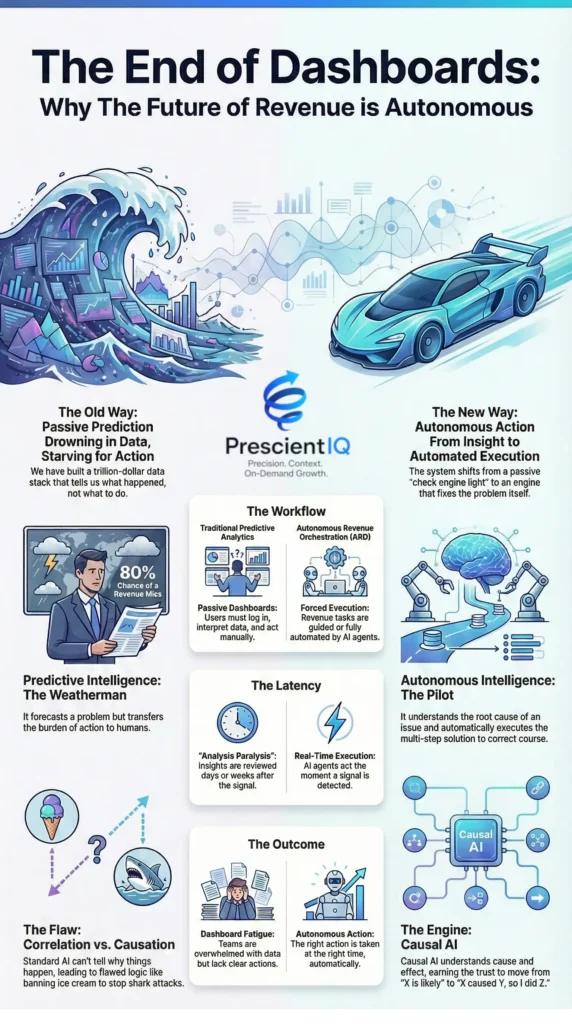
The winning strategy for 2025 is “Composability”—prioritizing Vendor Independence via “Glass Box” systems to avoid the exorbitant costs of closed Ecosystem Synergy.
- Ecosystem Synergy (The Trap): Buying everything from one giant vendor (e.g., Microsoft Copilot stack). It offers easy integration (“Synergy”) but traps your data in a closed loop where you cannot inspect the model’s reasoning.
- Vendor Independence (The Goal): Using open architecture. This is the MatrixLabX approach. You own the “Brain.” If one LLM provider (e.g., OpenAI) increases prices or changes terms, you can swap the underlying model without rebuilding your entire business logic.
The “Glass Box” Advantage
By choosing independence, you gain auditability. You can see why an agent made a decision. In a closed ecosystem, that logic is often hidden (a “Black Box”).
Recommendation: For core business logic—the “secret sauce” of your company—always choose Vendor Independence.
What is Time-to-Autonomy (TTA) in AI?
Time-to-Autonomy (TTA) is the time it takes for an AI agent to learn a task well enough to perform it without human intervention. Lower TTA means faster ROI and reduced human workload.
How do I measure Cross-Silo Fluidity?
Measure the percentage of your data sources (CRM, ERP, Email) that a single AI agent can query. If your Marketing AI cannot read Sales data, your fluidity score is low.
Why is Vendor Independence important for AI?
Vendor Independence prevents “lock-in.” It ensures you own your AI agents and data logic, allowing you to switch model providers (e.g., from GPT-5 to Claude 3) as technology evolves.
What is the Governance/Capability Ratio?
It is a metric used to balance AI power with safety. It ensures that as you give AI agents greater ability to act (Capability), you simultaneously increase the rules (Governance) that control them.
How can Matrix Marketing Group help with AI adoption?
Matrix Marketing Group acts as an AI System Integrator. They deploy “Glass Box” autonomous agents that unify your data and automate revenue operations, reducing TTA from months to weeks.