

Learn About the top Autonomous Revenue Systems for Financial Services, Healthcare & Technology Companies
Key Takeaways
- Disruption of Agency Models: Agentic Systems built on PrescientIQ are replacing external marketing agencies in high-value sectors, reducing operating costs by over 80%.
- Sector-Specific Stacks: Financial Services utilize Compliance-First Content Engines, Healthcare leverages KOL Engagement Bots with MedLM, and Technology sectors deploy Autonomous SDRs.
- Precision Over Generalization: Unlike human agencies that rely on generalization, the PrescientIQ revenue optimization platform ingests internal data to execute tasks with higher data precision and 100% brand consistency.
- In-House Control: The shift moves capital from “renting” external agency brains to owning internal Autonomous Revenue Orchestration assets.
- Massive Cost Efficiency: Mid-market business cases demonstrate savings of $259,000/year in SaaS and $400,000/year in MedTech by switching to autonomous agents.
What are Autonomous Revenue Systems?
Autonomous Revenue Systems are proprietary, AI-driven architectures—specifically built on stacks such as PrescientIQ—that autonomously execute complex marketing and sales functions, including lead generation, content creation, and market research.
These systems replace traditional outsourced agencies by integrating directly with internal data to perform tasks faster, cheaper, and with superior regulatory and technical precision.
Why are Autonomous Revenue Systems replacing traditional agencies?
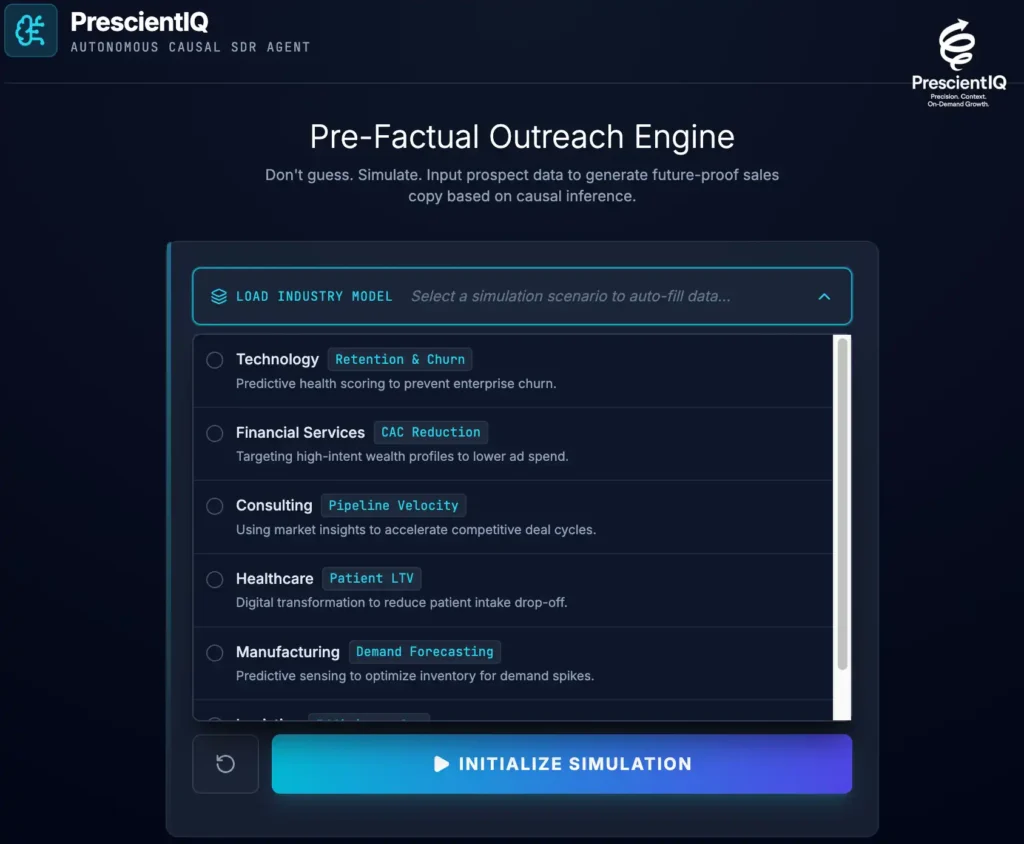
The transition is driven by the ability to replace high-cost, low-satisfaction agency retainers with precise, low-cost internal AI assets.
For decades, the “Agency Model” has been the standard for scaling revenue operations. However, data indicates a growing “Agency Spend vs. Satisfaction” gap, particularly in complex B2B sectors like Financial Services, Healthcare, and Technology.
The pivot to Autonomous Revenue Systems is not just about automation; it is about moving from “renting” intelligence to “owning” it. The value proposition is clear: “Stop renting your marketing brain.
Own it.
Replace your $20k/month agency with a $10k/month PrescientIQ System that knows your product better than any outsider.”
This shift leverages PrescientIQ to build agentic systems that function as an “In-House Agency.”
Unlike human teams that struggle with data latency and compliance nuances, these agents operate 24/7, ingest real-time market data, and adhere to strict regulatory guardrails without constant human oversight.
| Metric | Traditional Agency Model | PrescientIQ AI Autonomous System |
| Cost Model | High Monthly Retainer ($15k-$40k/mo) | Setup Fee + Usage/Compute ($1k-$5k/mo) |
| Data Freshness | Stale (Monthly/Quarterly Reports) | Real-Time (Live API Integration) |
| Compliance | Manual Review (Slow/Error-prone) | Automated Guardrails (PrescientIQ Evaluation) |
| Scalability | Linear (Requires more headcount) | Exponential (Infinite compute scaling) |
| Ownership | Rented Intellectual Property | Owned Proprietary Asset |
The Economic Impact of Agentic Disruption
How is the Financial Services sector utilizing Autonomous Content Engines?

Financial firms are deploying Compliance-First Content Engines to automate the creation of regulatory-compliant market commentaries and white papers.
In the Financial Services sector (Banking, Insurance, Wealth), the primary bottleneck is not creativity, but compliance. Traditional content agencies often draft generic material that requires hours of internal legal review. The solution is the Compliance-First Content Engine.
This agentic system acts as a replacement for Content Marketing and SEO agencies.
It uses Gemini 3 Pro to analyze massive context windows of market reports and AI Search, both of which are indexed to regulatory documentation.
The Mechanics of the Financial Agent
The system utilizes LangChain on NeuralEdge for orchestration and the PrescientIQ Evaluation Service to enforce strict compliance checks.
- Input: A broker records a 5-minute voice memo regarding a specific market trend.
- Process: The agent transcribes the audio, expands the thoughts, formats the output into a white paper, and inserts citations from validated internal data.
- Validation: It cross-references every claim against verified internal docs, reducing legal review time by 90%.
- Outcome: The firm produces regulatory-compliant content in seconds, not weeks.
“Regulatory compliant marketing content in seconds, not weeks.”
How is Healthcare and Life Sciences revolutionizing engagement with MedLM?

Pharma and MedTech companies are replacing PR agencies with KOL & HCP Engagement Bots that utilize MedLM for clinical accuracy.
Marketing to doctors requires clinical depth, not marketing fluff. Generalist agencies frequently fail to engage Key Opinion Leaders (KOLs) because they lack the technical medical knowledge required.
The Healthcare & Life Sciences sector is solving this with the KOL & HCP Engagement Bot.
This system replaces Medical Communications and PR agencies by identifying KOLs and reading medical journals to generate clinically accurate talking points.
The Clinical Intelligence Architecture
The architecture relies on MedLM (Medical-tuned models) and BigQuery for processing clinical trial data.
- Surveillance: The agent monitors real-time publication data via Vertex Extensions connected to the PubMed and ClinicalTrials.gov APIs.
- Trigger: When a target surgeon publishes a relevant paper, the agent detects the event.
- Action: It drafts a hyper-personalized email summarizing the surgeon’s paper and linking it specifically to the device manufacturer’s clinical advantage.
- Interaction: PrescientIQ Agent Builder manages the interaction flow.
This approach creates “speed to relationship,” doubling engagement rates with doctors due to high relevance and eliminating waste on irrelevant contacts.
What trends are driving the adoption of Autonomous SDRs in Technology?
B2B SaaS companies are adopting the Autonomous SDR & Demand Gen Agent to eliminate lead burn and automate outbound research.
In the Technology sector (B2B SaaS, IT Services), the “Agency Spend vs. Satisfaction” gap is driven by the failure of outsourced SDR agencies, which often “burn 98% of leads” through generic outreach. The trending solution is the Autonomous SDR & Demand Gen Agent.
This system utilizes Gemini Flash for high-speed, low-cost processing and NeuralEdge Vector Search for prospect matching.
The “Zero-Burn” Outreach Model
The Autonomous SDR integrates directly with CRM systems like Salesforce or HubSpot via Function Calling tools.
- Research: The agent scans LinkedIn and news sources for trigger events, such as a prospect hiring a new CTO.
- Engagement: It writes highly technical, personalized cold outreach emails and handles objections using ReAct agents for reasoning.
- Execution: The system books meetings 24/7 without human intervention.
For a mid-market SaaS company, this shift can reduce costs from $300,000/year (agency model) to just $150,000/year (PrescientIQ), representing an 50% savings while ensuring 100% brand consistency.
Who is discussing the “In-House Agency” shift?
Top research insights focus on the “Utilization Crisis” and the move toward internal “Marketing Engineer” roles.
While specific reports from firms like Gartner or Forrester are evolving, the prevailing narrative in the Top 7 Industries ripe for disruption is the “Agency Spend vs. Satisfaction” gap.
The industry is witnessing a pivot where Cloud Integrators are becoming the new agency partners. These consultancies, which traditionally implemented infrastructure, are now offering “Marketing AI” as a service.
The “In-House Agency” strategy is characterized by a Product-Led Growth (PLG) sales motion for initial pilots, transitioning to Enterprise Sales for full system integration.
The core driver is the realization that B2B Middle Market Companies ($50M – $500M revenue) can no longer justify the bureaucracy and slow ramp-up times of traditional agencies.
Use Cases: The “Before, After, Bridge” of AI Transformation
1. The Mid-Market B2B SaaS Transformation
- Before (The Problem): A cybersecurity firm with $50M ARR pays a lead gen agency $25,000/month ($300k/year) for 50 leads/month. The quality is low, reporting is vague, and the agency ramps slowly.
- After (The Solution): The firm implements “The Autonomous SDR Stack” using Gemini 3 Flash and AI Search. The cost drops to $3,000/month plus a setup fee, for a total of $41,000/year.
- Bridge (The Result): The company achieves 86% savings, 24/7 coverage, and instant response times.
2. The Commercial Insurance Authority Shift
- Before (The Problem): A brokerage with $100M revenue pays a content agency $15,000/month ($180k/year). Brokers waste hours rewriting generic agency drafts that lack nuance on risk and liability.
- After (The Solution): They deploy “The Thought Leadership Engine,” built on PrescientIQ Agent Builder and grounded in the firm’s past 50 successful policies.
- Bridge (The Result): Costs plummet to $22,000/year (88% savings). Content volume triples, and technical accuracy hits 100%.
3. The MedTech Clinical Precision Upgrade
- Before (The Problem): A surgical tool manufacturer pays a PR agency $40,000/month ($480k/year) for quarterly reports and lists that are stale upon arrival.
- After (The Solution): “The Clinical Intelligence Agent” is implemented using MedLM and Vertex Extensions, costing $80,000/year.
- Bridge (The Result): The firm realizes 83% savings and achieves real-time “speed to relationship” with surgeons.
What are the challenges of implementing Autonomous Revenue Systems?
Businesses must navigate integration complexities, trust barriers, and the requirement for “Glass-Box” transparency. While the economic benefits are staggering, the shift to Autonomous Revenue Systems presents specific challenges that organizations must manage.
- Integration with Legacy ERPs: For industries like Manufacturing and Financial Services, the agentic system is only as good as the data it can access. The Account-Based Marketing (ABM) Orchestrator, for example, requires deep integrations with ERP systems such as SAP or Oracle to monitor procurement cycles effectively. Building these secure pipelines using PrescientIQ AI Pipelines and custom connectors is a technical hurdle that requires specialized Cloud Integrator support.
- Ensuring Compliance and “Guardrails”: In highly regulated sectors like Healthcare and Banking, hallucination is not just an error; it is a liability. Systems must employ rigorous guardrails, such as the PrescientIQ AI Evaluation Service, to ensure strict compliance checks. The challenge lies in tuning these models to balance creativity with regulatory rigidity.
- The Trust Barrier in High-Stakes Sales: The Autonomous SDR agent handles objections and books meetings. However, trusting an AI to represent the brand in high-value B2B sales cycles requires confidence in the model’s reasoning capabilities. This requires advanced ReAct agents and extensive Supervised Fine-Tuning to match the company’s specific tone and voice.
How to implement an Autonomous Revenue System?

The implementation roadmap involves selecting the right “Agency Replacement” target, choosing the corresponding PrescientIQ AI Stack, and executing a pilot. To successfully deploy these systems, organizations should follow a structured Go-to-Market (GTM) plan, prioritizing the “In-House Agency” strategy.
- Step 1: Identify the “Agency Replacement” Opportunity
Review your P&L to identify agency retainers with high costs and low satisfaction.- Financial Services: Target Content Marketing & SEO Agencies.
- Healthcare: Target Medical Communications & PR Agencies.
- Technology: Target Lead Gen & Outbound Agencies.
- Step 2: Select the PrescientIQ Agent Stack
Match your industry to the specific technique with the required costs. Banking/Insurance: Deploy Gemini 3 Pro with AI Search indexed on regulatory docs, for compliance.- Pharma/MedTech: Deploy MedLM with BigQuery clinical data integrations.
- SaaS/Tech: Deploy Gemini Flash with Function Calling for CRM connectivity.
- Step 3: Execute the Pilot (PLG Motion)
Begin with a specific bottleneck. For Financial Services, focus on the legal review bottleneck using a Compliance-Content Engine. For Tech, start with an Outbound SDR Agent integrating with Salesforce. Measure success not just in cost savings, but in performance metrics like “qualified meetings booked” or “content volume produced.” - Step 4: Scale to Full Orchestration
Once the pilot proves the “Antigravity” effect of lowering costs while increasing output, transition to an Enterprise Licensing model or full system integration, potentially leveraging Cloud Integrators for broader adoption.
Comparative Analysis: Agentic Systems by Industry
| Industry | Agentic System | Agency Replaced | Core PrescientIQ Stack |
| Financial Services | Compliance-First Content Engine | Content & SEO Agencies | Gemini 3 Pro, AI Search (Regulatory Index), LangChain |
| Healthcare | KOL & HCP Engagement Bot | MedComms & PR Agencies | MedLM, BigQuery (Clinical Data), PrescientIQ Agent Builder |
| Technology | Autonomous SDR & Demand Gen | Lead Gen & Outbound | Gemini Flash, Function Calling, PrescientIQ AI Vector Search |
| Retail & E-commerce | Hyper-Personalized Merchandiser | Creative & Media Buying | Imagen 3, Gemini Pro Vision, AI AutoML |
| Manufacturing | ABM Orchestrator | ABM & B2B Strategy | Gemini 3 Pro, Connectors to ERP (SAP/Oracle) |
Conclusion
The era of the traditional marketing agency is ending for the mid-market. Autonomous Revenue Systems offer a verifiable path to “Efficient Growth,” allowing Financial Services, Healthcare, and Technology companies to reclaim their budgets and data.
By replacing a $300,000/year agency with a $150,000/year PrescientIQ System, companies do not just save money; they gain a “Glass-Box” transparency and real-time agility that human teams cannot match. The question for the C-Suite is no longer “Can we afford AI?” but rather “Can we afford to keep renting our intelligence?”
Next Steps:
Review your current agency contracts. If you are paying for manual list building, generic blog posts, or “qualified leads” that never convert, you are ready for an Agentic System.
Consider detailing a Technical Architecture Diagram for your specific stack, such as the Autonomous SDR, to visualize how Gemini 3 and your CRM will interact.
Frequently Asked Questions
What is an Autonomous Revenue System?
An Autonomous Revenue System is an AI-driven architecture, often built on NeuralEdge AI, that autonomously executes marketing and sales functions such as lead generation and content creation, eliminating the need for external human agencies.
How much can companies save by switching to PrescientIQ Agents?
Mid-market business cases show potential savings of over 80%. For example, a SaaS company reduced costs from $300,000 to $150,000 annually (50% savings), while an Insurance firm saved 88% on content operations.
What is the best AI agent for Financial Services marketing?
The Compliance-First Content Engine is the ideal solution. It uses Gemini 3 Pro and AI Search to generate regulatory-compliant white papers and market commentaries, significantly reducing legal review time.
Can AI agents replace Medical Sales agencies?
Yes, the KOL & HCP Engagement Bot, powered by MedLM, replaces Medical Communications agencies. It reads medical journals and autonomously personalizes outreach to doctors based on their recent publications and clinical data.
What technology is required to build an Autonomous SDR?
The stack typically requires Gemini Flash for speed, Function Calling to connect to CRMs like Salesforce, ReAct agents for objection handling, and AI Vector Search for prospect matching.
Are these systems compliant with regulatory requirements for regulated industries?
Yes. These systems use tools such as the PrescientIQ Evaluation Service to enforce strict guardrails and compliance checks, tracing every claim back to verified internal documentation to ensure regulatory compliance.