

Why Salesforce & HubSpot’s AI Won’t Solve Your Revenue Gap
Learn Why Salesforce & HubSpot’s AI Won’t Solve Your Revenue Gap.
Based on the current 2024–2025 market landscape, the “Revenue Gap” in midmarket businesses is driven by a phenomenon economists call the “Productivity J-Curve.”
While Enterprise giants are seeing revenue lifts from custom AI and agile startups are built on AI natively, the Midmarket ($50M–$1B revenue) is currently stuck in the “dip”—spending money on AI without yet seeing the returns.
Here is the breakdown of what is causing this gap and why it represents the perfect storm for PrescientIQ.
1. The “Productivity J-Curve” Trap

Historically, when a new General Purpose Technology (like AI) is introduced, productivity (and revenue) initially drops before it skyrockets.
- The Cause: Companies pause “real work” to figure out the new tools. They spend capital on software, training, and data cleaning, distracting them from sales execution.
- The Midmarket Problem: Enterprises have enough cash to weather this “dip” for 2–3 years. Midmarket companies do not. They are currently in the “Investment Valley”—paying for complex-to-implement AI tools that are temporarily dragging on revenue rather than lifting it.
2. The “Implementation Gap” (Build vs. Buy)
Midmarket companies are in a “Goldilocks” crisis:
- Too Complex for “Off-the-Shelf”: Generic tools (such as ChatGPT or HubSpot) aren’t powerful enough to handle their complex legacy data or specific workflows.
- Too Poor for “Custom Build”: They cannot afford to hire a team of AI Engineers ($300k/year each) to build a custom “Salesforce Tower” like the Fortune 500 can.
- The Result: They buy “Co-pilots” that their staff ignores because they require too much manual prompting. 70% of AI pilots in the midmarket fail to reach production due to integration friction.
3. The “Data Debt” Anchor
Startups have clean, modern data stacks. Enterprises have armies of Data Engineers to clean their mess.
- The Midmarket Reality: Midmarket companies often sit on 15+ years of “Data Debt”—messy CRMs, duplicate records, and siloed ERPs.
- The Consequence: Modern AI models hallucinate when fed messy data. Because midmarket firms lack the “Data Ops” teams to clean this fuel, their AI engines sputter, leading to failed campaigns and lost revenue opportunities.
4. The Talent/Capacity Shortage
The AI revolution requires a new kind of worker: one who knows how to orchestrate AI.
- The Midmarket is currently losing the war for talent. They cannot compete with Big Tech salaries for AI-savvy employees.
- Existing employees are fearful or untrained, leading to “Shadow AI” usage (employees secretly using ChatGPT), which poses security risks rather than driving strategic revenue.
The PrescientIQ Opportunity
This “Revenue Gap” is the exact problem Autonomous Agents solve.
- The Solution: Midmarket companies cannot afford to build the machine, and they don’t have the people to drive the Co-pilot.
- Your Pitch: “PrescientIQ bridges the Midmarket Revenue Gap. We don’t ask you to build AI, and we don’t ask your team to learn prompt engineering. We provide Autonomous Agents that arrive ‘pre-trained’ and do the work for you. We skip the ‘J-Curve’ dip and go straight to the revenue lift.”
Executive Summary for the C-Suite:
- The Conflict: Salesforce (Agentforce) and HubSpot (Breeze) now offer “free” or built-in AI agents. CFOs are asking why they should approve a budget for specialized AI platforms like PrescientIQ.
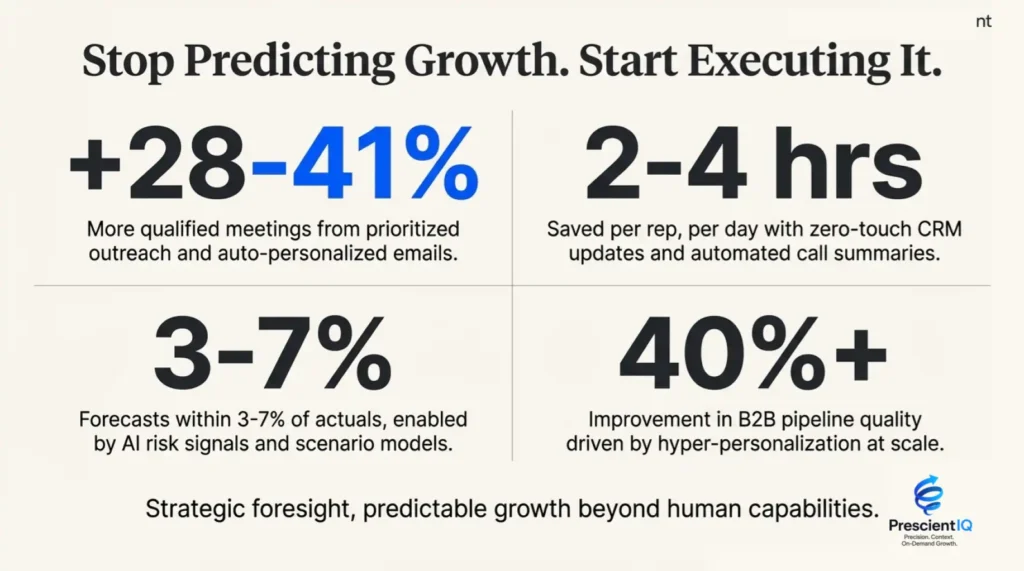
- The Reality: CRM agents are Task Doers—they automate workflows within a silo. PrescientIQ is a Revenue Strategist—it uses predictive modeling (“Pre-factual Simulation”) to determine which workflows should run to maximize revenue.
- The ROI: You pay for PrescientIQ to avoid the cost of executing the wrong strategy at scale. While Agentforce helps you dig a hole faster, PrescientIQ tells you where the gold is buried.
I. Introduction: The Dangerous Allure of “Good Enough”
The most dangerous sentence in a boardroom right now is, “Why are we buying another AI tool when Salesforce has one for free?”
It is a sensible question. On the surface, the value proposition of Salesforce’s Agentforce and HubSpot’s Breeze seems unbeatable: AI agents built directly into the CRM you already pay for, ready to automate emails, summarize records, and “do the work.”
For a CEO looking to cut bloat, the “free” option is seductive. But for a CRO looking to hit a Q3 revenue target, this “free” labor is a trap.
There is a fundamental misunderstanding of what these tools actually do. Breeze and Agentforce are excellent Task Doers. They are tireless interns who will happily execute bad instructions at lightning speed. If you tell them to email 5,000 unqualified leads, they will do it flawlessly, damaging your domain reputation in record time.
PrescientIQ is different. It is not an intern; it is a Revenue Strategist. It is the difference between an autopilot that keeps the plane level and a flight simulator that predicts the storm 500 miles ahead—and tells you exactly how to navigate around it.
This article outlines the business case for why “free” agents are expensive in the long run, and why a “Flight Simulator” for revenue is the only investment that actually protects your bottom line.
II. The “Free” AI Reality Check: Dismantling the Pricing Myth
Before discussing strategy, we must address the financial elephant in the room. Neither Agentforce nor Breeze is truly “free” for the enterprise utility required to move the needle on revenue.
1. Salesforce Agentforce: The “Freemium” Enterprise Trap
Salesforce has mastered the art of complex pricing. While basic agent capabilities may be bundled into the high-tier “Einstein 1” editions, functional execution often relies on a consumption model.
- The Cost of Conversation: Enterprises often pay via “Flex Credits,” costing roughly $2 per conversation. If you deploy an agent to nurture 10,000 leads autonomously, that is not a free experiment; it is a $20,000 line item.
- The Implementation Tax: Agentforce is not plug-and-play. It requires defining “Topics,” setting guardrails, and mapping intents. This usually necessitates weeks of expensive consultancy or high-level RevOps hours.
- Data Cloud Dependency: To make Agentforce truly smart, it needs data. Salesforce will aggressively push you toward Data Cloud to unify that data, adding another significant recurring revenue tier to your contract.
2. HubSpot Breeze: The “Gated” Garden
HubSpot’s model is more accessible but equally tiered.
- The Ceiling: The “free” credits included in lower tiers are sufficient for testing, but not for scaling.
- The Lock-In: Breeze’s Prospecting and Customer Agents are powerful, but they only work if all your data is inside HubSpot. If your intent data lives in 6sense and your usage data lives in Snowflake, Breeze is partially blind. You pay for Breeze not with money, but with vendor lock-in, forcing you to migrate every aspect of your GTM stack into HubSpot to get the value.
3. The Hidden Cost: The Efficiency of Failure
The true cost, however, isn’t the software licensing. It is the cost of being wrong, faster.
AI Agents act as force multipliers.
- If your current sales messaging converts at 1%, and you use human SDRs, you burn 100 leads to get 1 meeting.
- If you use Agentforce to automate that same bad messaging 100x faster, you haven’t solved the revenue problem. You have simply burned through your entire Total Addressable Market (TAM) in a week.
You do not pay PrescientIQ to do the work cheaply. You pay PrescientIQ to ensure the work is right.
III. The Landscape: Three Distinct Classes of AI
To understand where PrescientIQ fits in the budget, we must separate the AI landscape into three distinct classes. We are moving from the age of the “Co-Pilot” (Assistants) to the age of the “Strategist” (Orchestrators).
| Feature | HubSpot Breeze | Salesforce Agentforce | PrescientIQ |
| Archetype | The Efficient Assistant | The Enterprise Automator | The Revenue Strategist |
| Primary Goal | Save Time (Efficiency) | Automate Workflows (Scale) | Save Revenue (Effectiveness) |
| Intelligence Type | Reactive: “Write an email to John because I clicked a button.” | Trigger-Based: “If lead score > 50, trigger the nurture sequence.” | Predictive: “Do not email John; call Sarah instead. The probability of winning is 3x higher.” |
| Scope | Marketing & Sales Ops | Cross-Cloud Workflows | Total GTM (Paid, Organic, Sales) |
| Data Source | Walled Garden (HubSpot Ecosystem) | Walled Garden (Salesforce Data Cloud) | MACH Architecture (Agnostic & Open) |
| The User | The Manager / Rep | The IT / Ops Team | The CRO / VP of Sales |
The Takeaway: Breeze and Agentforce compete with each other. PrescientIQ sits above them both.
IV. The Killer Feature: The “Flight Simulator” for GTM
If you are explaining this to a CFO, use this analogy.
Imagine a pilot flying a commercial airliner.
- Agentforce is the Autopilot. It keeps the plane steady, adjusts the flaps, and follows the flight plan entered by the pilot. It is reactive. If the flight plan flies directly into a hurricane, the Autopilot will fly the plane smoothly and efficiently through it.
- PrescientIQ is the Flight Simulator. Before the plane even takes off, it runs 10,000 scenarios. It looks at weather patterns (market intent), fuel levels (budget), and historical crash data (closed-lost reasons). It tells the pilot: “If you fly this route, you have a 40% chance of failure. If you adjust 10 degrees North, your success rate jumps to 92%.”
The Power of Pre-Factual Simulation

The core differentiator of PrescientIQ is Pre-Factual Simulation.
Most CRM agents execute live. You input a prompt, and they generate an output.
PrescientIQ ingests data from your CRM, your ad platforms, your intent providers, and the open web to simulate the outcome of a strategy before you spend a dollar.
Example:
- Agentforce: You create a flow to email every CEO in your database. Agentforce executes it.
- PrescientIQ: You propose the campaign. PrescientIQ runs the simulation and reports:
“Simulations based on Q2 historical data show that emailing CEOs at this stage results in a 0.5% reply rate and high unsubscribe risk. However, 50 of these accounts have high engagement on LinkedIn. Recommendation: Shift $5,000 of budget to LinkedIn Retargeting for these 50 accounts, and task SDRs to call the VP of Operations instead. Projected lift: +18% pipeline.”
You pay for PrescientIQ to avoid wasting the $50,000 you were about to spend on a bad strategy.
V. Escaping the Walled Garden: The MACH Advantage
In the modern enterprise, data is everywhere. It is in Salesforce, Snowflake, Google Ads, LinkedIn Campaign Manager, 6sense, and Outreach.
The fatal flaw of CRM-native agents is blindness.
- Salesforce Agentforce sees Salesforce data perfectly. But can it see that your cost-per-click on LinkedIn just spiked for a specific audience? Can it see the intent signals from G2 that haven’t been synced to the CRM yet? Generally, no—not without massive integration costs.
- HubSpot Breeze is trapped inside the HubSpot ecosystem. It optimizes for HubSpot activities, not holistic business outcomes.
The MACH Architecture Solution
PrescientIQ uses MACH Architecture:
- Microservices
- API-first
- Cloud-native
- Headless
This means PrescientIQ is Platform Agnostic. It sits above your tech stack, acting as the central brain.
- Ingestion: It pulls ad spend data, intent signals, and CRM pipeline data into a unified view.
- Orchestration: It doesn’t just update a CRM record. It can trigger a LinkedIn ad, pause a Google keyword, and task an SDR simultaneously.
This neutrality is critical. You don’t want your “Strategist” to be beholden to the company that sells you the database. You want an unbiased brain that directs traffic across all your tools.
VI. The “Monday Morning” Test: A Story of Two VPs

Let’s apply this to a real-world scenario. It is Monday morning, four weeks before the end of Q3. The revenue team is missing its number by 20%. Two different VPs of Sales take two different approaches.
Scenario A: The “Free” Agent Approach (Volume)
VP Sarah logs into Salesforce. She sees the gap. She turns to Agentforce and issues a command:
“Identify all open leads from the last 90 days and send them a re-engagement email sequence asking for a meeting.”
The Execution:
- Agentforce works perfectly. It drafts a polite email and sends 5,000 messages in an hour.
- The Outcome:
- Activity metrics skyrocket. The dashboard looks green.
- However, 4,900 of those leads were not in a buying window. They mark the email as spam.
- Sarah’s domain reputation drops, causing future emails to land in spam folders.
- The 100 leads who reply are mostly “Unsubscribe” or low-quality tire kickers.
- Result: The team is busy, but the revenue gap remains. Sarah executed a bad plan efficiently.
Scenario B: The PrescientIQ Approach (Precision)
VP David logs into PrescientIQ. He sees the gap. He asks the system:
“Diagnose the pipeline gap and recommend the highest probability path to close the 20% deficit.”
The Execution:
- PrescientIQ simulates the CRM, Ad platforms, and Intent data.
- The Recommendation:
“Mass emailing will not bridge the gap. Analysis shows 30 accounts in ‘Closed-Lost’ from last year are currently surging on G2 for ‘Enterprise Security.’ Furthermore, your top 3 closers have a 40% win rate against competitors in this vertical.
1. Action: Activate ‘Competitor Takeout’ play for these 30 accounts.
2. Orchestration: Automatically add contacts to LinkedIn Audience ‘High Intent’.
3. Task: Generate personalized Loom video scripts for Closers A, B, and C to send to these accounts.”
The Outcome:
- David approves the play.
- Marketing spend is targeted only at those 30 accounts.
- Sales reps focus on high-probability calls, not cold emails.
- Result: David generates less “activity” but closes 5 large deals, bridging the gap.
The Difference: Sarah used AI to create Noise. David used AI to create Signal.
VII. The ROI Business Case: Why the CFO Should Sign
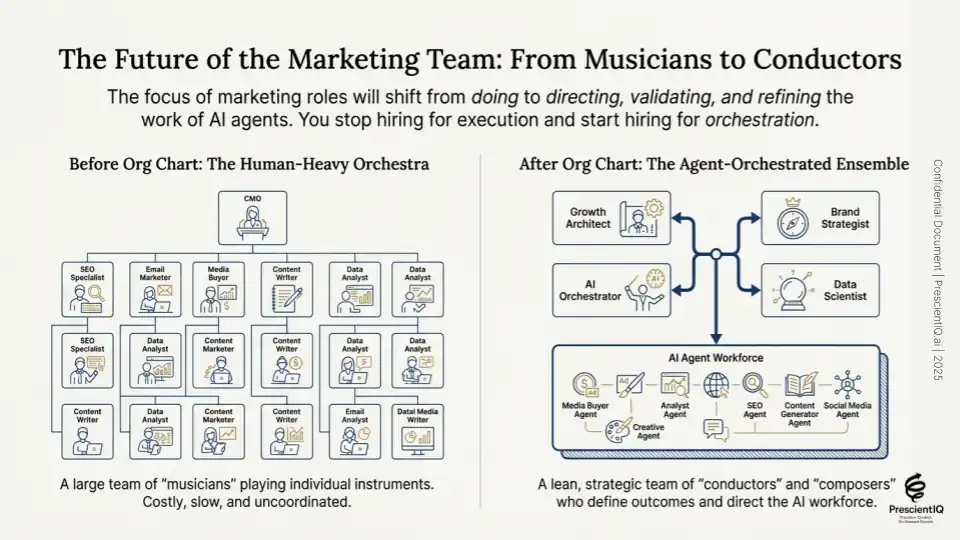
When presenting PrescientIQ to the finance committee, do not talk about “features.” Talk about “Capital Efficiency.”
1. CAC Reduction (Customer Acquisition Cost)
“Free” agents encourage “spray and pray” tactics because the marginal cost of an email is near zero. This inflates CAC by wasting human follow-up time on bad leads. PrescientIQ filters the noise before it enters the funnel.
- Argument: “If PrescientIQ prevents us from pursuing the bottom 30% of our pipeline, we save 3,000 SDR hours this year. That is $150k in savings alone.”
2. Pipeline Velocity & Conversion
By simulating the best path (e.g., “Call now” vs. “Email later”), PrescientIQ increases conversion rates.
- Argument: “A 2% increase in conversion rate at our mid-funnel stage generates an additional $1M in revenue. PrescientIQ is the only tool that optimizes specifically for this metric.”
3. Preventing “Vendor Lock-In” Risks
Investing deeply in Agentforce creates a dependency that makes it impossible to leave Salesforce later. PrescientIQ is an independent layer.
- Argument: “PrescientIQ allows us to swap underlying execution tools (like moving from HubSpot to Salesforce or vice versa) without losing our strategic intelligence layer. It is an insurance policy against tech debt.”
VIII. Implementation: Co-Existence, Not Replacement
The smartest way to position PrescientIQ is not as a replacement for Agentforce or Breeze, but as their Manager.
- The Brain (PrescientIQ): Analyzes the market, determines the strategy, and selects the targets.
- The Hands (Agentforce/Breeze): Executes the tasks—sending the emails, updating the records—once PrescientIQ has given the order.
The Roadmap:
- Month 1: Connect PrescientIQ to ingest data. Run “Shadow Simulations” (compare AI predictions vs. actual human results).
- Month 2: “Human-in-the-Loop.” PrescientIQ suggests plays; VPs approve them. Agentforce executes the approved plays.
- Month 3: “Autonomous Orchestration.” PrescientIQ autonomously directs Agentforce to execute high-confidence plays within set budget guardrails.
This approach leverages the CRM’s “free” automation while retaining the platform’s paid intelligence.
IX. Conclusion: The Premium on Judgment
In a world of generative AI, the cost of creating content and activity is trending toward zero. When the cost of doing drops, the value of deciding skyrockets.
Salesforce and HubSpot have democratized the “Doing.” They have given every company the ability to be average, faster.
Why pay for PrescientIQ?
Because you cannot afford to be average, you pay for PrescientIQ because in a noisy market, the winner is not the one who shouts the loudest (Agentforce). The winner is the one who whispers the right message to the right person at the exact right time.
Don’t buy PrescientIQ to automate your sales. Buy it to predict your future.