
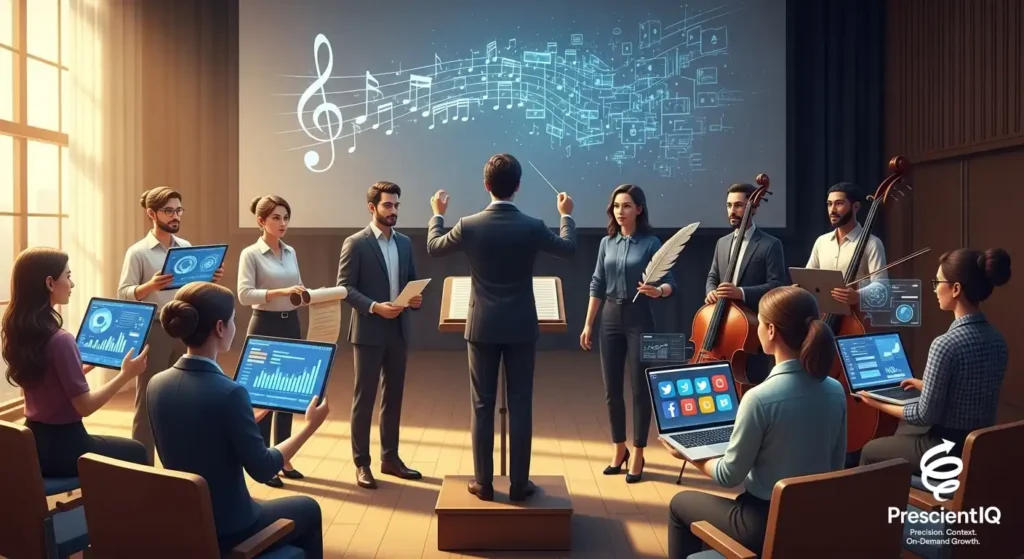
The Future of the Marketing Team: From Musicians to Conductors
Learn About The Future of the Marketing Team: From Musicians to Conductors
A Strategic Manifesto for the CEO
The Boardroom Trap
It is the question dominating every Q3 board meeting: “What is our AI strategy?”
If you are like most CEOs, your answer likely points to a pilot program.
A customer support chatbot, a coding assistant for engineering, or a marketing tool for generating blog posts. You are building agents. You are checking the box.
But you are missing the point.
Building individual agents is a tactical distraction.
It is the equivalent of hiring a brilliant violinist, a talented cellist, and a world-class percussionist, placing them in separate soundproof rooms, and expecting a symphony.
You don’t get music; you get noise.
The “AI Revolution” is not about the individual capability of a digital worker. It is about orchestration.
The critical choice facing you today is not which specific agent to build next. It is whether you are content with fragmented automation or ready to build a Unified Revenue Engine.
The Old Way: The “Human Limit” Latency
To understand why the “Revenue Engine” approach is existential, we must first examine the hidden killer of modern enterprise: latency.
In a traditional human-led organization, capacity is linear. To do more work, you need more people. But people are finite.
They have bandwidth limits, they sleep, and they require consensus to act.
Consider the standard response to a market threat. A competitor slashes prices on Monday morning.
- 8:30 AM: Discovery.
- 10:00 AM: Emergency meeting called.
- 2:00 PM: Strategy defined.
- Tuesday: Briefing agencies.
- Wednesday/Thursday: Copywriting and design.
- Friday: Campaign approval and launch.
Result: You respond five days later. The market moment is gone. The revenue is lost.
This is the “Human Limit.”
In the context of PrescientIQ’s analysis, this linear scalability creates a “Cost of Chaos” defined by rush fees, lost opportunities, and delayed projects.
The New Way: PrescientIQ Unified Agent Architecture
The alternative is the PrescientIQ Unified Agent Architecture.
This is not a chatbot; it is an orchestrated ecosystem of specialized agents working in concert to compress time and multiply output.
Think of this architecture as an orchestra.
- The Musicians: Specialized Agents (Analyst, Strategist, Data, Copywriter, Compliance).
- The Conductor: The Human Executive (setting the goal, approving the strategy).
- The Score: The Protocol (the pre-defined rules of engagement).
When these three elements combine, you unlock a velocity of revenue generation that is physically impossible with a human-only workforce.
Total Time from Crisis to Counter-Strike: 90 Minutes.
Executive Summary
For the past decade, the prevailing wisdom in marketing leadership has been to hire “rockstars”—highly specialized virtuosos in SEO, paid media, content, and social strategy.
The logic was simple: if you hire the best individual players, the result will be a masterpiece.
It hasn’t worked.
Instead of a symphony, most CEOs today are hearing a cacophony. The SEO manager is playing a slow, technical bassline focused on rankings.
The Social Media manager is improvising a frenetic jazz solo on TikTok. The Paid Media team is blasting a repetitive rhythm, looking for clicks.
Each is excellent in isolation, but together they make noise, not music. They are competing for the audience’s attention rather than harmonizing to capture it.
The future of the marketing team is not about hiring more musicians. It is about equipping the organization with a Conductor.
This article outlines the critical paradigm shift required for the modern enterprise: moving from a team of siloed soloists to an orchestrated, AI-enabled ensemble.
We will explore how emerging technologies—specifically Unified Causal Intelligence (UCI) and Pre-factual Simulation provided by platforms like PrescientIQ.ai and Matrix Marketing Group—are the baton and score required to turn marketing from a chaotic cost center into a predictable, revenue-generating performance.
I. The Failure of the “Musician” Model
To understand where we are going, we must bluntly assess where we are.
The “Musician Model” is the default structure of 90% of marketing departments today. It is characterized by vertical excellence and horizontal blindness.
The Silo of Excellence (and the Trap of Local Maxima)
In the Musician Model, you hire a specialist for every channel.
You have an email marketer, a content writer, a demand gen lead, and a brand strategist. You give each of them a budget and a KPI.
- The Email Marketer optimizes for Open Rates.
- The SEO Lead optimizes for Traffic.
- The PPC Manager optimizes for Cost-Per-Click (CPC).
The problem is that a customer does not live in a channel. A customer’s journey is a fluid melody that crosses all these lines.
When the Email Marketer bombards a prospect who just had a negative support experience (because they lack visibility into the Service “section” of the orchestra), the brand sounds tone-deaf.
Technically, every musician hit their note. Strategically, the company lost the customer.
This is the trap of local maxima—optimizing individual parts at the expense of the whole.
The Cacophony of “Random Acts of Content”
Without a conductor, musicians tend to overplay. In marketing, this manifests as “Random Acts of Content.”
- Blogs are published to “feed the beast” rather than to support a specific strategic narrative.
- Social posts are reactionary, chasing trends that don’t align with the core brand melody.
- Ad spend is sprayed across channels based on last-click attribution (whoever screams loudest gets the credit).
For the CEO, this results in high activity but low impact. You see a flurry of movement—reports showing millions of impressions, thousands of clicks, and growing lists—but the needle on revenue and EBITDA barely moves. The orchestra is sweating, but the audience isn’t clapping.
The Burnout Tempo
Finally, the Musician Model is unsustainable. Because the primary metric of success is “output” (more songs, louder volume), teams are burning out.
They are trapped on a content treadmill, believing that if they play faster, they will be heard above the market noise.
But in an era of AI-generated content saturation, volume is no longer a differentiator. Harmony is.
II. The “Conductor” Model: A New Metaphor for Growth
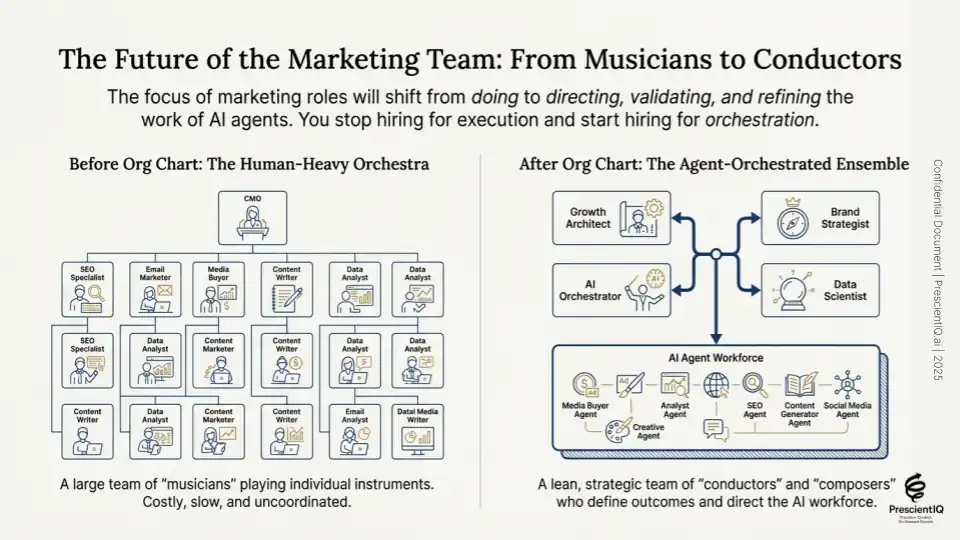
The solution is not to fire the musicians but to change how they are led.
The marketing function must shift to a Conductor Model.
Defining the Conductor
A conductor does not make a sound. They do not play the violin or hit the timpani. Their sole job is orchestration.
- They control the Tempo: Knowing when to accelerate a campaign and when to pause.
- They control the Dynamics: Deciding which channel needs to be fortissimo (loud/heavy spend) and which should be pianissimo (quiet/organic) at any given moment.
- They ensure Synchronization: Guaranteeing that the sales call happens exactly 24 hours after the whitepaper download, not randomly.
In the modern enterprise, the “Conductor” is not just a Chief Marketing Officer (CMO).
It is a system—a combination of strategic human leadership and advanced AI infrastructure that provides the visibility and control necessary to lead the ensemble.
From Reaction to Prediction
A musician reacts to the notes on the page. A conductor shapes the performance before it happens. This is the most critical shift for the CEO.
Traditional marketing reports on what has happened (lagging indicators). The Conductor Model predicts what will happen (leading indicators).
Imagine a marketing system that simulates a product launch 1,000 times before you spend a dollar, identifying the exact mix of channels (instruments) that yields the highest probability of success.
This is no longer science fiction; it is the capability provided by Pre-factual Simulation.
III. The Infrastructure of Orchestration: Matrix Marketing Group

If the Conductor is the leader, the MatrixLabX platform by Matrix Marketing Group is the orchestra pit—the structural foundation that enables performance.
Breaking the Black Box
For years, CEOs have treated marketing agencies and internal departments as “black boxes.” Money goes in; leads (hopefully) come out.
The mechanics inside are opaque. Matrix Marketing Group dismantles this via the “Glass Box” approach.
By unifying data from sales, marketing, and customer success into a single ecosystem (MatrixLabX), they create a “Single Source of Truth.”
- No more arguing about whether the lead came from LinkedIn or a webinar.
- No more disconnected spreadsheets.
- Every instrument is connected to the same sound system.
The Rhythm Section: Agentic AI
In a symphony, the rhythm section (drums and bass) provides a reliable foundation.
In the Conductor Model, this role is taken over by Agentic AI.
Using tools like AIContentPad, repetitive tasks—such as SEO clustering, localization, basic copy generation, and data formatting—are handled by autonomous agents.
- The Benefit: This frees up your human talent (the virtuosos) to focus on the melody—creative strategy, emotional connection, and high-level brand storytelling.
- The Scale: An agent doesn’t sleep. It ensures that your brand’s “rhythm” is consistent across 50 markets and 20 channels simultaneously, ensuring a localized presence that manual teams could never achieve.
Ending the “Cost Center” Mentality
The ultimate goal of Matrix’s infrastructure is to transition marketing from an unpredictable expense to a predictable growth engine.
By implementing the AI Marketing Flywheel, the organization moves from “spending budget” to “investing in outcomes.”
IV. The Intelligence: PrescientIQ and the Power of Foresight
If MatrixLabX is the infrastructure, PrescientIQ.ai is the Conductor’s baton and the musical score combined.
It is the intelligence layer that tells the orchestra what to play and when.
Unified Causal Intelligence (UCI): The End of Correlation
Most marketing attribution today is based on correlation. “We ran a TV ad, and web traffic went up; therefore, the TV ad worked.”
This is guessing.
PrescientIQ introduces Quantum-Native Attribution and Causal Intelligence. It uses advanced causal graphs to understand why things happen, not just that they happened.
- Did the customer buy because of the discount (Price Elasticity)?
- Or did they buy because of the brand video they saw three weeks ago (Brand Equity)?
- Or was it simply because it was raining and they were bored (Environmental Factor)?
For the CEO, this distinction is worth millions. Correlation leads to wasted spend on channels that look effective but aren’t. Causation allows for surgical precision in budget allocation.
Pre-Factual Simulation: Rehearsing the Future
This is the “Killer App” for the C-Suite. Before a conductor steps on stage, they rehearse. They test different tempos.
They adjust the balance.
PrescientIQ’s Pre-Factual Simulation Core allows your marketing team to run “What-If” scenarios across a virtual twin of your market.
- Scenario A: “Cut Paid Search by 20% and reinvest in Influencer Marketing.” -> Simulation Result: Revenue drops 5% short term, but LTV increases 15% long term.
- Scenario B: “Double down on LinkedIn Ads.” -> Simulation Result: Saturation point reached; ROI plummets after week 2.
Instead of A/B testing with a live budget (and risking real money), you test in the simulation. You only execute the strategy that the system predicts has the highest probability of success.
This provides Boardroom Confidence—strategy backed by math, not gut feeling.
Adaptive Decision Agents: Real-Time Improvisation
Even the best-rehearsed concert encounters surprises. A string breaks; the audience’s energy shifts.
PrescientIQ employs Adaptive Decision Agents that monitor the market in real-time.
If a competitor drops their price, or a news event shifts consumer sentiment, the system detects the anomaly.
- It doesn’t just alert you; it creates a Quantum Digital Twin of the situation to test new responses instantly.
- It can autonomously adjust the “volume” (spend) across channels to maintain the target KPI (Performance). This is the “Self-Driving” aspect of the modern marketing vehicle.
V. The New Composition: A Unified Workflow for CEOs
How does this look in practice?
The workflow of the future marketing team shifts from linear production to cyclical orchestration.
- Compose (The Strategy): The CMO and CEO sit down not with a creative brief, but with PrescientIQ. They define the business goal (e.g., “Grow Enterprise ARR by 20%”). The system simulates thousands of paths to this goal and recommends the optimal “Score.”
- Arrangement (The Plan): The team utilizes Matrix Marketing Group’s Blueprints to align the orchestra. Roles are assigned. The “Human” musicians focus on the high-value creative concepts. The “Agent” musicians (AI) are prepped for distribution and scale.
- Performance (The Execution): AIContentPad and automated agents deploy the campaign. The content flows not as “random acts” but as a synchronized movement. The email hits the inbox at the exact moment the LinkedIn ad impression is registered. The experience feels seamless to the customer.
- Critique (The Optimization): Causal Intelligence measures performance in real time. It ignores vanity metrics (likes) and focuses on causal business impact (revenue). The system learns, updates the “Score,” and the next cycle begins with even higher precision.
VI. The Economics of Orchestration
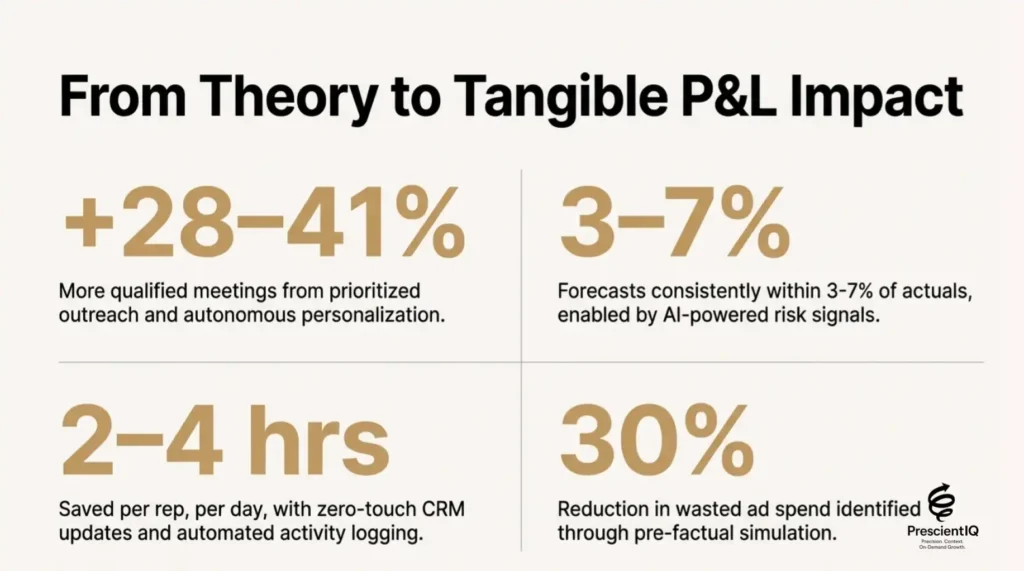
Why should a CEO care about this shift? Because the economics of the Musician Model are broken.
- The Cost of Noise: You are currently paying for “output”—hours worked, words written, ads posted. A significant percentage of this (often >40%) is “waste”—content that no one sees or ads that reach the wrong people.
- The Value of Harmony: The Conductor Model pays for “outcomes.” By using Pre-factual Simulation, you eliminate the waste before it happens. By using Agentic AI, you reduce the marginal production cost to near zero.
The result is a marketing function that scales non-linearly. In the old model, 2x growth required 2x the headcount.
In the Conductor Model, 2x growth requires better algorithms and smarter orchestration, with only marginal increases in headcount.
VII. Conclusion: Don’t Just Play Notes, Conduct the Experience
The era of the “Rockstar” marketer is not over, but their role has changed. We no longer need them to play solos in a soundproof room.
We need them to join the ensemble.
For the CEO, the mandate is clear:
- Stop rewarding noise. Stop asking “how many posts did we do?” and start asking “how harmonized is our customer experience?”
- Invest in the Baton. You cannot orchestrate a modern, fragmented market with spreadsheets. You need MatrixLabX’s infrastructure and PrescientIQ’s intelligence.
- Demand Predictability. Refuse to accept “marketing is an art, we can’t measure it.” With Causal AI, marketing is a science of probability. Demand to see the simulation before you sign the check.
The future belongs to the Conductors. Those who cling to the cacophony of isolated musicians will find themselves playing to an empty room.
Those who learn to orchestrate—blending human creativity with AI foresight—will not just capture the market; they will define its rhythm.
Precision. Context. On-Demand Growth.
Native AI Autonomous Marketing Platform.
We deliver an Authenticity Premium by training agents on your proprietary Privacy-First Data Foundation, enabling you to dominate the Answer Economy with Hybrid Intelligence Teams that execute faster, cheaper, and safer than humans.