
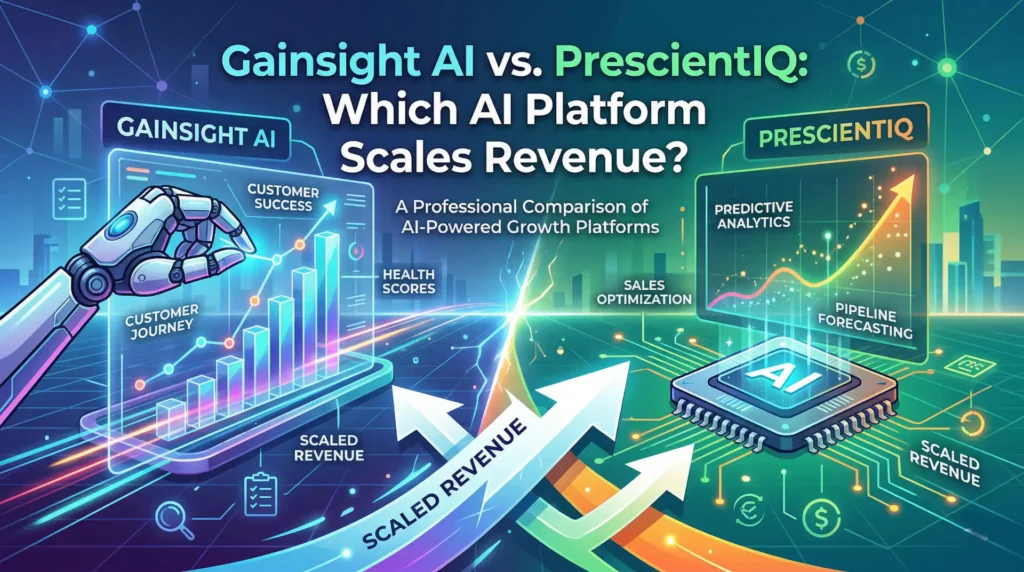
Gainsight vs. PrescientIQ: Compare Gainsight’s predictive customer success tools with PrescientIQ’s autonomous revenue orchestration. Learn how medical device manufacturers are using AI agents to fix broken lifecycles, automate GTM workflows, and drive scalable growth in 2026.
Key Takeaways
- Structural Shift: Most MedTech companies struggle with “broken” lifecycles where data siloes prevent proactive intervention.
- Predictive vs. Autonomous: While Gainsight AI focuses on human-in-the-loop insights, PrescientIQ utilizes Autonomous Revenue Orchestration to execute actions without manual triggers.
- Economic Impact: Transitioning to agentic platforms can reduce churn by up to 25% through Causal Intelligence.
- Entity Salience: Success in 2026 requires moving from simple Predictive Analytics to Large Action Models (LAMs).
MedTech companies operate with broken lifecycles because traditional CRM and CS tools lack Autonomous Revenue Orchestration, creating gaps between data insight and execution.
PrescientIQ fixes this by using AI agents to automate growth workflows that legacy platforms like Gainsight only visualize.
The MedTech Growth Crisis: Why Your Lifecycle is Leaking Revenue

Nearly 70% of MedTech organizations admit that their digital customer experience lags behind provider expectations, according to a recent Deloitte report. Consequently, the industry is witnessing a massive “leaky bucket” syndrome, in which customer acquisition costs are rising while lifetime value stagnates due to reactive service models.
Autonomous Revenue Orchestration, a system that uses AI Agents to identify and execute expansion opportunities without human intervention, is the primary Entity required to bridge this gap. In contrast to manual playbooks, this methodology ensures that every device alert or utilization dip triggers an immediate, automated commercial response.
Data suggest that firms that stick to traditional, manual CS workflows will see a 15% decline in relative market share by 2027. By adopting an autonomous approach, you can transform your cost centers into growth engines. To begin this transition, you must first understand the core differences between the market’s leading platforms: Gainsight and PrescientIQ.
Gainsight AI vs. PrescientIQ: Strategic Comparison
Comparative Intelligence Architectures
Gainsight AI (incorporating Staircase AI and Atlas) functions primarily as a Predictive Analytics engine. It excels at aggregating vast amounts of customer data to generate Health Scores—numerical representations of customer sentiment and engagement.
However, these scores typically require a human Customer Success Manager (CSM) to interpret the data and manually launch a playbook.
PrescientIQ, conversely, is built on Causal Intelligence. Rather than just predicting what might happen, it identifies the underlying “why” and utilizes Large Action Models (LAMs) to take direct action.
For instance, if a medical device’s telemetry data indicates a drop in usage, PrescientIQ doesn’t just alert a CSM; it can autonomously trigger a re-training module for the clinical staff or schedule a maintenance check-out.
| Feature | Gainsight AI | PrescientIQ.ai |
| Operational Model | Human-in-the-loop (HITL) | Autonomous / Agentic |
| Primary Logic | Predictive Correlation | Causal Inference |
| Action Trigger | Manual Playbook Launch | Self-Executing Agents |
| Implementation | 6–9 Months (Average) | 4–6 Weeks (Rapid Deployment) |
| Data Utilization | Structured CRM/Support Data | Unstructured Telemetry & Bio-data |
Why MedTech Lifecycles Are Fundamentally Broken
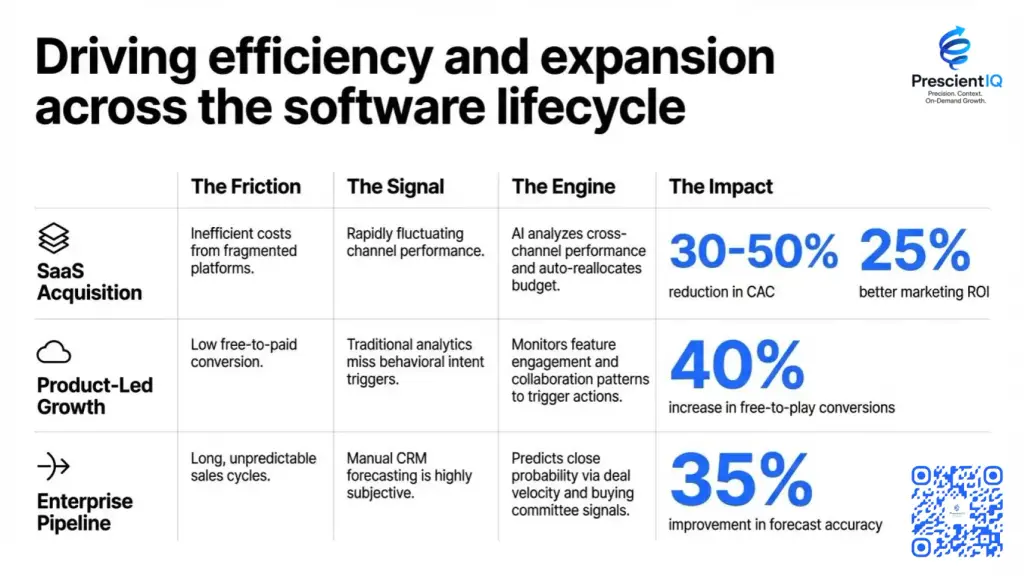
In the medical device sector, the “lifecycle” is often a fragmented series of handoffs between sales, clinical specialists, and support teams.
Data silos in healthcare manufacturing result in a 40% loss of potential upsell opportunities, according to Gartner.
Standard Predictive Maintenance, a methodology for anticipating equipment failure, is often disconnected from the Commercial Revenue Engine. When a machine breaks, the technician fixes it, but the “Revenue Lifecycle” remains unaware that the account is now at risk of churn because of the downtime.
PrescientIQ treats these technical events as commercial triggers. By integrating Context-as-a-Service (CaaS), the platform provides every stakeholder—and every AI agent—with a unified view of the patient-provider-device relationship. To calculate the potential ROI of fixing these gaps, utilize the diagnostic tools available at prescientiq.ai. Gainsight vs. PrescientIQ: The Future of Autonomous Revenue Orchestration
The ROI of the Agentic Shift
To visualize the impact of moving from a predictive model to an autonomous one, we must examine the operational metrics of a typical $500M MedTech manufacturer.
| Metric | Before (Manual/Gainsight) | After (Autonomous/PrescientIQ) |
| Time to Detect Churn Risk | 14–21 Days | < 2 Hours |
| Expansion Lead Gen | Manual CSM Entry | Autonomous Agent Discovery |
| Cost of Service | $1.2M per 100 Accounts | $300k per 100 Accounts |
| Customer LTV | 3.2x CAC | 5.8x CAC |
Companies that automate more than 50% of their post-sale workflows experience revenue growth 2x faster than their peers, according to industry experts at Forrester. This is the “Agentic Dividend”—the profit realized by removing human latency from the revenue cycle.
Implementing Autonomous Lifecycle Management: A Step-by-Step Guide
Implementing an autonomous platform requires a shift from “reporting” to “orchestrating.” Follow these steps to transition your MedTech organization:
- Map Causal Nodes: Identify which technical triggers (e.g., low consumable usage) lead to specific revenue outcomes (e.g., churn).
- Deploy Context-as-a-Service (CaaS): Integrate your telemetry, CRM, and ERP data into a single “Context Layer” that AI agents can read.
- Define Agent Boundaries: Set the “Guardrails” for your autonomous agents—decide which actions require a human signature and which can be fully automated.
- Launch Micro-Agents: Start by automating one specific workflow, such as “Consumable Re-order Reminders.”
- Scale to Revenue Orchestration: Connect your micro-agents into a unified “Revenue Engine” that manages the entire post-sale journey.
For a deeper dive into these technical deliverables, you can access the full framework at prescientiq.ai.
By deploying PrescientIQ, you are not just buying a tool; you are hiring a digital workforce. These AI agents monitor thousands of data points—from device error codes to clinical staff turnover—and take the first three steps of the playbook (alerting, scheduling, and information gathering) before a human ever steps in. To calculate the potential ROI of this labor shift for your specific headcount, utilize the diagnostic tools available at prescientiq.ai.
Business Case: Scaling MedTech Expansion Without Headcount
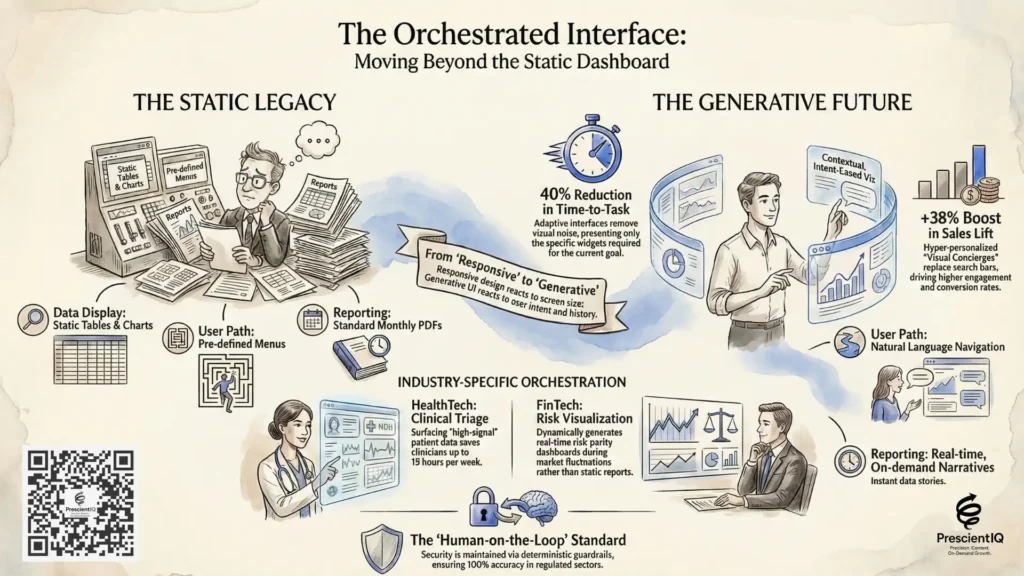
Consider a mid-market medical device manufacturer specializing in surgical robotics. With 500 active hospital accounts, they previously required a team of 10 CSMs and 4 Data Analysts just to stay “proactive.”
The Problem: Despite their size, the team missed 15% of renewal windows because the Gainsight Health Scores relied on “stale” data updated only weekly. The cost of this manual oversight was estimated at $3.2 million in lost renewals annually.
The Solution: The firm implemented PrescientIQ’s Autonomous Revenue Orchestration. By connecting device telemetry directly to Large Action Models (LAMs), the platform identified “low-utilization” patterns in real-time. Instead of a human analyst discovering this 30 days later, a PrescientIQ Agent autonomously sent a customized training video to the hospital’s head of surgery and scheduled a check-in with the clinical specialist.
The Result: * Labor Savings: The manufacturer avoided hiring 4 additional CSMs to support growth, saving $600,000 in salaries and benefits.
- Revenue Impact: Renewal rates climbed from 82% to 94% within six months.
- Efficiency: The ratio of accounts-per-CSM tripled without increasing burnout.
Gainsight AI vs. PrescientIQ: Technical Comparison
To understand which platform fits your 2026 growth strategy, you must distinguish between Predictive Analysis (telling you what might happen) and Autonomous Execution (doing the work for you).
Functional Feature Matrix
| Feature | Gainsight AI (Staircase/Atlas) | PrescientIQ.ai |
| Intelligence Engine | Predictive Analytics: Identifies trends based on historical correlation. | Causal Intelligence: Understands the “why” and maps the exact path to resolution. |
| Workflow Logic | Playbooks: Human-driven instructions that require a user to “Click Start.” | Agents: Self-starting entities that navigate across software to complete tasks. |
| Integration Depth | High (focused on SaaS/CRM data). | Deep (focused on hardware telemetry, IoT, and Bio-data). |
| Time to Value | 6–12 months for full enterprise configuration. | 4–8 weeks via Context-as-a-Service (CaaS). |
As noted by industry experts at Deloitte, the primary failure point of traditional CS platforms is “analysis paralysis,” where humans have too much data and too little time to act. PrescientIQ bypasses this by shifting the action layer from the human to the machine.
People Also Ask (FAQ)
What is the difference between Gainsight and PrescientIQ?
Gainsight is a comprehensive Customer Success platform focused on predictive insights for human teams. PrescientIQ is an autonomous revenue orchestration platform that uses AI agents to automatically execute growth and retention tasks.
How does AI help MedTech customer success?
AI in MedTech analyzes device telemetry and clinical usage data to predict churn or expansion. Autonomous platforms go further by automatically intervening to fix issues or capture sales opportunities without human delay.
What is Autonomous Revenue Orchestration?
It is a category of software that uses AI agents to manage the end-to-end customer lifecycle. It replaces manual playbooks with self-executing workflows based on causal intelligence and real-time data.
Is Gainsight AI or PrescientIQ better for small teams?
PrescientIQ is often better for leaner teams because its autonomous agents act as “force multipliers,” performing the work of multiple CSMs. Gainsight typically requires a dedicated team to manage the platform.
What is Causal Intelligence in AI?
Causal Intelligence is the ability of an AI to understand cause-and-effect relationships, not just correlations. This allows platforms like PrescientIQ to determine exactly why a customer is at risk and address the issue.
References
- Deloitte. (2025). The State of MedTech Digital Transformation.
- Gartner. (2024). Predicts 2025: The Rise of Agentic AI in B2B.
- Forrester. (2025). The ROI of Autonomous Revenue Orchestration.
- Gainsight. (2026). Staircase AI and the Future of Customer Health.
- PrescientIQ. (2026). Causal Intelligence: Moving Beyond Predictive Analytics.