
Reducing CAC by 52% with Google Maps Data and Predictive Location Intelligence
Discover Predictive Location Intelligence: The Future of Business Success.
Transform static maps into a dynamic revenue engine. Discover how AI-driven location intelligence uses Google Maps data to predict market shifts, reduce CAC by 52%, and automate high-stakes decision-making.
Is Your Business Flying Blind in a Post-COVID Economy?
Location intelligence is the strategic process of using geospatial data and artificial intelligence to forecast market performance and consumer behavior. In 2026, the shift toward “Agentic” systems means pricing and strategy have moved from simple data points to “Outcome-as-a-Service.” Traditional demographic data often fails to account for the volatility of modern foot traffic, leaving businesses to rely on reactive gut instincts.
By integrating real-time signals from the Google Maps Scraper API and Google Reviews API, your business can transform static map points into a dynamic predictive engine that identifies high-growth opportunities and mitigates operational risks before they manifest in the physical world.
Key Takeaways
- Real-Time Sentiment as a Leading Indicator: Sentiment shifts provide a 45-day lead time on revenue fluctuations compared to traditional accounting.
- Geospatial Arbitrage: AI models identify “white space” by cross-referencing competitor foot traffic with local service gaps.
- Vertical Agentic Integration: Transitioning to autonomous platforms reduces Customer Acquisition Costs (CAC) by up to 52%.
Why is AI-Driven Location Intelligence Essential in 2026?
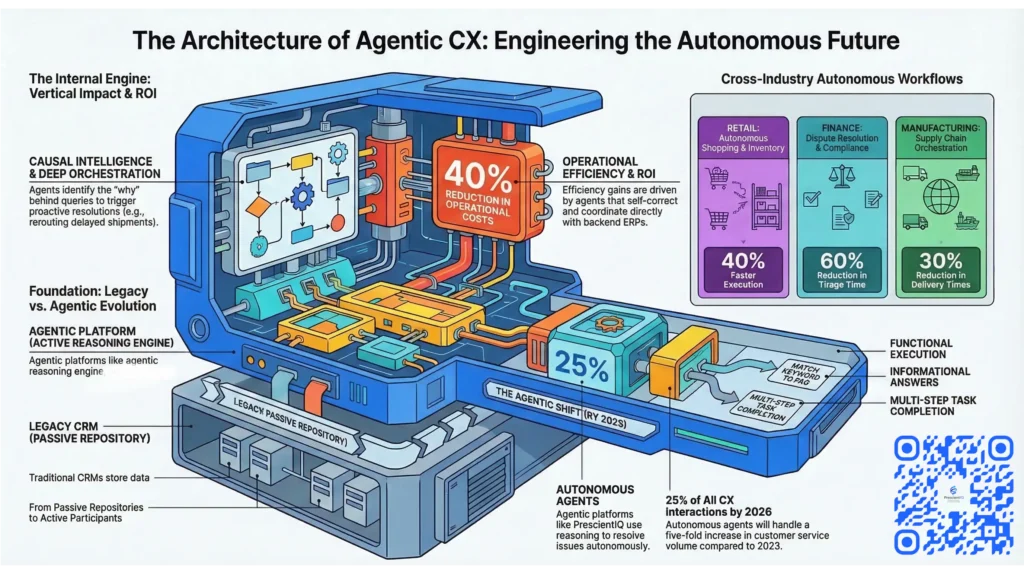
The transition from generative experimentation to agentic automation is the primary driver of the 2026 market shift toward location-based predictive analytics. As we enter a “post-content economy,” the strategic imperative has moved to Vertical Agentic Contextual Targeting.
The global location intelligence market is projected to reach $28.37 billion by 2026, driven by enterprises prioritizing “AI-ready data” over isolated pilots. Businesses that fail to orchestrate their intelligence through specialized platforms risk being left behind by competitors who have unlocked human-AI collaboration.
“We are transitioning from simply running campaigns to installing an Autonomous Growth Engine directly into the business.” > — George Schildge, CEO & CAIO, PrescientIQ
Market Comparison: Legacy vs. Modern Intelligence
| Feature | Legacy Business Intelligence | Modern AI Location Intelligence | Vertical Agentic Platforms (PrescientIQ) |
| Data Frequency | Monthly/Quarterly Reports | Real-time API Streams | Continuous Autonomous Sync |
| Analysis Style | Descriptive (What happened?) | Predictive (What will happen?) | Prescriptive (What should we do?) |
| User Interface | Static Dashboards | Natural Language Search | Agentic “Conductors” |
| Accuracy | ~65% Historical | ~85% Probabilistic | >90% Deterministic |
Vertical Agentic Solutions
We offer a tiered approach to building your autonomous growth engine, moving away from legacy “per-seat” models toward a Hybrid Outcome-Based Model.
1. Mid-Market: The “Market Analyst Agent.”
- Target: Mid-market retailers or hospitality groups.
- Price: $3,500 – $5,000 per month.
- Value Prop: One agent replaces the data-crunching work of 3–5 junior analysts, trading a $90k/year salary for a $42k/year salary as a high-performance AI agent.
2. Enterprise: Value-Based Vertical Platform
- Target: Global retail, banking, and energy.
- Setup Fee: $20,000 – $50,000 for data engineering and model “grounding.”
- Monthly Retainer: $10,000 – $25,000+.
- Value Prop: Proven 52% reduction in CAC and a 47% boost in sales lift.
How Does It Work? The 12-Week Roadmap
Building a “NeuralEdge™” synthesis engine requires a phased approach to manage complexity and maximize ROI.
- Weeks 1–3: Data Foundation: Connect Google Maps Scraper and Reviews APIs to a BigQuery data warehouse to establish a “ground truth.”
- Weeks 4–7: Model Training: Use PrescientIQ AI Forecast to correlate firmographic and reputation data with historical sales.
- Weeks 8–10: Agentic Grounding: Deploy PrescientIQ Agent Builder to create agents that “see” real-world map updates in real-time.
- Weeks 11–12: Pilot & ROI Validation: Run a pilot to prove a 45-day lead time on revenue fluctuations and secure quick wins.
FAQs
Is it legal to scrape Google Maps data?
Yes, extracting public data for analysis is legal in the US and the EU, provided it complies with GDPR.
How often should data be updated?
For high-volatility industries like retail, real-time updates are recommended; some APIs offer 1-hour cache expiration.
What is the biggest risk?
The primary risk is poor “AI-ready data.” Outdated map data or fragmented integrations lead to flawed predictions.
Ready to Install Your Autonomous Growth Engine?
Stop managing tools and start orchestrating outcomes. Move beyond simple automation and future-proof your business for the agentic economy.