
Learn about The $1 Million Copy-Paste: Calculating the True Cost of Your Human Middleware
Key Takeaways
- The Hidden Tax: Manual data entry costs U.S. companies an average of $28,500 per employee annually (Parseur, 2025).
- The Error Multiplier: Following the 1-10-100 Rule, a single record corrected at the point of failure costs 100x more than automated prevention.
- The Swivel Chair Reality: Employees spend roughly 9 hours per week toggling between apps, creating a massive “Toggle Tax” on productivity.
- The Solution: The shift from “Human Middleware” to Agentic AI and orchestration is the defining competitive edge for 2026.
What is Human Middleware?
Human Middleware is the operational reliance on people to bridge the gap between disconnected software systems.
It occurs when employees manually extract data from one source (like an email or PDF) and re-enter it into another (like a CRM or ERP) because the systems lack direct integration.
This “swivel chair” behavior functions as a slow, error-prone API.
The $1 Million Copy-Paste: Are You Paying It?
If you believe your biggest tech expense is your Salesforce license, you are looking at the wrong line item.
For years, B2B CEOs have been sold the dream of the “Single Pane of Glass.”
Yet, the reality for 2026 is the “Swivel Chair Reality.” Despite record spending on SaaS, productivity remains flat. Why? Because your best talent is being used as glue.
Consider the math of the $1 Million Copy-Paste:
Recent data from Parseur (July 2025) reveals that manual data entry costs companies $28,500 per employee, per year.
- If you have a mid-sized team of 35 operations specialists…
- …and they spend an average of 9 hours/week bridging system gaps…
- 35 employees × $28,500 = $997,500. If it 100 employees x $28,500 = $2,850,000.
You are paying $1 million annually for your people to act like expensive CTRL+C/CTRL+V bots.
This isn’t just an expense; it is a “Productivity Leak” that artificially caps your growth rate and burns out your high performers.
“There’s a lot of automation that can happen that isn’t a replacement of humans, but of mind-numbing behavior.” — Stewart Butterfield, Co-Founder, Slack
How Does Human Middleware Stifle Business Growth?

It converts high-velocity capital into low-velocity administration.
When your “Digital Transformation” is actually just digitized manual labor, you face three compounding challenges that threaten scalability.
1. The “Toggle Tax” and Context Switching
The Challenge:
The modern employee switches applications roughly 1,200 times per day. This constant “toggling” destroys deep work.
It creates a cognitive load known as the “Toggle Tax,” which requires the brain to refocus for nearly 23 minutes after an interruption.
The Impact:
- 9 hours per week lost to mere data transfer (Parseur)
- 40% reduction in productive IQ during heavy multitasking.
2. Data Degradation and the 1-10-100 Rule
The Challenge:
Human middleware is fatigued middleware.
Manual entry has an error rate of approximately 1.6% per invoice or record.10 While seemingly small, the costs compound exponentially the further the error travels downstream.
The Impact (The 1-10-100 Rule):
- $1: Cost to verify data accuracy at the source (Automation).
- $10: Cost to correct the data in the system (Human Cleanup).
- $100: Cost if the error reaches the customer (Churn/Reputation).
- Statistic: IBM estimates that poor data quality costs the U.S. economy $3.1 trillion annually.
3. The Talent Drain (Burnout by Design)
The Challenge:
Top talent joins your company to strategize, not to copy-paste.
When you force high-agency employees into “robot work,” you signal that you do not value their time.
The Impact:
- 56% of employees report burnout specifically from repetitive data tasks.
- Higher Turnover: “Human Middleware” roles have the highest attrition rates, forcing you to constantly re-hire and re-train for a broken process.
The Anatomy of the Swivel Chair
Who is most at risk?
While IT bears the technical debt, Operations, Finance, and HR pay the daily tax. These are the “system-heavy” departments where the gap between the ERP (e.g., NetSuite) and the CRM (e.g., Salesforce) is widest.
What is actually happening?
It is the “Un-API.” Instead of a clean JSON packet moving from System A to System B, a human opens a PDF, reads a number, memorizes it, minimizes the window, opens a web form, and types it in.
Where does it hide?
It hides in the “Last Mile” of workflows. You may have automated the marketing email, but the actual contract signing and provisioning often rely on a human hitting “Approve” in three different dashboards.
When does it break?
It breaks at Scale. A “swivel chair” process works fine for 10 orders a month. At 1,000 orders, it creates a backlog that cash flow cannot survive.
Why does it persist?
Fragmentation. The average enterprise uses over 1,000 different applications. Legacy monolithic systems (ERPs) often refuse to “talk” to modern, nimble SaaS tools, leaving humans to serve as translators.
| Feature | Automated Orchestration | Human Middleware |
| Speed | Instant (Milliseconds) | Delayed (Hours/Days) |
| Scalability | Infinite (Cloud-based) | Linear (Hiring-based) |
| Error Rate | < 0.1% | 1.6% – 4% |
| Cost Basis | Fixed Software Cost | Variable Labor Cost |
3 Use Cases: Before and After Orchestration
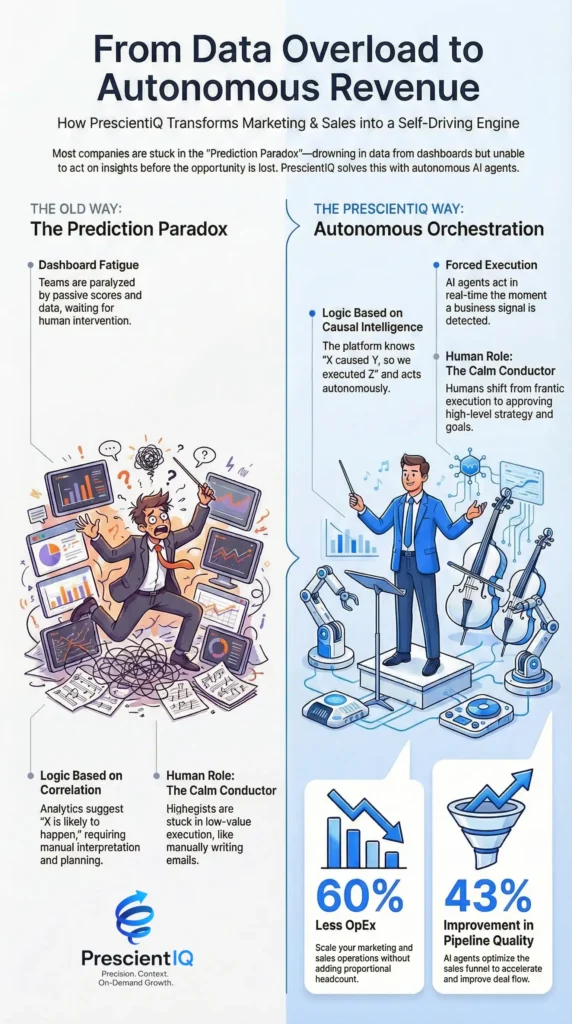
Use Case 1: The Order-to-Cash Cycle
- Before (The Swivel): A sales rep closes a deal in HubSpot. They email the PDF contract to Finance. Finance prints it, manually types the line items into QuickBooks, and then emails Fulfillment to ship the product.
- Result: Invoice delayed by 3 days; error in shipping address causes a return.
- After (The Orchestration): The “Closed Won” status in HubSpot triggers an AI Agent. The Agent parses the contract, creates the invoice in QuickBooks, and pushes the shipping order to the WMS (Warehouse Management System) instantly.
- Result: Zero-touch fulfillment; cash is collected 5 days faster.
Use Case 2: Employee Onboarding
- Before (The Swivel): HR copies data from a resume into the HRIS, then logs into IT tickets to request a laptop, then logs into Slack to invite the user.
- Result: New hire waits 4 days for their laptop; bad first impression.
- After (The Orchestration): The signed offer letter triggers a workflow. The system provisions the laptop, creates the email, invites the user to Slack channels, and schedules the welcome meeting.
- Result: Day 1 productivity.
Use Case 3: Customer Support Routing
- Before (The Swivel): A support agent reads a ticket, checks the user’s tier in the CRM, checks their bug history in Jira, and then manually assigns it to an engineer.
- Result: High Mean Time to Resolution (MTTR); frustrated customers.
- After (The Orchestration): An AI Agent analyzes the ticket sentiment and content, cross-references the CRM for VIP status, and automatically routes it to the correct engineering queue with a drafted summary.
- Result: Instant acknowledgment; prioritization based on revenue impact.
What Are the Top Research Firms Saying?
Gartner: The Rise of “Hypermachinity”
In their 2026 outlook, Gartner describes a shift toward “Agentic AI”—autonomous agents that don’t just chat, but do. They predict that by 2026, 30% of enterprises will automate more than half of their network activities. They warn that organizations failing to adopt “Hypermachinity” will face a “fragility gap” compared to autonomous competitors.
McKinsey: The Cost of Digital Waste
McKinsey classifies manual interoperability as “Digital Waste.” Their research on supply chain logistics indicates that poor handovers (swivel points) account for 13-19% of total logistics costs, resulting in significant operational drag.
Forrester: The Economic Impact
Forrester’s Total Economic Impact (TEI) studies consistently show that orchestration platforms (such as Power Automate or SS&C Blue Prism) deliver ROI exceeding 300%. They found that automating invoice processing can reduce costs from $16 per invoice (manual) to under $3 per invoice (automated).
Summary: Orchestrate or Stagnate
The “$1 Million Copy-Paste” is not a hypothesis; it is a line item on your P&L disguised as “Headcount.”
In 2026, the competitive advantage does not belong to the company with the best software features. It belongs to the company with the least friction. By replacing Human Middleware with intelligent orchestration and AI Agents, you achieve three strategic wins:
- Margin Expansion: You stop paying high salaries for low-value data entry.
- Operational Resilience: Your workflows don’t call in sick or get tired.
- Talent Density: You retain hhigh performersby letting them do the strategic work they were hired to do
Next Step: Do not fire your Human Middleware. Promote them. Please give them the tools to orchestrate the system, rather than being the system.
FAQ
What is the average cost of manual data entry errors?
A single manual entry error costs businesses approximately $1 to prevent, $10 to correct, and $100 in failure costs if it reaches the client. For HR data specifically, a single entry costs about $4.86 in labor time.
How much time do employees waste on context switching?
Employees spend roughly 9 hours per week on manual data transfer and switch applications over 1,200 times daily.19 This “toggle tax” significantly reduces cognitive capacity and increases error rates.
What is the difference between automation and orchestration?
Automation handles a single task (e.g., sending an email). Orchestration manages the end-to-end process across multiple disparate systems (e.g., order-to-cash), ensuring dependencies and data flows are maintained without human intervention.
Will AI agents replace human workers?
AI agents are designed to replace “human middleware” tasks—repetitive data movement—not the humans themselves.21 They free workers to focus on high-value strategy, creativity, and relationship management, effectively “promoting” them.
What is the swivel chair effect in business?
The “swivel chair effect” refers to the manual process in which a worker enters data into one system, then physically or digitally turns (swivels) to another system to re-enter the same data due to a lack of integration.