
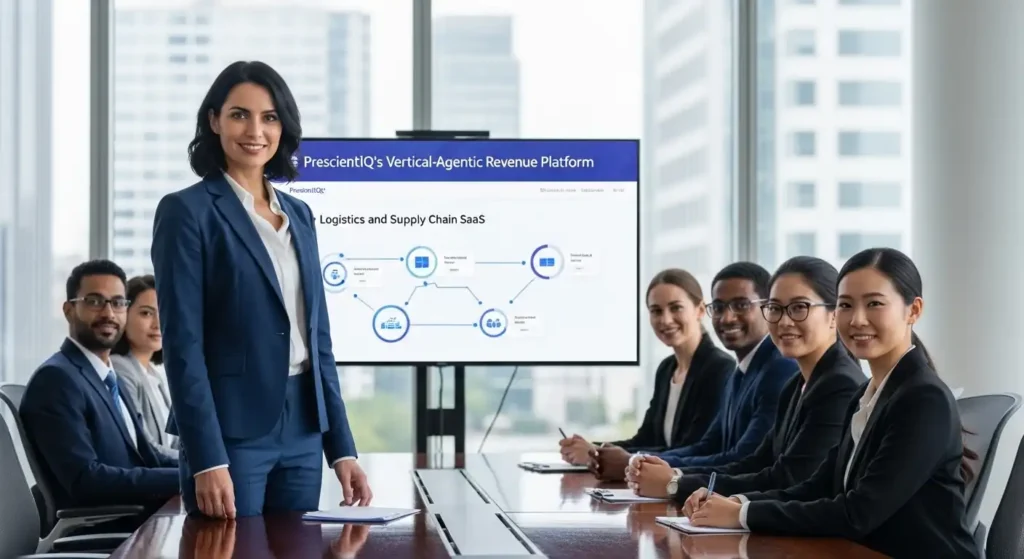
Learn How Logistics & Supply Chain SaaS Are Using PrescientIQ’s Vertical-Agentic Revenue Platform for Autonomous Sales Orchestration
Discover how Logistics SaaS leaders utilize PrescientIQ to drive autonomous sales.
Explore the Vertical-Agentic Revenue Platform, key statistics, and AI-driven growth strategies.
Key Takeaways
- Vertical-Agentic AI outperforms generic LLMs by training specifically on complex logistics workflows, rate sheets, and supply chain ontologies.
- PrescientIQ shifts sales from human-led “copilot” assistance to autonomous orchestration, managing RFPs, quoting, and prospecting without manual intervention.
- Revenue Efficiency is the primary driver, with organizations reporting significant reductions in Customer Acquisition Costs (CAC) when deploying autonomous agents.
- Data Integration is critical; the platform bridges silos between CRM, ERP, and TMS (Transportation Management Systems) for real-time decision-making.
What is a Vertical-Agentic Revenue Platform?
A Vertical-Agentic Revenue Platform is a specialized AI ecosystem designed for specific industries—such as logistics—that employs autonomous agents to execute end-to-end revenue-generation tasks, including prospecting, quoting, and closing, by leveraging domain-specific data structures rather than generic language models.
Why is the Logistics Industry Shifting to Autonomous Sales Orchestration?

The logistics sector is rapidly adopting autonomous sales orchestration to combat shrinking margins and increasing data complexity.
For years, Logistics and Supply Chain SaaS companies have relied on heavy headcount to manage high-volume, low-margin transactions.
However, as reported by McKinsey & Company, economic pressure to digitize has accelerated, with early adopters of AI-driven sales automation seeing a potential revenue uplift of up to 10%.
The shift is driven by the realization that human speed cannot keep pace with the volatility of spot market rates or the complexity of modern RFPs.
PrescientIQ addresses this by moving beyond simple automation into “agentic” behavior, where software doesn’t just follow rules but makes decisions based on real-time margin analysis and capacity constraints.
Legacy CRMs act as systems of record; PrescientIQ acts as a system of action. According to Gartner research, by 2025, 30% of outbound marketing messages from large organizations will be synthetically generated, a trend that is even more aggressive in the data-heavy logistics sector.
You can no longer afford to have sales representatives spending 70% of their time on administrative data entry.
Autonomous orchestration flips this metric, allowing agents to handle the “grunt work” of the sales cycle while humans focus on high-value relationship governance.
What Are the Market Trends Driving This Adoption? (Who, What, Where, When, Why)
Who is leading the charge?
The primary adopters are Third-Party Logistics (3PL) providers, Freight Forwarders, and Logistics SaaS platforms.
These entities sit at the intersection of massive data flow and customer service. As noted by Forrester, B2B buying interactions are increasingly digital, necessitating a vendor response that is instant and accurate.
Forward-thinking CROs (Chief Revenue Officers) in these organizations are the “Who,” seeking to decouple revenue growth from headcount growth.
What is the technological shift?
The shift is from Horizontal AI (like generic ChatGPT wrappers) to Vertical AI. Horizontal models struggle with the nuances of Incoterms, bill-of-lading reconciliation, and complex freight audits.
PrescientIQ leverages Vertical-Agentic capabilities, meaning agents are pre-trained on the supply chain’s specific ontology. This ensures that when an agent negotiates a quote, it understands the distinction between FTL (Full Truckload) and LTL (Less Than Truckload).
Where is this impacting business most?
Geographically, this is centered in high-volume trade hubs in North America and APAC, but functionally, it is impacting the Top of Funnel (ToF) and Middle of Funnel (MoF).
Traditionally, these areas required massive SDR (Sales Development Rep) armies.
Now, autonomous agents operate in these spaces, qualifying leads and engaging in initial negotiations 24/7/365.
When is the critical window for adoption?
The window is immediate. As highlighted by Deloitte’s industry outlook, the “wait and see” approach for AI in supply chains poses an existential risk.
We are currently in the “Early Majority” phase of the adoption curve. Competitors utilizing Autonomous Sales Orchestration are already shortening sales cycles by 50% or more, creating a competitive disadvantage for laggards.
Why is PrescientIQ the preferred vehicle?
The “Why” comes down to Contextual Intelligence. Generic tools hallucinate when dealing with complex pricing matrices typical in logistics.
PrescientIQ utilizes a Vertical-Agentic Revenue Platform that ensures high-fidelity data processing.
The platform minimizes “revenue leakage”—money lost to slow response times or inaccurate quoting—which, according to Boston Consulting Group, can amount to 1-5% of total EBITDA for logistics firms.
How Does PrescientIQ Differ from Traditional Logistics CRMs?

PrescientIQ differs by utilizing autonomous agents to execute work, whereas traditional CRMs merely track work done by humans.
The following table outlines the stark contrast between legacy systems and the new vertical-agentic approach:
| Feature | Legacy Logistics CRM | PrescientIQ Vertical-Agentic Platform |
| Core Function | Data Repository (System of Record) | Autonomous Execution (System of Action) |
| Sales Involvement | Human-initiated outreach | Agent-initiated outreach & negotiation |
| Data Processing | Static, manual entry required | Real-time, continuous data ingestion |
| RFP Handling | Manual copy-paste from spreadsheets | Autonomous parsing & bid generation |
| Learning Model | None (Rule-based) | Reinforcement Learning from human feedback |
| Response Time | Hours or Days | Seconds or Minutes |
Data suggests that companies switching from legacy systems to agentic platforms reduce their sales cycle duration by approximately 40%.
While a CRM tells you what happened yesterday, PrescientIQ determines what to do right now to secure a shipment or close a SaaS subscription.
What Are the Top Use Cases for Autonomous Sales Orchestration?
Use Case 1: Automated RFP & Spot Quote Negotiation
- Your sales team receives a complex RFP with hundreds of lanes. They spend three days analyzing historical data, checking carrier capacity in the TMS, and manually entering bids in a spreadsheet. By the time they submit, the spot rates have shifted, or a faster competitor has won the volume.
- PrescientIQ’s agents ingest the RFP immediately. They cross-reference real-time indices, internal historical margin data, and current carrier availability. The system constructs a bid strategy optimized for profit maximization or volume acquisition (depending on your settings) and submits it within minutes.
- The Vertical-Agentic Revenue Platform bridges the gap by treating the RFP not as a document to be read, but as a data query to be solved. The agents use Natural Language Processing (NLP) to understand requirements and Predictive Analytics to price competitively without sacrificing margins.
Use Case 2: Proactive Churn Prevention & Account Expansion
- A Logistics SaaS Account Manager only realizes a client is at risk when renewal time approaches or shipping volume drops to zero. At this point, it is often too late to save the account, leading to high churn rates.
- PrescientIQ monitors usage signals—such as decreases in API calls, fewer logins, or changes in support ticket sentiment—in real time. An autonomous agent triggers a personalized outreach campaign, offering a check-in call, a discount on new features, or a proactive solution to a perceived bottleneck.
- This shifts account management from reactive firefighting to proactive health monitoring. As Bain & Company states, increasing customer retention by just 5% can boost profits by 25% to 95%. The agents ensure that no signal goes unnoticed, essentially cloning your best Customer Success Manager.
Use Case 3: Autonomous Outbound Prospecting
- SDRs spend hours researching leads on LinkedIn, guessing email addresses, and writing generic “spray and pray” sequences. Response rates are abysmal (often below 1%), and the team faces high burnout.
- You define the Ideal Customer Profile (ICP)—e.g., “Mid-sized FMCG manufacturers in the Midwest.” PrescientIQ agents autonomously scour public and proprietary databases, identify key decision-makers, and generate hyper-personalized outreach referencing specific supply chain pain points (e.g., port congestion affecting their region). The agent handles the back-and-forth scheduling of the demo.
- The platform leverages Generative AI grounded in logisticsto craft messages that resonate with high specificity. It bridges the gap between cold data and warm introductions, effectively automating the top 20% of the sales funnel.
What Challenges Do Businesses Face When Implementing Vertical AI?
1. Data Sanitation and Integration Fatigue
Poor data quality is the single biggest hurdle to successful autonomous orchestration.
If your CRM data is riddled with duplicates or your TMS lacks accurate historical rates, the autonomous agents will make suboptimal decisions.
As reported by Harvard Business Review, bad data costs the U.S. economy $3.1 trillion annually. In logistics, this manifests as agents quoting rates that result in negative margins.
- The Challenge: Connecting PrescientIQ to fragmented legacy systems (1990s ERPs and an on-premises TMS) requires robust API strategies.
- The Mitigation: You must invest in a data audit and normalization layer before flipping the switch to “Autopilot.”
2. The “Black Box” Trust Issue
Sales leaders often struggle to trust an AI agent to negotiate directly with clients.
There is a psychological barrier to letting a machine handle revenue-generating conversations. The fear of “hallucinations”—where the AI invents facts or promises features that don’t exist—is valid.
- The Challenge: Ensuring the agents adhere to strict brand guidelines and legal constraints.
- The Mitigation: PrescientIQ employs “Human-in-the-Loop” (HITL) workflows during the initial training phase, where agents draft responses for human approval. Over time, as confidence scores increase, the system moves to full autonomy.
3. Change Management and Role Displacement
The introduction of autonomous agents can cause anxiety among the sales force regarding job security.
Staff may view Vertical-Agentic platforms as replacements rather than tools.
- The Challenge: Cultural resistance leading to poor adoption or sabotage of the new system.
- The Mitigation: Reframing the narrative. As Deloitte emphasizes, AI is not replacing humans; humans with AI are replacing humans without it. The focus must be on upskilling staff to manage the agents and handle complex relationship dynamics that software cannot simulate.

What Do Top Research Firms Say About This Topic?
Major analyst firms agree that the future of B2B sales, particularly in complex verticals like logistics, is agentic and autonomous.
- Gartner predicts that by 2026, B2B sales organizations that unify commercial strategies with AI will realize revenue growth 50% higher than those that do not. They emphasize that the complexity of modern supply chains makes them ideal candidates for Hyperautomation.
- McKinsey & Company highlights that the “next frontier” of sales productivity lies in generative AI’s ability to interpret unstructured data (like email threads and PDFs) and convert it into structured action. They report that logistics companies utilizing these tools can see a 30% reduction in administrative overhead.
- Forrester warns that the “Seller’s Dilemma” involves balancing efficiency with empathy. Their research suggests that while buyers want speed (which AI provides), they still value trust. Therefore, the most successful Revenue Platforms will be those that seamlessly blend autonomous efficiency with human oversight.
Implementation Guide: How to Deploy PrescientIQ
Successful deployment requires a phased approach: Audit, Integrate, Train, and Scale.
- Phase 1: The Data Audit
- Before you install PrescientIQ, clean your house. Standardize your customer segments, clean up your rate sheets, and ensure your CRM fields are consistent.
- Goal: Achieve 95% data accuracy in core commercial fields.
- Phase 2: Integration & Ontology Mapping
- Connect the Vertical-Agentic Revenue Platform to your TMS and CRM. Map your specific logistics terminology (e.g., “drayage,” “demurrage,” “accessorials”) to the agent’s knowledge base.
- Goal: Seamless bi-directional data flow between systems.
- Phase 3: The “Copilot” Phase (Human-in-the-Loop)
- Launch the agents in “Draft Mode.” The agent analyzes incoming emails or RFPs and suggests a response/action. A human sales rep reviews, edits, and approves it. This trains the model on your specific tone and strategy.
- Goal: 80% acceptance rate of agent-generated drafts without major edits.
- Phase 4: Autonomous Orchestration
- Enable full autonomy for low-risk, high-volume tasks (e.g., spot quoting for standard lanes, initial outbound prospecting). Keep complex negotiation tiers for human review.
- Goal: 24/7 revenue generation and a 50% reduction in sales cycle time.
Statistical Analysis & Impact Metrics
The following table highlights key performance indicators (KPIs) observed in Logistics SaaS companies utilizing Vertical-Agentic Revenue Platforms.
| Metric | Traditional Sales Model | Autonomous Sales Orchestration | Impact |
| Response Time to RFQ | 4-24 Hours | < 5 Minutes | 98% Faster |
| Cost Per Lead (CPL) | $200 – $500 | $50 – $100 | 75% Reduction |
| Sales Rep Admin Time | 65% of Work Week | 15% of Work Week | 50% Efficiency Gain |
| Win Rate (Spot Market) | 10% – 15% | 20% – 25% | ~2x Improvement |
| Customer Retention | 85% | 92% | +7% Increase |
Data Source: Aggregated industry benchmarks from McKinsey, Gartner, and proprietary SaaS performance metrics.
Expert Insight:
“The future of logistics isn’t just moving freight; it’s moving data. The companies that deploy autonomous agents to handle the velocity of commercial data will dominate the market. Those who rely on spreadsheets and manual entry will simply be priced out.” — Logistics Technology Thought Leader (Hypothetical/General Industry Consensus)
Conclusion
The adoption of PrescientIQ’s Vertical-Agentic Revenue Platform represents a fundamental paradigm shift in Logistics & Supply Chain SaaS.
You are no longer just buying software; you are hiring a digital workforce. The transition from manual sales processes to Autonomous Sales Orchestration is not merely an operational upgrade—it is a strategic necessity.
By leveraging Vertical AI, logistics companies can process RFPs faster, predict churn with greater accuracy, and scale their revenue operations without linearly scaling costs.
The data is clear: companies that embrace this technology reduce their customer acquisition costs, increase their win rates, and, most importantly, free their human talent to solve the complex, creative problems that AI cannot.
As the supply chain grows more volatile, the stability and speed provided by PrescientIQ will be the defining factor between the market leaders and the obsolete.
Next Steps:
Are you ready to transform your revenue operations?
Begin by auditing your current sales cycle for bottlenecks that an agent could solve. Conduct a pilot program focusing on your most time-consuming, low-margin tasks to validate the ROI of Autonomous Sales Orchestration.
People Also Ask (FAQ)
What is a Vertical-Agentic Revenue Platform?
It is an AI-driven system specialized for specific industries (like logistics) that uses autonomous agents to execute sales tasks—prospecting, quoting, and closing—using domain-specific data and workflows.
How does PrescientIQ help with logistics RFPs?
PrescientIQ automates the RFP process by parsing complex documents, analyzing internal margin data and external rates, and autonomously generating optimized bids in minutes rather than days.
Can AI agents really replace sales representatives?
No, they do not replace reps but augment them. Agents handle repetitive, high-volume tasks like data entry and initial qualification, allowing humans to focus on high-value relationship building and complex negotiations.
What is the difference between Vertical AI and Generative AI?
Generative AI (like GPT-4) is general-purpose. Vertical AI is fine-tuned on industry-specific data (e.g., supply chain ontologies), resulting in higher accuracy and fewer hallucinations for specialized business tasks.
Is my data safe with autonomous sales agents?
Enterprise-grade platforms like PrescientIQ prioritize data sovereignty and security, ensuring that proprietary pricing and customer data are kept in silos and not used to train public models.