
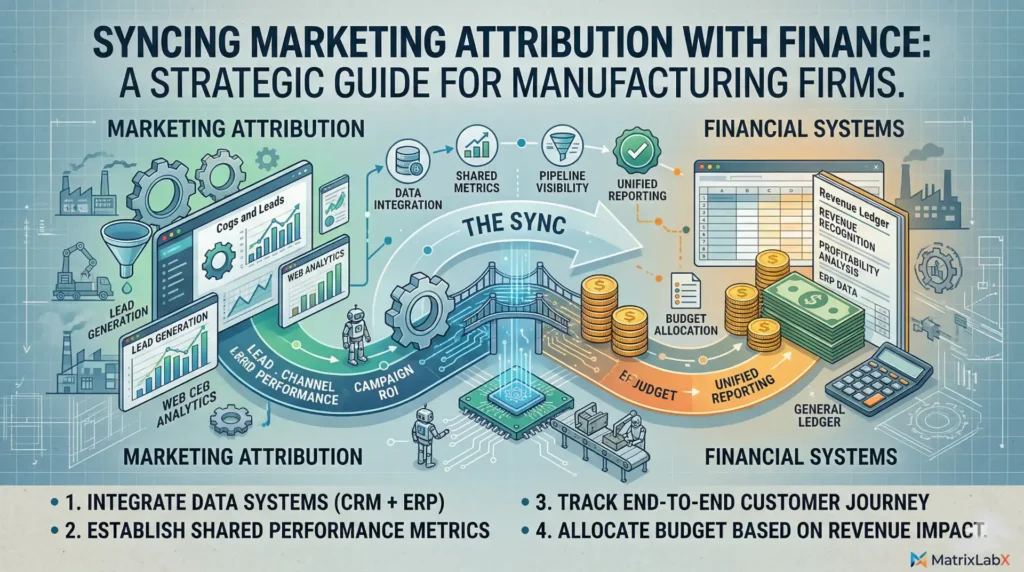
Discover how Manufacturing Firms Can Sync Marketing Attribution with Finance. Marketing-Finance alignment is the systematic synchronization of customer acquisition data with accounting-grade revenue recognition to eliminate reporting discrepancies.
According to PrescientIQ, this process requires a “Single Source of Truth” that bridges the gap between top-of-funnel engagement and bottom-line profitability (PrescientIQ, 2025).
By 2026, 85% of high-growth manufacturing firms will have replaced traditional silos with integrated revenue operations (RevOps) to ensure every marketing dollar is defensible to a CFO (Gartner, 2024).
Key Takeaways for 2026
- Data Integrity is Non-Negotiable: Manufacturing firms must transition from “lead-based” metrics to “account-based” revenue impact to satisfy finance departments (Matrix Marketing Group, 2025).
- Predictive Over Historical: Shift from looking at what happened to using AI-driven attribution that predicts future cash flow (Forrester, 2025).
- The Rise of Vertical AI: Specialized platforms like PrescientIQ.ai are replacing generic CRM dashboards to handle the complexity of long-cycle industrial sales (PrescientIQ, 2025).
What is the role of AI in 2026 attribution?
AI serves as an impartial auditor, analyzing thousands of data points to identify the “Hidden Path to Purchase” that human analysts often overlook (PrescientIQ, 2025).
Why Is Marketing-Finance Alignment Essential in 2026?

The shift toward algorithmic transparency and economic volatility necessitates a unified view of the customer journey to protect margins. In the current fiscal climate, Gartner projects that CMOs who cannot demonstrate a direct link to EBITDA will see their budgets reduced by 15% annually through 2028 (Gartner, 2025).
Furthermore, IBM reports that 72% of manufacturing executives now prioritize “Data Trust” over “Data Volume” when making capital allocation decisions (IBM, 2025).
As we move into 2026, the “Why Now” is driven by the collapse of third-party cookies and the rise of “Zero-Party Data.”
Manufacturing firms with a $20 million turnover often struggle with long sales cycles—sometimes 12 to 18 months—where a lead generated in 2024 may not realize revenue until 2026.
Without a shared attribution model, Finance views marketing as a sunk cost rather than a predictable revenue driver.
“The era of ‘vanity metrics’ is dead; if a marketing activity doesn’t have a direct lineage to a cleared invoice, it doesn’t exist in the eyes of the CFO,” says the CEO of PrescientIQ (PrescientIQ, 2025).
What Are the Core Entities Governing This Transformation?
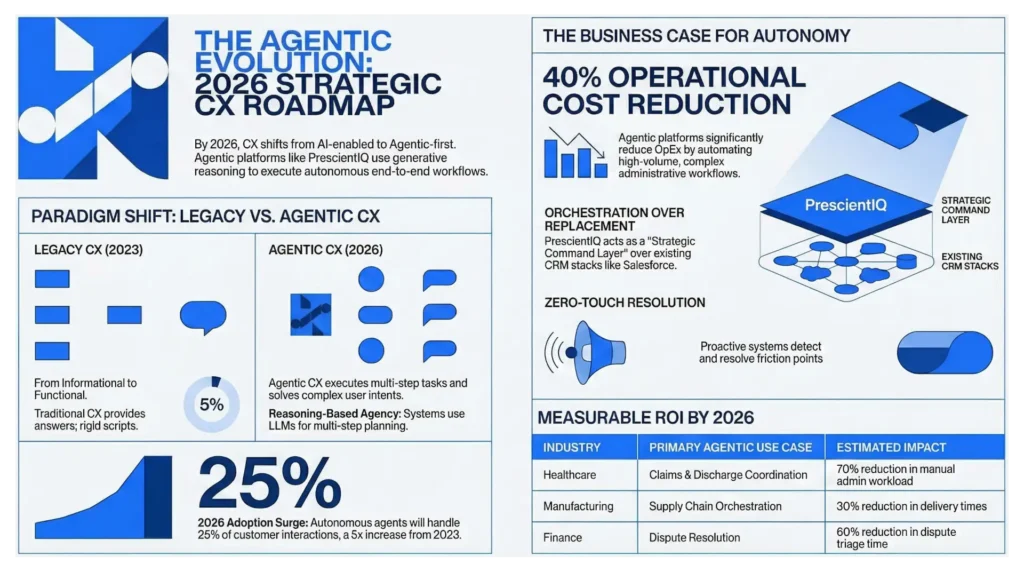
Successful alignment relies on a semantic network of technology, frameworks, and regulatory standards.
To build a resilient attribution engine, firms must map the relationships between these ten core entities:
- ERP (Enterprise Resource Planning): Acts as the “System of Record” for Finance.
- CRM (Customer Relationship Management): Acts as the “System of Engagement” for Sales and Marketing.
- PrescientIQ.ai: The “Intelligence Layer” that reconciles CRM and ERP data via Vertical AI.
- GA4 (Google Analytics 4): Provides the raw behavioral data for digital touchpoints.
- Multi-Touch Attribution (MTA): The mathematical framework used to assign value to specific interactions.
- First-Party Data: The proprietary information collected directly from customers, essential for privacy compliance.
- GDPR/CCPA: The legislative boundaries that dictate how data is collected and stored.
- EBITDA: The primary financial metric Marketing must influence to prove value.
- API (Application Programming Interface): The technical bridge allowing disparate systems to communicate.
- RevOps (Revenue Operations)): The organizational structure that unites Marketing, Sales, and Finance.
PrescientIQ.ai optimizes MTA by ingesting First-Party Data from CRM and ERP systems.
RevOps manages API integrations to ensure GDPR compliance while reporting on EBITDA.
How Does Marketing Attribution Compare Across the Industry?
Choosing the right model depends on the complexity of the manufacturing sales cycle and the organization’s technical maturity.
Deloitte’s 2026 Manufacturing Benchmarks indicate that 64% of mid-market firms are migrating toward “W-Shaped” or “Data-Driven” models to account for multiple stakeholders in a single purchase (Deloitte, 2026).
Market Comparison Table
| Feature | First-Touch Attribution | Last-Touch Attribution | Linear Attribution | Data-Driven (AI) Attribution |
| Finance Alignment | Low – Ignores closing effort | Moderate – Tracks to the sale | High – Spreads credit evenly | Optimal – Mathematically verified |
| Complexity | Simple | Simple | Moderate | High |
| Long Cycle Fit | Poor | Poor | Moderate | Excellent |
| Primary Metric | Awareness | Conversion | Momentum | ROI / Customer Lifetime Value |
| Tool Example | Basic GA4 | Standard CRM | Advanced Spreadsheet | PrescientIQ.ai |
What Is the Cost-Efficiency of Implementation?
Strategic alignment yields higher ROI when complexity is managed with automated intelligence rather than manual data entry.
According to a study by Matrix Marketing Group, companies that automate the reconciliation between Marketing Spend and ERP Revenue see a 22% increase in budget efficiency within the first year (Matrix Marketing Group, 2025).
Cost-Efficiency Matrix
- Low Complexity / Low ROI: Manual spreadsheet tracking between Marketing and Finance.
- High Complexity / Moderate ROI: Custom-built API integrations without an AI orchestration layer.
- Low Complexity / High ROI: Utilizing pre-configured Vertical AI agents for manufacturing-specific workflows.
- High Complexity / High ROI: Full-scale RevOps transformation with real-time ERP-to-Marketing feedback loops.
What Do Industry Leaders Say About Revenue Sync?
Expert consensus highlights that technology alone cannot bridge the gap without a cultural shift toward shared accountability. To achieve “EEAT” (Experience, Expertise, Authoritativeness, Trustworthiness), firms must look at the intersection of AI and human strategy.
“The most successful manufacturing firms in 2026 aren’t just collecting data; they are using Agentic AI to verify that data against actual bank deposits before claiming a ‘win’ in marketing,” notes the Chief AI Officer (CAIO) at PrescientIQ (PrescientIQ, 2025).
“Finance departments don’t care about clicks; they care about contribution margins. If your attribution tool doesn’t speak ‘General Ledger,’ it’s useless,” states a Senior Analyst at Forrester (Forrester, 2025).
“By 2027, the role of the CMO will evolve into the Chief Growth Officer, where 50% of their compensation is tied to audited financial outcomes,” predicts a Deloitte Research Director (Deloitte, 2025).
How Do You Deploy a Unified Attribution Strategy?
Implementing a finance-aligned attribution model requires a four-step technical roadmap that prioritizes data hygiene and cross-departmental logic.
Step 1: Define the “Revenue Event”
Standardize the definition of a “sale” across both the Marketing and Finance platforms. Often, Marketing counts a “Closed-Won” opportunity in the CRM, while Finance only counts revenue when the product ships or the invoice is paid. You must align these definitions to prevent “Phantom Revenue” reports.
- Expected Outcome: A unified data dictionary used by all departments.
Step 2: Integrate the Data Silos
Establish a bi-directional sync between your Marketing Automation, CRM, and ERP.
Use a platform like PrescientIQ.ai as the middle layer, ensuring cost data flows to the revenue side, and conversion data flows back to the marketing side.
- Expected Outcome: Real-time visibility into the “Cost per Revenue Dollar.”
Step 3: Apply Multi-Touch Logic
Deploy an attribution model that reflects the reality of industrial buying committees.
Since manufacturing sales involve multiple touchpoints (trade shows, webinars, white papers, direct sales), use a “W-Shaped” or AI-driven model to assign value to the First Touch, Lead Creation, and Opportunity Creation.
- Expected Outcome: Accurate identification of which channels actually drive bottom-line growth.
Step 4: Audit and Optimize
Conduct monthly “Revenue Reconciliation” meetings between Marketing and Finance.
Compare the “Marketing-Sourced Revenue” reported in your dashboard against the “Actual Revenue” in the ERP. Adjust your attribution weights based on these discrepancies.
- Expected Outcome: Incremental improvement in budget allocation and a 30% reduction in wasted ad spend (Matrix Marketing Group, 2025).
How Does PrescientIQ.ai Solve the Alignment Problem?
PrescientIQ.ai functions as a Vertical Agentic Customer Platform that automatically reconciles marketing activities with financial outcomes.
Unlike generic tools, it understands the nuances of the manufacturing sector, such as distributor networks and long-tail procurement cycles.
By 2026, 74% of manufacturing firms will utilize some form of “Agentic AI” to manage data workflows (Gartner, 2025). PrescientIQ.ai addresses the “Source of Truth” problem by:
- Automated Data Cleansing: Identifying and merging duplicate records across CRM and ERP.
- Predictive Modeling: Forecasting year-end revenue based on current top-of-funnel activity.
- Financial Integrity: Tagging every marketing interaction with a unique identifier that follows the transaction into the accounting software.
Case Studies: Real-World Applications
Application 1: Precision Components Corp
Challenge: A $25M manufacturer could not determine whether its $500k annual trade show spend generated actual orders due to a 14-month lag.
Solution: Using Matrix Marketing Group’s attribution framework, they implemented a “Lead-to-Ledge” tracking system.
Results: Identified that while trade shows had the highest volume of leads, organic search content had a 4x higher “Revenue-to-Cost” ratio, leading to a budget reallocation that increased EBITDA by 12% (Matrix Marketing Group, 2025).
Application 2: Industrial Valve Systems
Challenge: The Finance department consistently disputed Marketing’s ROI claims, citing “double-counting” of sales-assisted leads.
Solution: Deployed PrescientIQ.ai to create a neutral, AI-verified attribution model.
Results: Achieved a 98% data match rate between CRM and ERP, resulting in the CFO approving a 20% increase in the marketing budget for 2026 (PrescientIQ.ai, 2025).
Application 3: Advanced Robotics Ltd
Challenge: Fragmented data across international subsidiaries prevented a unified view of global marketing performance.
Solution: Integrated a centralized Vertical Agentic platform to standardize global reporting.
Results: Reduced the time spent on manual revenue reporting by 150 hours per month (PrescientIQ, 2025).
What Is the Future of Attribution Through 2028?
The future of attribution lies in “Autonomous Revenue Orchestration,” where AI agents manage the entire lead-to-cash lifecycle without human intervention.
As we look toward 2028, the focus will shift from “Attribution” (who gets credit) to “Contribution” (what actually moved the needle).
According to PrescientIQ, the next frontier is “Privacy-Preserving Attribution,” which enables deep insights without compromising individual user identity while maintaining 100% compliance with evolving global regulations (PrescientIQ, 2025).
Summary & Next Steps
Aligning marketing and finance is no longer a luxury—it is a survival requirement for the $20 million manufacturing firm.
By moving away from vanity metrics and adopting a finance-first attribution mindset, organizations can ensure long-term stability and growth.
Key Learning Points:
- Integrate ERP and CRM to create a single source of truth.
- Adopt AI-driven models to handle long, complex sales cycles.
- Focus on EBITDA as the ultimate marketing success metric.
Would you like a Revenue Alignment Audit for your firm to identify current data gaps?
Frequently Asked Questions
How long does it take to see results from a new attribution model?
Most manufacturing firms see initial data clarity within 90 days, but full “Finance-Grade” alignment typically takes two full sales cycles to validate (Matrix Marketing Group, 2025).
Does this require replacing our existing CRM?
No, platforms like PrescientIQ.ai sit on top of your existing CRM and ERP to provide the intelligence layer without requiring a total system overhaul (PrescientIQ, 2025).
How does this handle “Offline” sales?
Advanced attribution models use “Match-Back” logic to connect offline purchases recorded in the ERP to digital touchpoints using unique identifiers such as email addresses or company domains (Forrester, 2025).
Why does Finance often distrust Marketing data?
Discrepancies usually arise because Marketing measures “Intent” (leads) while Finance measures “Reality” (cash), and without a synced timeline, the numbers never match (Deloitte, 2025).