Why the Mid-Market C-Suite is Killing Reactive Marketing and Betting on Hybrid Intelligence
Learn Why the Mid-Market C-Suite is Killing Reactive Marketing and Betting on Hybrid Intelligence.
By George Schildge (LinkedIn)
It is 2026. The slide deck on the boardroom table is glowing with the usual comforting hues of up-and-to-the-right arrows.
Your CMO is explaining, with palpable enthusiasm, how “brand sentiment velocity” is surging and “MQL engagement clusters” are densifying.
If you are a CEO or CFO of a middle-market technology company, you are likely experiencing a familiar physiological reaction: your eyes are glazing over, and your hand is instinctively moving toward your wallet to snap it shut.
For years, this has been the uneasy truce between the C-suite and Marketing. They speak in impressions; you speak in EBITDA. They ask for faith; you demand causality.
But in 2026, this truce had dissolved. The macroeconomic environment is too volatile for faith-based budgeting, and the technological landscape has become too chaotic for “spray and pray” tactics.
The era of the “hope-cast”—the marketing budget built on historical assumptions and optimistic projections—is over. It has been eviscerated by a deluge of generative AI noise and by tightening capital-efficiency standards.
The question facing the C-suite in 2026 isn’t “How much should we spend on marketing?” It is: “How do we turn marketing spend from a distressed expense into a predictable, engineered financial instrument?”
The answer lies in a radical shift that is currently bifurcating the B2B technology market.
The winners are abandoning reactive tactics and are instead aggressively funding “Hybrid Intelligence” ecosystems designed for pre-factual simulation.
Here is the unvarnished reality of where smart money is flowing in 2026, and why the mid-market needs to stop hiring generalists to solve specialist problems.
I. The Mid-Market Paradox: Squeezed by Giants and Noise
If you are running a B2B tech firm with $50M to $500M in revenue, you are currently standing in the most dangerous territory in the digital economy.
On one side, you have the enterprise giants—the Salesforce, the Oracles, the Googles.
They have armies of in-house data scientists and budgets to build proprietary, hermetically sealed AI engines that predict customer behavior with frightening accuracy.
On the other side, you have the ankle-biters—thousands of VC-backed startups armed with cheap, potent generative AI tools.
They can flood the market with “good enough” content, clone your messaging, and saturate your channels with noise faster than your team can write a single white paper.
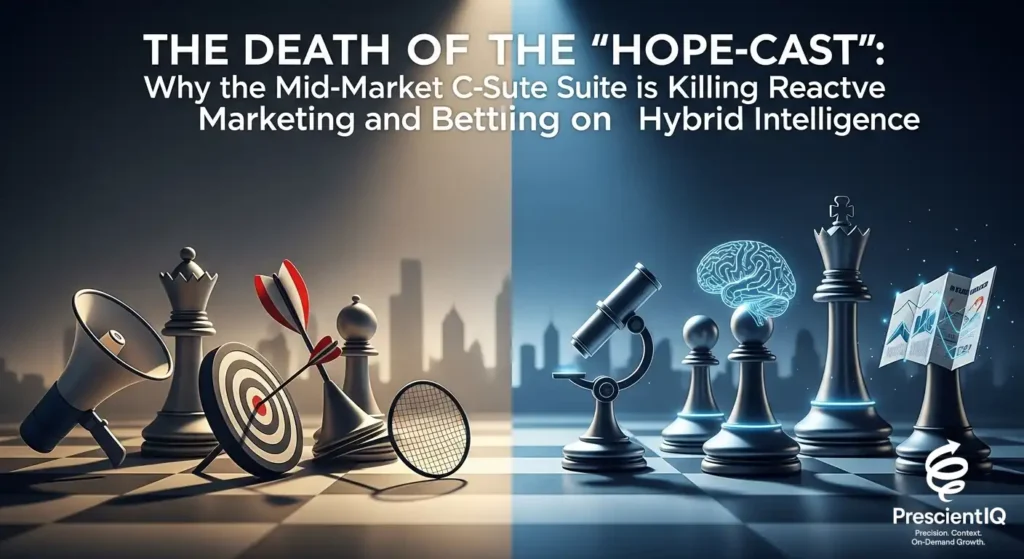
The mid-market is squeezed. You cannot out-spend the giants on R&D, and you cannot out-shout the startups on volume.
For the last three years, the typical response to this pressure was to buy more software. The average mid-market MarTech stack bloomed into a grotesque garden of disconnected point solutions—an SEO tool here, an intent-data platform there, a CRM that hates them both.
By 2025, CEOs realized they hadn’t built a growth engine; they had built a technical debt generator. They were sitting on terabytes of data but were functionally blind. The tools were smart, but the connections between them were dumb.
In 2026, the spending priority has shifted drastically from buying tools to buying clarity. The modern CFO is demanding “Glass-Box” transparency.
If Marketing puts a dollar into the machine, the CFO demands to see the causal chain—not just correlation—leading to $12.50 in pipeline revenue.
If your marketing leader cannot provide that glass box, their budget is getting slashed.
II. The Trend: From Historical Analytics to “Pre-Factual” Simulation

The most significant shift in 2026 spending is abandoning historical analytics as a planning tool.
Looking at Q4 2025 performance to plan Q2 2026 strategy is now considered organizational malpractice. The variables change too fast. Algorithms shift, competitors pivot, and buyer sentiment continually re-optimizes.
The leading mid-market companies are reallocating budget toward Unified Causal Intelligence and Simulation-First Marketing.
This is not about asking “What happened?” It’s about asking “What if?”
Instead of launching a $200,000 LinkedIn ad campaign and hoping it works, companies are investing in platforms that create “digital twins” of their market environment. They run the campaign in a simulated reality 10,000 times overnight, adjusting variables—budget weighting, creative messaging, target account lists—to find the optimal path to revenue before spending a single real-world dollar.
This is the financialization of marketing. It treats campaign spend like a portfolio investment, requiring stress-testing and probabilistic modeling before capital deployment.
The CFO loves this. It eliminates the “experimental budget” black hole. You aren’t funding a marketing experiment; you are funding a pre-validated probability curve.
The spend isn’t released until the simulation proves the ROI floor. Mid-Market C-Suite is Killing Reactive Marketing and Betting on Hybrid Intelligence, and do you know why?
III. The Crisis: The AI Talent Gap is the New Technical Debt
This drive toward simulation and advanced AI exposes the most critical crisis facing mid-market C-suites in 2026: You cannot hire the people to run this stuff.
We are in the depths of the “AI Fluency Gap.”
While 95% of B2B marketing teams claim to use AI, most are merely “prompt jockeys”—using ChatGPT to write mediocre emails or Midjourney to generate blog art.
True simulation-first marketing requires a different breed of talent.
It requires causal AI architects, econometricians, and data strategists who understand the nuances of B2B SaaS metrics like Net Revenue Retention (NRR), Annual Contract Value (ACV), and CAC payback periods.
An enterprise giant can afford to pay $350,000 a year for a Lead Data Scientist. A mid-market firm cannot afford three of them, let alone the twelve needed to run a fully autonomous marketing operation.
This creates a dangerous trap. CEOs are approving budgets for sophisticated AI platforms, but their internal teams lack the expertise to orchestrate them. The result is a Ferrari engine dropped into a go-kart chassis. The technology sits idle, or worse, it’s used incorrectly, generating “hallucinated” strategies that burn cash faster than manual methods ever could.
In 2026, the biggest waste of marketing spend isn’t bad ad copy; it’s underutilized AI infrastructure due to the talent void.
IV. The Solution: The Rise of “Hybrid Intelligence” (Models + Pods)
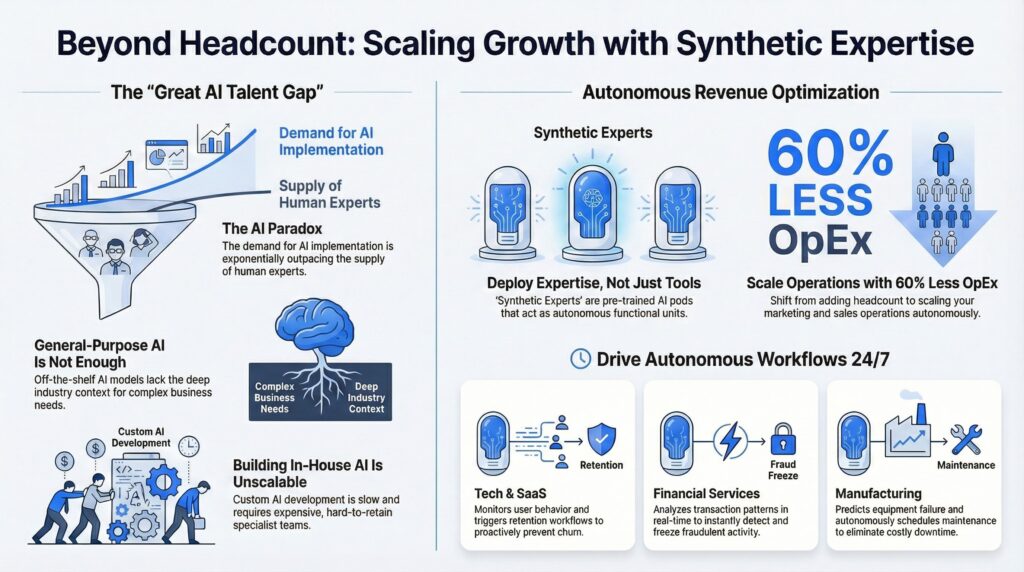
So, how does the mid-market CEO solve the paradox? How do you gain enterprise-level predictive capability without an enterprise-level payroll?
You stop trying to build it in-house.
The smartest money in 2026 is moving away from disjointed SaaS tools and toward integrated “Hybrid Intelligence” ecosystems.
This is the recognition that AI is not a replacement for human expertise, but a force multiplier that requires highly specialized human guidance.
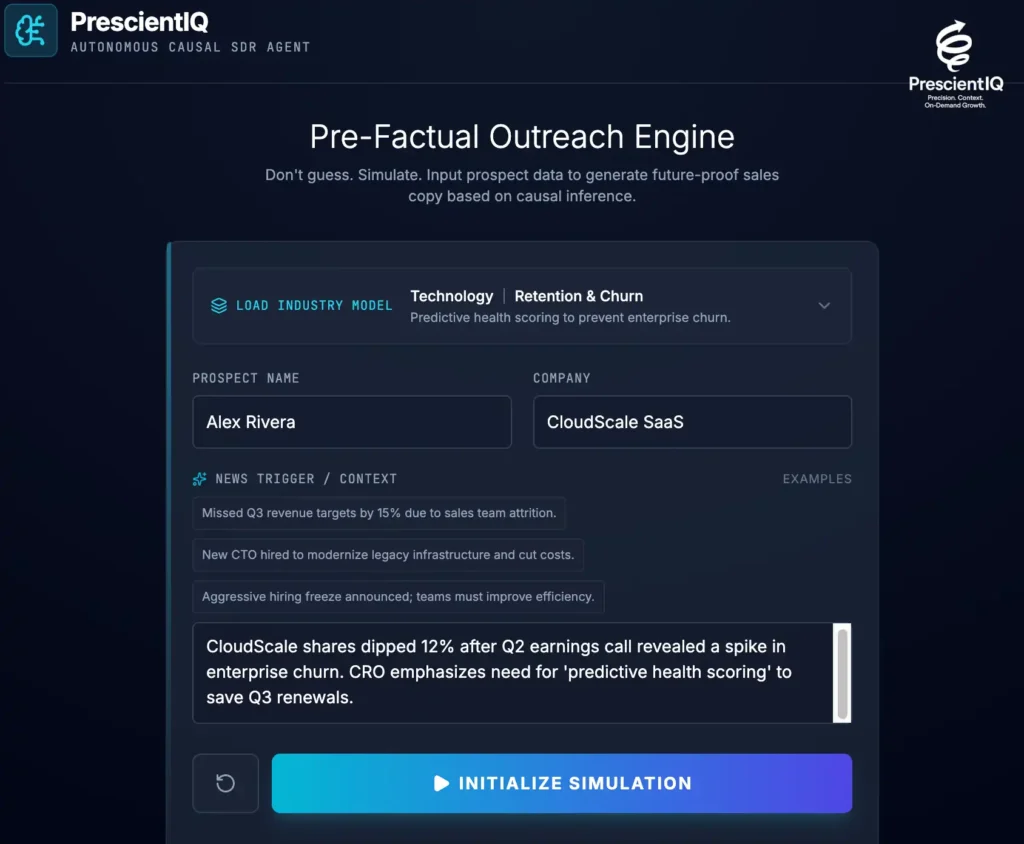
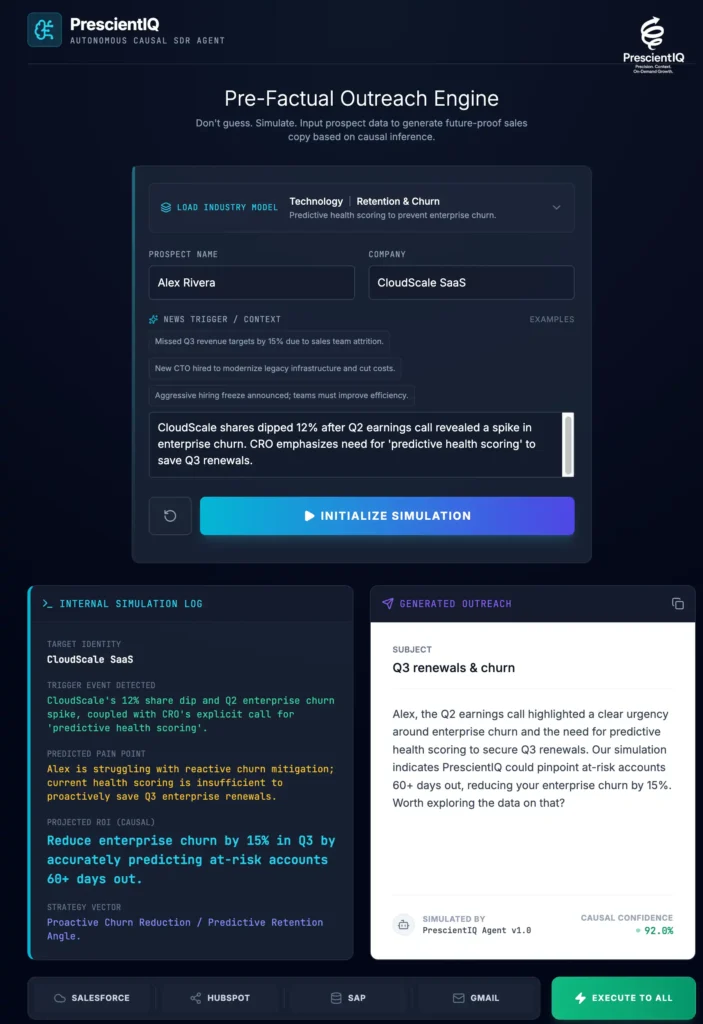
This is where solutions like PrescientIQ are fundamentally reshaping mid-market strategy.
They are not selling a tool; they are selling an outcome based on a new operational model designed specifically for the mid-market reality.
The PrescientIQ approach—and the model for 2026 success—addresses the two core crises simultaneously: the need for industry-specific precision and the lack of in-house talent.
The “Industry Model” Advantage (Stopping the Hallucinations)
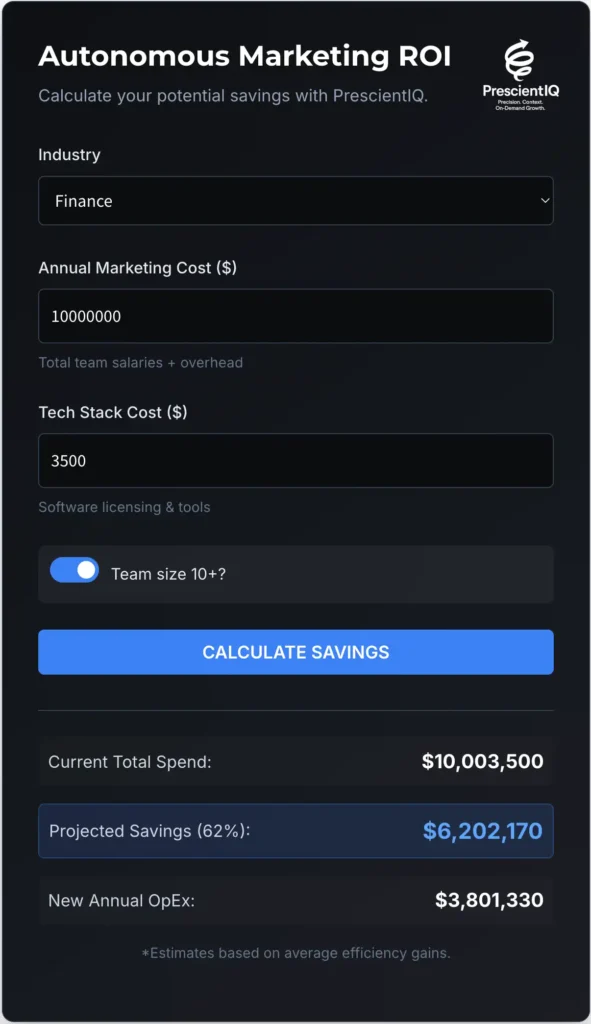
Generic Large Language Models (LLMs) are jacks-of-all-trades and masters of none. If you ask a generic model to optimize a B2B complex sales cycle campaign, it will give you advice suitable for selling sneakers directly to consumers.
It doesn’t understand the difference between an MQL and an SQL in the context of cybersecurity software.
The 2026 spend is shifting toward pre-trained Industry Models.
PrescientIQ, for example, offers models specifically trained on the B2B technology and SaaS landscapes.
These models already “know” the jargon, the typical sales cycles, the buying committee dynamics, and the key performance indicators of your sector.
For the CEO, this means drastically reduced Time-to-Value.
You don’t spend six months “teaching” the AI your business. It hits the ground running, running simulations based on relevant industry data from day one.
The “Pods” Model (Closing the Talent Gap)
This is the critical innovation for the C-suite.
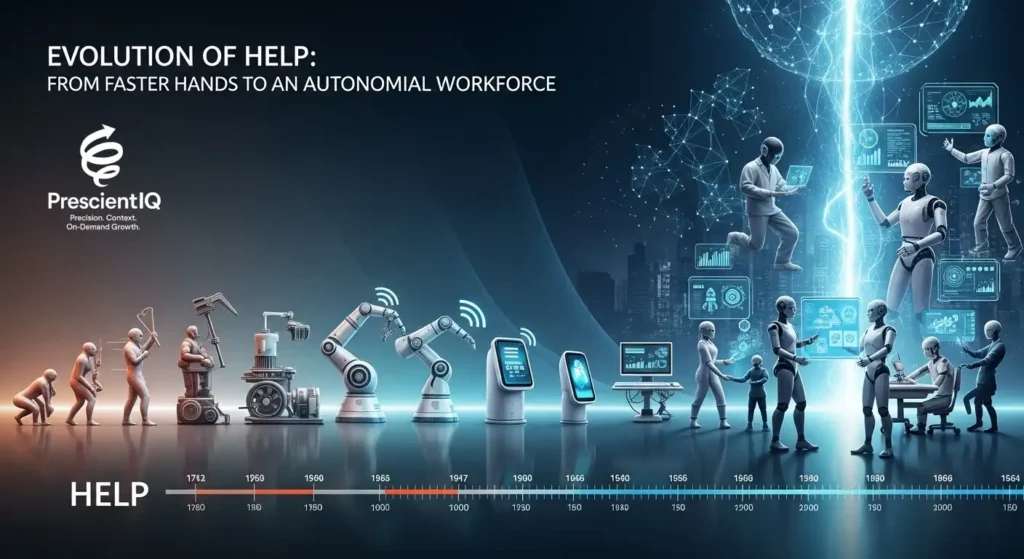
Recognizing that mid-market companies cannot hire the necessary data science talent fast enough, the new model bundles the software with the human expertise needed to run it.
PrescientIQ doesn’t just hand you a login to a complex simulation engine and wish you luck. They provide access to “AI Pods”—specialized teams of strategists and data scientists from Matrix Marketing Group.
Think of it as “Data Science as a Service,” but deeply integrated into the platform.
These Pods act as an extension of your internal team. They are the pilots for the complex aircraft you just bought. They orchestrate the Unified Causal Intelligence engine, interpret the simulation results, and ensure the AI remains aligned with your quarterly revenue targets.
For the CEO and CFO, this is the ultimate derisking move.
It converts fixed payroll costs into variable, scalable OpEx. You gain the capabilities of an elite data science team without the recruitment headaches, retention risks, or massive overhead.
V. The C-Suite Mandate for 2026
The mandate for the mid-market tech CEO in 2026 is clear: Stop guessing. Mid-Market C-Suite is Killing Reactive Marketing and Betting on Hybrid Intelligence and Better Performing Makreting and Sales.
The convergence of causal AI and specialized talent models has removed the excuse for opaque marketing budgets. If your marketing team cannot show you a simulation-backed probability curve for their proposed spend, send them back to the drawing board.
Your checklist for approving the 2026 marketing budget should look like this:
- KILL THE HOPE-CAST: Reject any plan based solely on backward-looking analytics or “industry benchmarks.” Demand pre-factual simulation.
- STOP HIRING GENERALISTS: Do not approve headcount for more “marketing managers” to solve a data science problem. Recognize that the talent gap is structural.
- INVEST IN HYBRID INTELLIGENCE: Shift capital toward solutions that bundle industry-specific AI models with the human expertise required to execute them.
In 2026, marketing is no longer an art form to be patronized. It is an engineering discipline to be optimized. The tools exist.
The talent models exist. The only remaining variable is the C-suite’s willingness to abandon the comfortable ambiguity of the past for the demanding precision of the future.