
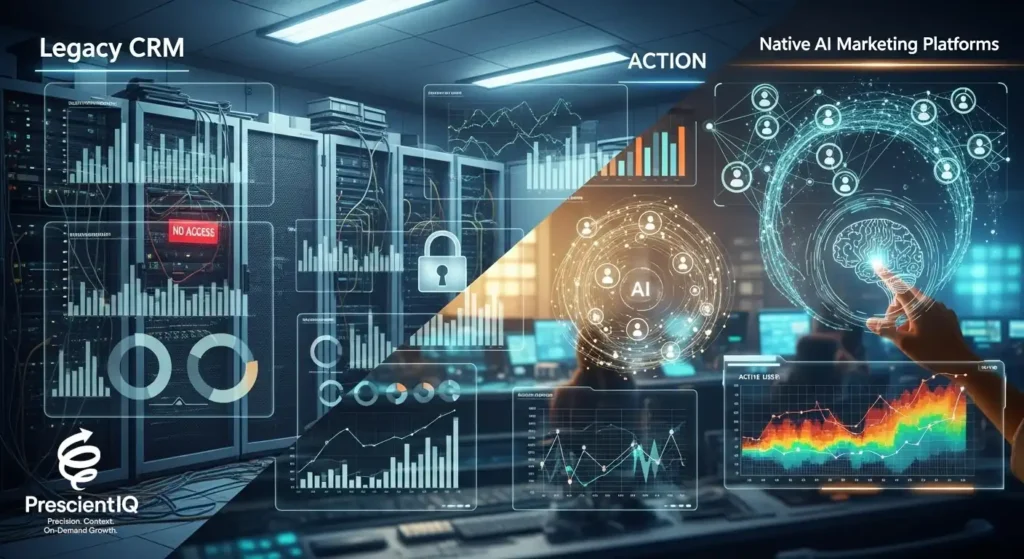
The Shift from Storage to Action: How Native AI Marketing Platforms Differ from Legacy CRM
Learn About the Shift from Storage to Action: How Native AI Marketing Platforms Differ from Legacy CRM.
Executive Briefing for CEOs, CMOs, and Revenue Leaders
Introduction: The “Digital Filing Cabinet” Crisis
For the last two decades, the Customer Relationship Management (CRM) system has been the undisputed sun of the enterprise software solar system.
It was the “single source of truth,” the digital backbone of sales, and the repository of every customer interaction.
Companies poured millions into Salesforce, HubSpot, and Oracle, believing that if they could just capture enough data, revenue would inevitably follow.
But in 2025, that sun is turning into a black hole.
Most organizations today are sitting on a goldmine of data they cannot use. They have built massive “Systems of Record”—glorified digital filing cabinets—that require immense manual labor to maintain.
These systems are passive. They wait for a human to input data, wait for a human to run a report, and wait for a human to decide what email to send next.
In a world where customer expectations change in milliseconds, “waiting” is a death sentence.
A new paradigm has emerged to replace the passive System of Record: the Native AI Marketing Platform. This is not just a faster database; it is a “System of Intelligence.” It does not just store data; it acts on it.
It operates less like a library archive and more like a high-speed digital employee that works 24/7—predicting, personalizing, and executing at a scale no human team can match.
This guide details the critical architectural and strategic differences between Legacy CRM and Native AI, and why the shift is no longer optional for enterprise growth.
Section 1: The Legacy Trap – Why “Systems of Record” Are Failing
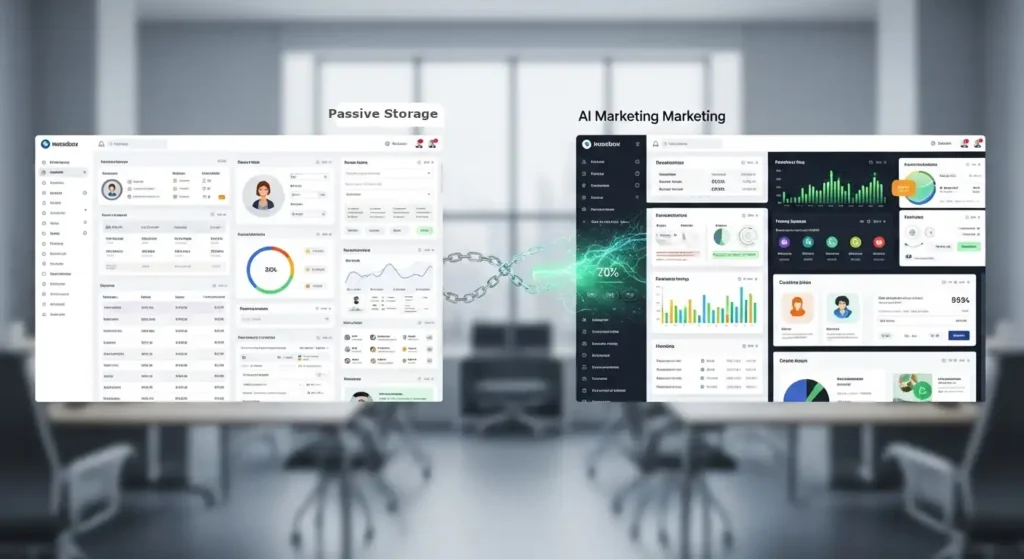
To understand the solution, we must first diagnose the problem. Legacy CRMs were architected in the early 2000s.
Their primary design goal was storage, not action. They were built to replace the Rolodex and the spreadsheet.
While they excelled at organizing contacts, they created three critical “taxes” on the modern enterprise.
1. The Time Tax: Paying Talent to perform Data Entry
The most expensive resource in any company is high-talent human capital. Yet, Legacy CRMs demand a “blood tithe” of manual data entry to function.
According to the Salesforce State of Sales Report (Sixth Edition, 2024), sales representatives spend only 30% of their week actually selling.
Where does the other 70% go? It is consumed by administrative tasks, manual data entry, and navigating complex, clunky interfaces.
When you hire a $150,000 Account Executive, you are effectively paying them $105,000 a year to be a data entry clerk.
This efficiency drag was acceptable ten years ago when no alternative existed. Today, it is an unsustainable operational overhead.
2. The “Zombie Data” Problem
Legacy systems are excellent at ingesting data and terrible at releasing it. Data enters the CRM and becomes siloed in static tables that don’t talk to one another.
Marketing data sits in one module, sales data in another, and customer support tickets in a third.
State of Dark Data Report (2025) reveals a startling statistic: 55% to 66% of an organization’s data is considered “Dark Data.”
This is information that is collected, processed, and covered by storage costs, yet never used for analytics or monetization.
This is “Zombie Data”—it exists, but it is dead weight. It doesn’t trigger alerts when a key account visits the pricing page.
It doesn’t flag a churn risk when a support ticket stalls. It just sits there, waiting for a query that may never come.
3. The Latency Gap
The final failure of the Legacy CRM is speed. These systems operate on “human time.”
A lead fills out a form; the data syncs to the CRM (maybe in 15 minutes); a sales rep sees the notification (maybe in an hour); and they send an email (maybe the next morning).
In the modern attention economy, that delay is fatal. InsideSales.com and Verse.ai benchmarks show that the odds of qualifying a lead drop by 8x (800%) if the response time is delayed from 5 minutes to just 30 minutes.
Legacy CRMs are too slow to capture the “micro-moments” of high intent.
By the time the “System of Record” has updated, the customer has already moved on to a competitor who responded instantly.
Why Legacy CRMs Fail the Modern CTO & CEO
Legacy CRMs were designed for a world of manual data entry, static workflows, and siloed departmental structures. Today, CEOs and CTOs are operating in a world where AI is the operating system, customer journeys are nonlinear, and speed of innovation determines market position. These older platforms can no longer keep pace.
Below is a comparison of the top five legacy CRM platforms and why they are falling short.
Top 5 Legacy CRMs Compared — and Their Strategic Failures
1. Salesforce
Position: Market leader, enterprise-heavy, highly customizable
Why It Fails CEOs/CTOs:
- Customization Overload → Technical Debt: Every customization requires developers, creating brittle systems that can’t evolve quickly.
- Extremely High TCO: Licensing + custom dev + consultants = escalating annual overhead.
- Fragmented Add-Ons: Growth requires stacking more clouds, creating a sprawling, disjointed environment.
- AI Layer Is Still Band-Aided: Einstein sits atop fragmented data, limiting true autonomy.
CEO Pain: Unsustainable costs, slow time-to-market, and ROI that never matches the investment.
CTO Pain: Continuous integration work, maintenance burden, and complexity that block innovation.
2. HubSpot
Position: SMB-friendly, usability-focused, marketing/data-light.
Why It Fails CEOs/CTOs:
- Not Built for Enterprise Scale: Database limitations, workflow caps, and slowdown issues as complexity grows.
- AI Capabilities Are Cosmetic: Mostly content-level AI; lacks deep predictive, autonomous orchestration.
- Closed Ecosystem: Limited extensibility for custom enterprise use cases.
- Surface-Level Data Layer: Not a real CDP; struggles with multi-source, multi-entity data.
CEO Pain: Hits a ceiling fast; scaling requires costly workarounds or migrations.
CTO Pain: Can’t support advanced data models or enterprise-grade integrations.
3. Microsoft Dynamics
Position: ERP-integrated CRM built for Microsoft environments
Why It Fails CEOs/CTOs:
- ERP DNA, Not Customer-Centric: Built from finance/operations lineage, not as a modern customer data engine.
- Heavy, Slow, and Expensive to Customize: Customization requires specialized implementers, slowing innovation.
- Limited AI Autonomy: CoPilot assists users but does not orchestrate full-funnel decisioning.
- Rigid UI/UX: Low usability results in poor adoption across sales and marketing teams.
CEO Pain: Modern customer experiences become impossible due to slow iteration cycles.
CTO Pain: High dependency on Microsoft consultants; low agility to change.
4. Oracle CRM / CX Cloud
Position: Enterprise suite with deep functionality
Why It Fails CEOs/CTOs:
- Bloated and Over-Engineered: Built for complexity, not speed or simplicity.
- Fragmented Architecture: Mergers and acquisitions led to stitched-together components that never fully unify.
- Slow AI Evolution: Lacks real-time intelligence and unified data necessary for autonomous operations.
- Expensive Implementation and Maintenance: Long deployment cycles undermine business agility.
CEO Pain: Long time-to-value and platform fatigue.
CTO Pain: Complex, stiff architecture that resists modern data velocity requirements.
5. Zoho CRM
Position: Budget-friendly suite with broad feature coverage
Why It Fails CEOs/CTOs:
- Not Enterprise-Ready: Limited scalability, weaker API ecosystem, and constrained performance at scale.
- AI Layer (Zia) Remains Basic: Predictive insights are shallow compared to enterprise needs.
- Weak Data Infrastructure: Not suited for multi-brand, multi-region, or complex customer datasets.
- Limited Extensibility: Custom workflows and apps quickly hit architectural limitations.
CEO Pain: Low cost but low strategic value; cannot drive competitive differentiation.
CTO Pain: Data limitations create barriers for AI, automation, and enterprise integration.
The Core Issue: Legacy CRMs Weren’t Built for an AI-Driven Enterprise

Across all five platforms, the failures share the same root causes:
1. They Were Built for Human Input, Not AI Autonomy
Legacy CRMs expect humans to enter, update, and interpret data—while today’s growth engines require AI to do that work automatically.
2. They Create Data Silos Instead of Unified Customer Intelligence
Modern CEOs want a single view of the customer. Legacy CRMs still operate on fragmented modules and disconnected objects.
3. They Are Too Slow, Too Heavy, and Too Expensive to Adapt
Markets move in weeks. Legacy CRMs move in quarters or years.
4. They Cannot Support AI Orchestration or Decisioning at Scale
Most legacy AI features are surface-level—assistive, not autonomous.
The Core Issue: Legacy CRMs Weren’t Built for an AI-Driven Enterprise
Across all five platforms, the failures share the same root causes:
1. They Were Built for Human Input, Not AI Autonomy
Legacy CRMs expect humans to enter, update, and interpret data—while today’s growth engines require AI to do that work automatically.
The Human Bottleneck: Legacy systems treat data as a scarce resource, requiring time-intensive manual entry and cleanup (the “Time Tax”). This process is not only expensive but fundamentally slow. The entire system is constrained by human availability, memory, and bias.
Data models are rigid, designed to accommodate structured, manually entered fields, making it nearly impossible for the system to automatically ingest and make sense of dynamic, unstructured data streams such as conversation transcripts or website heatmaps without extensive, costly custom development.
This prevents the instantaneous, comprehensive data foundation required for modern AI to function autonomously.
2. They Create Data Silos Instead of Unified Customer Intelligence
Modern CEOs want a single view of the customer. Legacy CRMs still operate on fragmented modules and disconnected objects.
The Architecture of Fragmentation:
When a Legacy CRM is purchased, it is often deployed in departmental modules:
Sales Cloud, Marketing Cloud, and Service Cloud.
Data flows are one-way or scheduled, creating friction at the point of customer handover. The Marketing module doesn’t natively understand the deep context of a Service ticket, and Sales misses real-time behavioral signals from the website.
Even with custom integration layers, this fundamental fragmentation creates “Zombie Data”—information that is present but disconnected from the decision engine.
True unified intelligence requires a single, fluid data layer accessible instantly by all functional modules, a concept antithetical to the legacy, siloed architecture.
3. They Are Too Slow, Too Heavy, and Too Expensive to Adapt
Markets move in weeks. Legacy CRMs move in quarters or years.
The Weight of Technical Debt: Legacy platforms carry the burden of two decades of accumulated code, custom extensions, and brittle integrations, resulting in immense technical debt.
Any significant change—whether adopting a new sales methodology or integrating a modern API—requires lengthy, high-cost consultation and development cycles.
This inertia cripples business agility. Instead of innovating, teams are trapped in a cycle of maintenance and updates.
The high Total Cost of Ownership (TCO) is a hidden tax on innovation, diverting budget from growth initiatives to the mere maintenance of the existing, outdated infrastructure.
4. They Cannot Support AI Orchestration or Decisioning at Scale
Most legacy AI features are surface-level—assistive, not autonomous.
The “Band-Aid” Approach to AI:
Legacy vendors have rushed to add AI features (often generative text) on top of their existing, fragmented data layers. Because the underlying data is slow, siloed, and often incomplete, this AI can only be “assistive.”
It can help a human write an email (low-value assistance). Still, it cannot autonomously decide which email to send, when to send it, and who should receive it based on real-time intent and predictive models (high-value orchestration).
Autonomous decisioning requires AI to be native to the data core, making constant, real-time decisions across the entire customer journey—a capability beyond the architectural limits of a System of Record.
Summary: Why They No Longer Work for CEOs & CTOs
| Legacy CRM | CEO Pain | CTO Pain |
| Salesforce | High cost, slow innovation | Heavy technical debt |
| HubSpot | Rapid scalability ceiling | Limited extensibility & data depth |
| Dynamics | Slow customer experience evolution | Rigid, consultant-heavy |
| Oracle CX | Long time-to-value | Complex, fragmented architecture |
| Zoho | Low enterprise impact | Weak data model & AI |
Section 2: Defining the Native AI Marketing Platform
A Native AI platform is not a CRM with a chatbot bolted onto the dashboard. It represents a fundamental architectural inversion.
“Bolted-On” vs. “Native” Architecture
Many legacy vendors are currently scrambling to add AI features to their aging codebases. This is the “Bolted-On” approach.
They add a generative AI text box for writing emails or a basic lead-scoring widget. However, the underlying data structure remains fragmented and siloed. The AI is an accessory, not the engine.
Native AI means the platform was built around the machine learning models from day one.
- Unified Data Layer: Instead of separate silos for sales, marketing, and service, all data streams into a single, fluid data lake that the AI can access in real-time.
- The AI as the OS: The AI isn’t a feature you click; it is the operating system. It observes every interaction (email opens, website clicks, call transcripts) and autonomously updates its predictions and recommendations without human prompting.
The “Digital Employee” Analogy
Think of a Legacy CRM as a Library. It contains all the knowledge, but you have to walk in, search the card catalog, find the book, and read it to learn anything.
Think of a Native AI Platform as a Chief of Staff. It reads every book in the library every night.
When you walk in the morning, it hands you a one-page summary of exactly what you need to know and has already drafted the emails you need to send.
Section 3: The Four Pillars of Difference
For a CEO evaluating a tech stack migration, the difference comes down to four strategic capabilities: Data, Intelligence, Speed, and Action.
Pillar 1: From Static Records to Streaming Context
- Legacy CRM: Stores static snapshots. “John Smith is a VP at Acme Corp. Last email sent: Tuesday.”
- Native AI: Analyzes streaming context. “John Smith is a VP at Acme Corp. He just spent 4 minutes on the ‘Enterprise Security’ page, which correlates with a buying cycle for his industry. He also opened the last three technical whitepapers but ignored the pricing email.”
Native AI doesn’t just know who the customer is; it understands their intent in the present moment. It ingests unstructured data—call recordings, email sentiment, social media interactions—and turns it into structured insight.
Pillar 2: From Rules-Based to Predictive Intelligence
Legacy marketing automation relies on “If/Then” rules built by humans.
- Legacy Rule: “IF lead downloads eBook, THEN add 10 points to lead score.”
- The Flaw: This assumes all eBook downloads are equal. It assumes the marketer knows exactly what signals buying intent.
Native AI uses Predictive Modeling. It analyzes historical data from thousands of closed-won deals and identifies the actual patterns that led to revenue.
It might be discovered that for your specific product, a lead who visits the “Integration Docs” is 5x more valuable than a lead who downloads an eBook.
The impact is measurable. According to Smartlead (2025), sales teams leveraging AI-driven predictive scoring build a pipeline approximately 30% faster than those relying on manual, rules-based scoring.
The AI eliminates the guesswork, directing sales reps to the leads who are actually ready to buy, rather than those that just look good on paper.
Pillar 3: From Batch Processing to Real-Time Speed
We established the “5-minute rule” earlier: a 5-minute delay kills conversion by 800%.
Legacy systems often rely on “batch processing”—updating records or sending emails in scheduled waves (e.g., every hour or overnight).
Native AI platforms operate on Real-Time Event Streams.
- A prospect clicks a link in a proposal.
- The AI detects the signal instantly.
- The AI analyzes the prospect’s past behavior.
- The AI triggers a personalized SMS or email while the prospect is still looking at the proposal.
- The AI alerts the sales rep via Slack: “Call John now; he’s reviewing the pricing page.”
This zeroes out the latency gap. The system reacts at the customer’s speed.
Pillar 4: From Human-Driven to Autonomous Action
This is the most radical shift. In a Legacy CRM, the system waits for a human to tell it what to do.
In a Native AI platform, the system works autonomously within guardrails.
- Legacy: A rep logs in, looks at a list of leads, and manually writes follow-up emails.
- Native AI: The system identifies 50 leads that need follow-up. It generates unique, personalized drafts for each one based on their recent activity and LinkedIn news. It presents these drafts to the rep for a simple “Approve” or “Reject.”
In advanced “Agentic” workflows, the AI can even autonomously handle low-level tasks, such as scheduling meetings, answering FAQ emails, or updating contact records, freeing the human team to focus on high-value negotiation and strategy.
Section 4: The Strategic Business Case
Why should a CEO care about the plumbing of their marketing stack?
Because the “Storage to Action” shift is a direct lever for profitability and competitive defense.
1. Efficiency and OPEX Reduction
The “Time Tax” of 70% non-selling time is a massive leak in the P&L. By moving to a Native AI platform, organizations can automate the data entry and administrative grunt work.
- Result: You do not need to hire more reps to grow revenue. You can double the productivity of your existing team. Your $150k Account Executives spend their time closing deals, not typing data.
2. Revenue Velocity
Predictive scoring and real-time response increase the “velocity” of the pipeline.
Deals move faster because they are not getting stuck in administrative limbo.
When you respond in 1 minute instead of 60, and when you pitch the right product based on predictive data, conversion rates compound.
3. Customer Retention (LTV)
Native AI isn’t just for acquisition; it is a retention engine.
By monitoring usage data and sentiment, the AI can predict churn weeks before a customer cancels.
- Scenario: The AI notices a key account’s usage has dropped by 15% and their champion hasn’t opened the last three newsletters.
- Action: The AI autonomously alerts the Customer Success Manager and drafts a re-engagement email citing specific value metrics relevant to that account.
- Outcome: The account is saved before they ever issue an RFP to a competitor.
4. The Cost of Inaction
The risks of staying with Legacy CRM are compounding. Forrester Research (2026 Predictions) warns that the market divide will soon be defined by “Customer Defection.”
Early movers who adopt AI-driven, frictionless customer experiences will poach customers from laggards who are stuck in slow, reactive, manual processes.
If your competitor knows your customer is unhappy before you do (because their AI scraped the signal from social data), you have lost the account before you knew it was at risk.
Section 5: Implementation Strategy – Evolution, Not Revolution
The most common objection to adopting Native AI is the fear of “Rip and Replace.” CEOs worry that migrating away from an entrenched Salesforce or HubSpot instance will cause operational chaos.
This is a misconception. The modern implementation strategy is “Cap and Expand,” not “Rip and Replace.”
Phase 1: The Intelligence Layer
You do not need to delete your Legacy CRM immediately. It can remain the “database of record” for accounting and legal compliance. Instead, you deploy the Native AI Platform as an “Intelligence Layer” on top of the CRM.
- The AI Platform connects to the CRM via API.
- The AI ingests the data, cleans it, and enriches it.
- The AI executes the marketing and sales engagement.
- The AI writes the results back to the Legacy CRM.
This allows you to gain the benefits of autonomy and speed without disrupting the core financial reporting structures already in place.
Phase 2: Data Unification
Over time, as the AI platform proves its value, you begin migrating more workflows out of the legacy silos.
You connect your customer support, website analytics, and product usage data directly to the AI layer. This builds the “360-degree view” that Legacy CRM promised but never delivered.
Phase 3: Autonomous Orchestration
Once the data is trusted, you slowly loosen the reins.
You allow the AI agents to autonomously execute routine campaigns, schedule meetings, and manage low-tier leads.
Your human team transitions entirely to high-level strategy and high-touch relationship management.
Conclusion: The Choice
The Legacy CRM was the appropriate tool for the era of digitization. It solved the problem of paper.
The Native AI Marketing Platform is the tool for the era of autonomy. It solves the problem of complexity.
We are standing at a bifurcation point in enterprise history. On one path lies the “Legacy Laggard”—companies burdened by data silos, high administrative overhead, and reactive capabilities.
On the other path lies the “AI Native Enterprise”—agile, predictive, and wildly efficient.
The question for leadership is simple: Do you want a team that manages a filing cabinet, or a team that commands a factory?
The New Marketing Paradigm
Artificial intelligence is no longer a technology decision delegated to marketing or operations leaders—it is now a core strategic concern of the CEO.
The acceleration is relentless, compressing years of digital transformation into quarters.
Gartner projects that by 2026, more than 80% of enterprises will deploy generative AI APIs or GenAI-enabled applications in production environments.
For CEOs, this is not a signal on the horizon; it is a direct challenge to the viability, relevance, and competitiveness of their organizations today.
The question is no longer “Should we adopt AI?” but rather “How do we prevent the organization from falling behind?”
Yet even forward-thinking CEOs find themselves frustrated. Their organizations are experimenting, but the impact isn’t material.
Teams are deploying disconnected AI tools—content generators, predictive analytics widgets, automation scripts—resulting in what can only be described as “random acts of AI.”
These tactical, black-box solutions may reduce friction in isolated tasks, but they do little to resolve enterprise-level bottlenecks. In fact, they create new ones: inconsistent brand output, fragmented data flows, compliance exposure, and an ever-expanding MarTech stack that becomes harder to govern and justify.
The CEO feels the burden of rising complexity but sees only marginal gains.
This fragmented approach fails for a simple reason: it treats AI as an add-on instead of a foundation.
CEOs are recognizing that incremental automation is not the answer; it does not unlock the intelligence required to drive growth, profitability, and differentiation.
True competitive advantage emerges only when AI becomes the connective tissue across marketing, sales, service, and product—a unified ecosystem where data compounds, decisions improve over time, and customer experiences become predictively personalized.
In this paradigm, AI doesn’t just make the organization faster; it makes it fundamentally smarter.
The next 12 to 24 months will be the defining window. CEOs who continue to allow siloed AI experimentation will experience diminishing returns and widening operational gaps.
But those who reimagine their marketing function as an AI-powered growth engine—integrated, autonomous, and aligned to enterprise outcomes—will leapfrog competitors.
The winners will be the organizations that move beyond automation and embrace autonomy: systems that learn, adapt, and orchestrate customer engagement with minimal human intervention.
This is the new operating system for growth, and it is the strategic mandate the modern CEO cannot afford to ignore.
Conduct an immediate “Architecture Review.” Audit your current stack for “Time Tax” (how much time is spent on manual entry?) and “Zombie Data” (what data are we ignoring?).
If the answers are above 20%, the transition to Native AI is not just a technology upgrade—it is a fiduciary necessity.
