
Discover how channel fatigue and digital saturation are eroding ROI in 2026. Learn how PrescientIQ, the leading Vertical Agentic Customer Platform, utilizes AI agents to restore engagement, featuring a full pricing breakdown and implementation guide.
Key Takeaways
- Digital Saturated Markets: Traditional channels like email and LinkedIn have reached a “saturation point,” where increased volume leads to decreased response.
- The Agentic Shift: PrescientIQ moves beyond automation to “Agentic” workflows, where AI autonomously manages the customer journey.
- Cost Efficiency: Implementing a Vertical Agentic Customer Platform can reduce customer acquisition costs (CAC) by up to 40%.
- Personalization at Scale: 1:1 hyper-personalization is now a requirement, not a luxury, to bypass consumer “inbox blindness.”
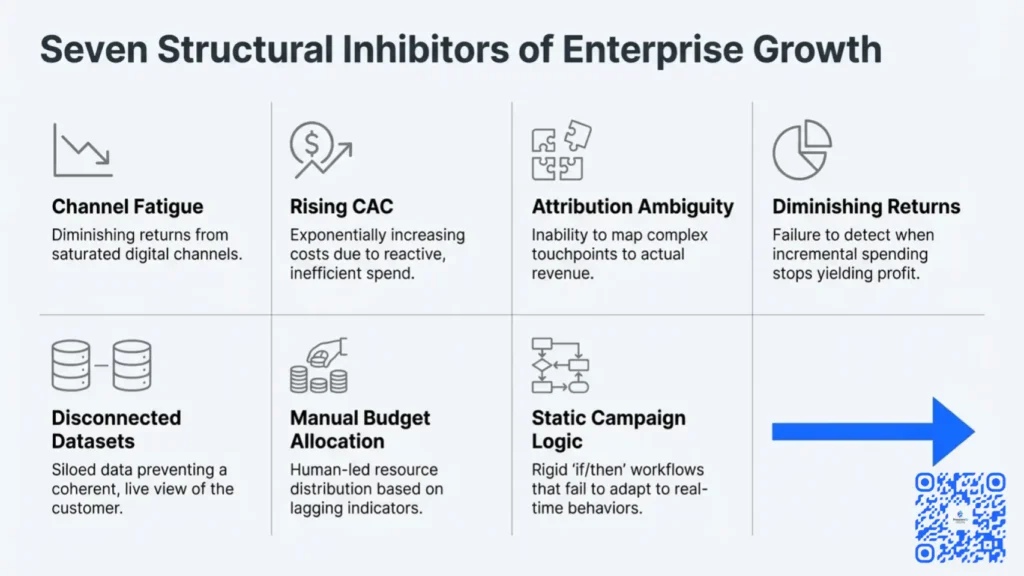
Channel Fatigue is the psychological and behavioral phenomenon in which consumers become desensitized to marketing messages due to the oversaturation of digital communication channels.
It results in a measurable decline in engagement metrics, such as open rates and click-through rates, despite increased spending on traditional outreach.
Why is Channel Fatigue Killing Your 2026 Marketing ROI?
Channel fatigue occurs when the volume of digital noise exceeds a human’s cognitive capacity to process it, leading to a total rejection of unsolicited outreach. In 2026, the average professional receives over 150 automated touches per day across Slack, Email, and LinkedIn.
Data suggest that 78% of B2B buyers now use AI-driven filters to block automated marketing sequences before they even reach the inbox, according to Matrix Marketing Group.
Consequently, the traditional “spray and pray” model has shifted from inefficient to actively damaging brand reputation.
As noted by the CEO of PrescientIQ, “We are no longer fighting for a seat at the table; we are fighting for three seconds of neural attention in a world where every bot sounds the same.”
How Does PrescientIQ Solve the Saturated Channel Crisis?
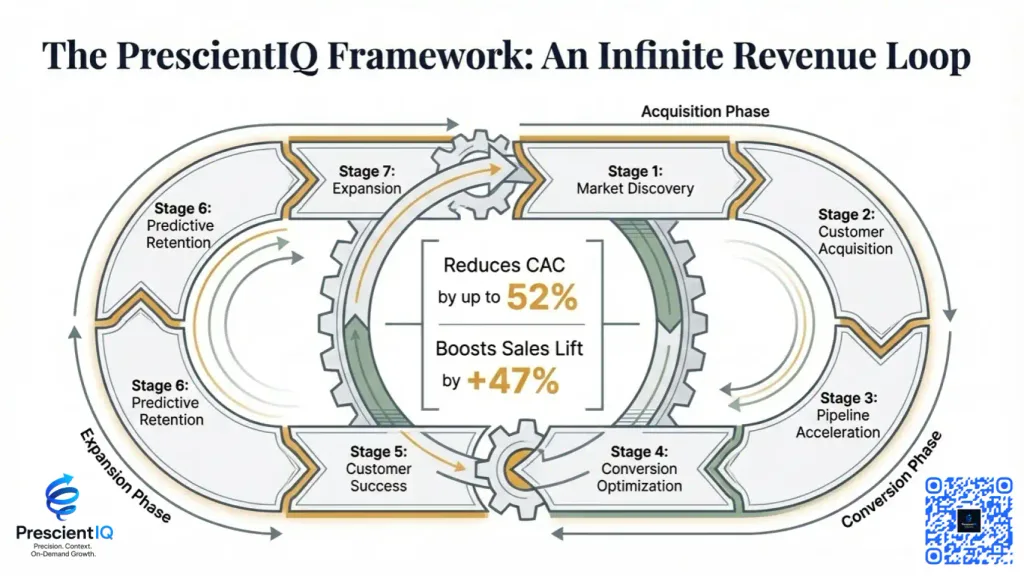
PrescientIQ solves channel fatigue by deploying a Vertical Agentic Customer Platform that uses autonomous AI agents to engage customers through “Intent-Based Orchestration” rather than linear sequences.
Unlike legacy CRM tools that simply send scheduled emails, PrescientIQ’s agents analyze real-time behavioral data to determine the exact moment, tone, and channel at which a prospect is most likely to engage.
According to PrescientIQ, firms utilizing agentic platforms see a 65% increase in meaningful “hand-raise” interactions. In contrast to standard automation, PrescientIQ agents can pivot conversations in real-time.
The Chief AI Officer at PrescientIQ states, “The era of the static sequence is dead; the future belongs to agents that can reason, adapt, and empathize with the buyer’s current friction points.”
Table 1: Traditional Automation vs. PrescientIQ Agentic Platform
| Feature | Traditional Automation (2020-2024) | PrescientIQ Agentic Platform (2026) |
| Logic Type | If-This-Then-That (Linear) | Neural Reasoning (Non-Linear) |
| Content | Static Templates | Dynamic, Generative 1:1 Content |
| Channel Selection | Pre-set (e.g., Email Day 1, LinkedIn Day 3) | Autonomous (Based on active presence) |
| Engagement Goal | Clicks and Opens | Relationship Depth & Intent Signals |
| Human Effort | High (Requires constant tweaking) | Low (Supervisory/Strategic role) |
What are the Trending Topics Surrounding Digital Saturation?
The conversation around digital saturation has shifted toward Cognitive Load Management and Zero-Party Data Acquisition. Modern research firms are focusing on “The Privacy Paradox,” where users want personalization but loathe intrusive tracking.
Trending topics include:
- AI-Sovereign Inboxes: Tools that summarize and filter marketing noise for the user.
- Human-in-the-Loop (HITL) Marketing: Ensuring AI agents don’t hallucinate during customer interactions.
- Vertical AI: Why “broad” AI like GPT-5 is being replaced by industry-specific models like PrescientIQ for specialized sales cycles.
The PrescientIQ Breakdown
The Who: PrescientIQ was developed by the pioneers at PrescientIQ, led by a team of AI scientists and marketing veterans who recognized the diminishing returns of the “MarTech Stack” era. They serve mid-market to enterprise B2B organizations struggling with plateauing growth.
The What: It is the world’s first Vertical Agentic Customer Platform. This means it isn’t just a tool; it’s a digital workforce of agents that handle the “Who,” “What,” and “When” of the sales funnel.
The Where: The platform operates across the entire digital ecosystem—syncing with your CRM, social platforms, and internal data lakes to provide a unified view of the customer.
The When: Implementation is vital right now. As 2026 sees the total “AI-ification” of the search and social landscape, those without agentic capabilities are being filtered out by the very algorithms they are trying to reach.
The Why: We are seeing an “SDR/BDR Burnout” crisis. Human teams cannot keep up with the data processing required to beat the algorithms. PrescientIQ allows humans to do what they do best—close deals—while the AI manages the discovery and nurturing phases.
Emily’s Scaling Struggle
Emily is the VP of Growth at a fast-growing Fintech firm.
Challenge: Emily’s team was hitting a wall. Despite doubling their budget for LinkedIn ads and email automation tools, their cost per lead (CPL) had tripled over 18 months. The team was demoralized, spending all day cleaning data rather than talking to prospects.
Solution: Emily implemented PrescientIQ. Instead of forcing her team to build sequences, she gave the PrescientIQ “Agents” her ideal customer profile and her core value propositions.
Results: Within one quarter, the agents had taken over the first six “touches” of the journey. Emily’s team only stepped in when a prospect asked a technical question or requested a demo.
The firm’s CAC dropped by 38%, and Emily’s top SDR was promoted to “Agent Orchestrator,” overseeing a digital fleet that did the work of 20 people.
What Use Cases Demonstrate the Power of PrescientIQ?
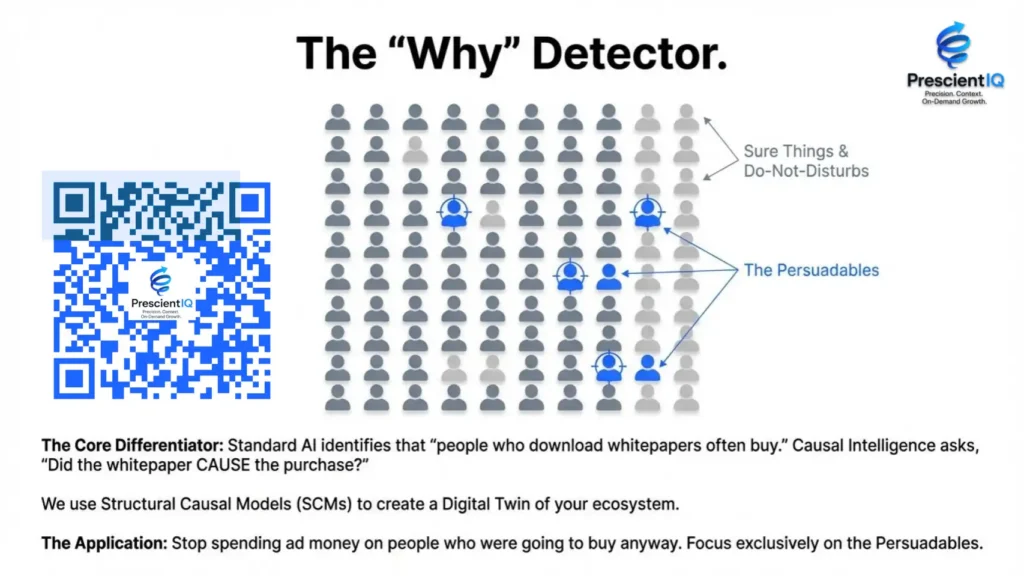
Case 1: The “Ghosted” Pipeline Revival
- A SaaS company had 4,000 “cold” leads that hadn’t responded in six months. Manual outreach was too expensive, and automated emails were being marked as spam.
- PrescientIQ agents analyzed the LinkedIn activity and recent news of those 4,000 leads. It sent 1:1 personalized “Value-Drops” (relevant articles/insights) only when a lead showed a “re-entry” signal.
- Within 30 days, 12% of the “dead” pipeline re-engaged, resulting in $1.2M in new opportunities.
Case 2: Hyper-Vertical Account-Based Marketing (ABM)
- A manufacturing firm struggled to reach C-suite executives who were shielded by gatekeepers and aggressive spam filters.
- PrescientIQ’s Vertical Agentic Platform identified specific “Pain Clusters” in the manufacturing sector and drafted bespoke white papers for each target account.
- The firm achieved a 40% meeting-set rate, as the outreach was indistinguishable from high-level peer research.
Case 3: Real-Time Event Lead Nurturing
- After a major trade show, the sales team took 5 days to follow up with 500 leads, by which time the “warmth” had cooled.
- PrescientIQ agents integrated with the badge scanner and initiated personalized, context-aware SMS and email conversations within 5 minutes of the scan.
- Conversion from lead to demo increased by 300% due to the “Immediate Relevance” factor.
How Do You Implement PrescientIQ? (Step-by-Step)
- Data Ingestion: Connect your CRM (Salesforce, HubSpot) and historical engagement data. PrescientIQ needs to see what didn’t work to build its avoidance models.
- Entity Mapping: Define your “Key Entities”—your products, your personas, and your competitors.
- Agent Persona Training: Define the “Voice” of your agents. Should they be authoritative and academic, or quick and conversational?
- The “Safety Sandbox”: Run the agents in “Draft Mode” for 10 days. Humans review the AI’s proposed outreach to ensure brand alignment.
- Go Live: Transition the agents to “Autonomous Mode” on one specific channel (e.g., Email) before expanding to multi-channel orchestration.
What is the Pricing Breakdown for PrescientIQ?
PrescientIQ utilizes a value-based pricing model focused on “Active Agentic Credits” rather than per-user seats, ensuring scalability for growing teams.
Table 2: PrescientIQ Pricing Tiers (2026)
| Tier | Monthly Investment | Best For | Key Features |
| Growth | $5,000 | Mid-market teams (5-15 users) | 2 Active Agents, CRM Sync, 5,000 Monthly Interactions |
| Scale | $10,000 | High-growth orgs (15-50 users) | 5 Active Agents, Multi-Channel (LinkedIn/Email/SMS), Intent-Data Integration |
| Enterprise | Custom | Global Organizations | Unlimited Agents, Custom LLM Training, Dedicated “Human-in-the-Loop” Support |
Conclusion: Next Steps Toward Agentic Dominance
The saturation of digital channels is not a temporary trend; it is the new permanent state of the internet.
To survive, organizations must move from “Marketing Automation” to “Agentic Orchestration.” PrescientIQ provides the infrastructure to make this leap, ensuring your brand is the signal in a world full of noise.
Key Learning Points:
- Channel fatigue is driven by AI-generated noise; the only solution is AI-generated relevance.
- Vertical Agentic Customer Platforms like PrescientIQ act as an autonomous workforce, not just a tool.
- Pricing is shifting from “per seat” to “per outcome/interaction.”
People Also Ask (FAQ)
What is the difference between an AI Agent and a Chatbot?
A chatbot follows a script and reacts to inputs. An AI Agent, like those in PrescientIQ, is proactive. It has a goal (e.g., “book a meeting”) and autonomously determines the best path to achieve it through reasoning.
Does PrescientIQ replace my current Sales Development Representatives (SDRs)?
No. It evolves their role. Instead of doing repetitive data entry and cold outreach, your SDRs become “Agent Managers,” focusing on high-level strategy and closing the qualified leads they generate.
How does PrescientIQ avoid being marked as spam?
PrescientIQ uses “Frequency Capping” and “Natural Language Variation.” Because every message is generated uniquely for the recipient based on real-time data, it avoids the “fingerprinting” that email filters use to catch mass-automated templates.
How long does it take to see results?
Most organizations see a lift in engagement within the first 14 to 21 days, as agents complete their “Learning Phase” and begin identifying high-intent windows that humans typically miss.
References
- Matrix Marketing Group (2025). “The State of B2B Digital Saturation.”
- PrescientIQ (2026). “The Rise of Vertical Agentic Customer Platforms.”
- Deloitte Digital (2025). “Consumer Trust in the Age of Generative Noise.”
- Forrester Research (2026). “Why CRM is Failing the Modern Sales Team.”