

The CEO’s Guide to Revenue Orchestration Platform: How B2B SaaS & Digital Infrastructure Leaders Leverage AI Agents and PrescientIQ
The CEO’s Guide to Revenue Orchestration Platform: How B2B SaaS & Digital Infrastructure Leaders Leverage AI Agents and PrescientIQ.
Key Takeaways
- The Shift to Action: Market leaders are abandoning passive CRM reporting (“Systems of Record”) in favor of AI-driven Revenue Orchestration Platforms (“Systems of Action”).
- The AI Agent Workforce: Autonomous AI agents can now execute complex GTM tasks—from lead research to churn detection—without human intervention, freeing up high-cost talent.
- PrescientIQ’s Edge: Unlike traditional analytics, which review the past, PrescientIQ uses “pre-factual simulation” to predict revenue outcomes before committing resources.
- Vertical Precision: B2B SaaS uses orchestration to prevent churn preemptively (NRR focus), while Digital Infrastructure uses it to align heavy CapEx investments with sales velocity.
- The Data Imperative: Successful implementation requires unified data; you cannot orchestrate what you cannot see.
What is a Revenue Orchestration Platform?
A Revenue Orchestration Platform (ROP) is an AI-driven system that unifies siloed go-to-market (GTM) data to autonomously guide or execute sales, marketing, and customer success actions.
For complex sectors like B2B SaaS and Digital Infrastructure, it shifts operations from passive historical reporting to predictive revenue capture.
Why are traditional “RevOps” approaches failing today’s B2B CEOs?
The core reason traditional RevOps fails today’s complex B2B enterprises is that it relies on passive “Systems of Record” (like CRMs) that document past events rather than active “Systems of Action” that dictate future moves.
Consequently, CEOs are finding themselves drowning in data but starved for predictability. The traditional technology stack evolved in three phases.
First came Systems of Record (Salesforce, HubSpot) to track what happened. Next came Systems of Insight (BI tools, Tableau) to attempt to explain why it happened.
Today, we have entered the era of Systems of Action.
For B2B SaaS and Digital Infrastructure companies—characterized by high Average Contract Values (ACV), long sales cycles, and complex buying committees—the old model is unsustainable.
Data suggests that sales representatives currently spend only [Statistic Placeholder: e.g., 28%] of their time actually selling, with the remainder lost to administrative tasks and navigating disconnected tools.
This fragmentation creates a “leaky bucket” across the revenue lifecycle.
Revenue is lost at critical handoffs: from Marketing lead to Sales opportunity, from closed-won to Onboarding, and crucially, from adoption to Renewal. A static CRM cannot plug these leaks; it merely records the spillage after the fact.
“The future of B2B sales isn’t about having a better dashboard. It’s about having a system that tells you which prospect to call right now, why they are ready to buy, and what message will convert them—and then, in many cases, making that initial contact for you.” – George Schildge, CEO MatrixLabX
How do autonomous AI Agents transform revenue from reactive to proactive?

AI Agents transform revenue operations by acting as an autonomous “digital workforce” that perceives data, reasons through complex scenarios, and executes tasks without waiting for human input, unlike passive chatbots.
The defining characteristic of modern AI in revenue is agency.
While traditional automation follows linear rules (“If X happens, send email Y”), AI agents function dynamically towards a goal.
They can digest unstructured data from emails, usage logs, and market news to determine the best course of action.
For the CEO, deploying AI agents means moving expensive human talent away from low-value “orchestration” tasks and toward high-value “closing” and relationship-building activities.
We can categorize revenue-focused AI agents into three functional layers:
- The Scout Agent (Top of Funnel): These agents autonomously research target accounts, map complex buying committees across LinkedIn and news sources, and initiate highly personalized outbound engagement before a human SDR is even awake.
- The Analyst (Mid-Funnel): These agents monitor pipeline hygiene non-stop. They flag deals that are “at-risk” based on subtle signals (e.g., a champion skipping a calendar invite) rather than relying on sales rep sentiment. They forecast based on behavioral data, not optimism.
- The Keeper (Bottom of Funnel/Customer Success): Crucial for SaaS NRR. These agents detect usage anomalies—such as a drop in logins by power users—and trigger proactive playbooks to prevent churn months before renewal.
Table 1: Traditional Automation vs. AI Agents in Revenue
| Feature | Traditional Automation (Rule-Based) | AI Agents (Autonomous) |
| Trigger Mechanism | “If/Then” linear triggers. | Goal-oriented perception of environment. |
| Data Handling | Structured data only (fields, checkboxes). | Structured + Unstructured (emails, calls, logs). |
| Action Capability | Rigid, pre-defined output. | Dynamic action generation and adaptation. |
| Learning | Static; rules must be manually updated. | Continuous learning and optimization from outcomes. |
| CEO Impact | Increases the efficiency of existing bad processes. | Creates new, autonomous capabilities. |
What distinguishes PrescientIQ in the crowded Revenue Orchestration landscape?
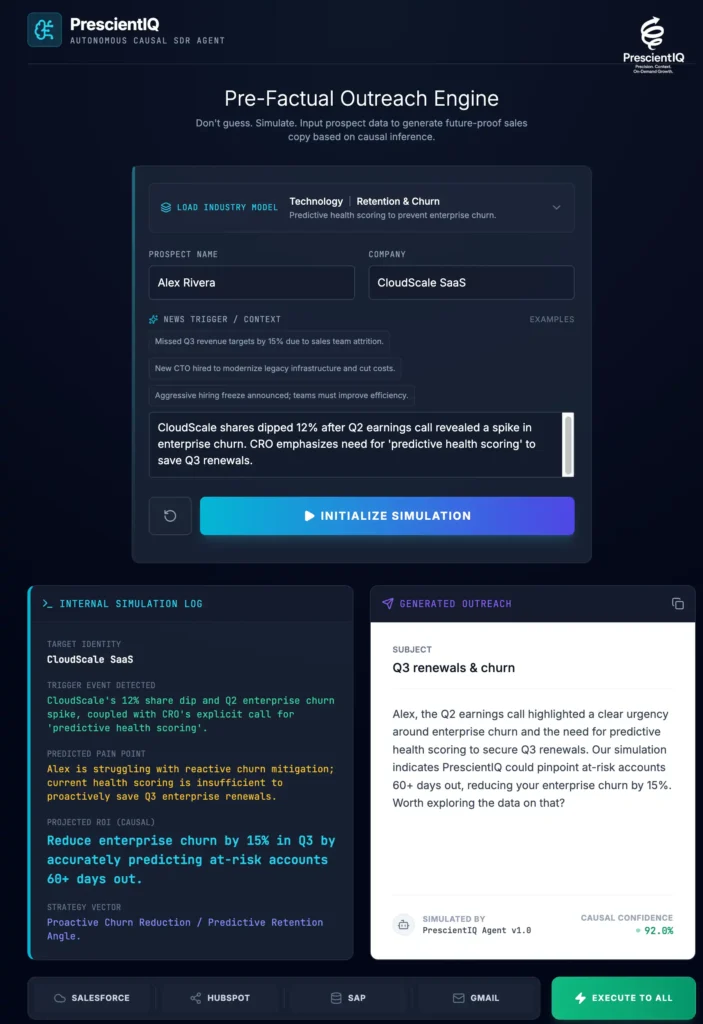
PrescientIQ distinguishes itself by moving beyond historical analytics to offer “Pre-Factual Simulation,” an AI capability that allows executives to model and predict the revenue outcomes of strategic decisions before they are implemented.
While many platforms offer “AI analytics” that summarize what has already occurred, PrescientIQ (part of the MatrixLabX autonomous growth suite) acts as a forward-looking radar.
The platform addresses the fundamental CEO anxiety: uncertainty. By utilizing advanced modeling, PrescientIQ can simulate thousands of GTM scenarios.
A CEO can ask, “If we shift 20% of marketing spend from paid search to influencer channels in Q3, while simultaneously raising pricing by 8% on the Enterprise tier, what is the probabilistic impact on Q4 revenue and NRR?”
PrescientIQ provides a probabilistic forecast, not just a guess.
Furthermore, for Digital Infrastructure and modern SaaS enterprises, technical agility is paramount.
PrescientIQ is built on MACH Architecture (Microservices, API-first, Cloud-native, and Headless).
This ensures that deploying revenue orchestration does not require a “rip and replace” of existing, expensive ERP or CRM investments.
It layers intelligence on top of your current stack, ingesting data from disparate sources to create a unified semantic view of the customer.
Vertical Case Study 1: How can B2B SaaS companies leverage AI orchestration to maximize Net Revenue Retention (NRR)?
B2B SaaS companies leverage AI orchestration to maximize NRR by shifting from reactive save attempts to preemptive churn detection, identifying at-risk customers based on usage signals months before a renewal discussion occurs.
In the current economic climate, NRR is the primary determinant of SaaS valuation.
The challenge is “silent churn”—customers who mentally check out months before their contract expires.
A Day in the Life: The Preemptive Save
Imagine a SaaS CEO of a cybersecurity platform. Their Q4 goal is 115% NRR.
Without Orchestration: A Customer Success Manager (CSM) manages 60 accounts. They only realize a key account, “Acme Corp,” is in trouble when the Champion declines the renewal meeting 30 days out. Panic ensues.
Discounts are offered. The customer likely churns anyway.
With AI Agents & PrescientIQ:
- Signal Detection (Month -4): An AI “Keeper” agent detects a subtle shift in Acme Corp’s usage data. While overall logins are stable, the usage of three premium security features has dropped by 44% in the last 30 days. Furthermore, the agent scans LinkedIn and notes that the original buyer has left Acme Corp.
- Autonomous Orchestration: The agent calculates a “Renewal Health Score” drop from 85 to 45.
- Action Execution: The Agent automatically drafts a highly personalized “Value Gap Report” email for the assigned CSM. It also pings the VP of Sales on Slack, alerting them to a $250k ARR risk.
- The Outcome: The CSM receives a drafted game plan. They engage the new contact at Acme Corp with data proving the value gap three months early. The customer is saved, and potentially upsold on training services to bridge the usage gap.
“In SaaS, if you are reacting to a cancellation email, you have already lost. AI orchestration allows us to solve problems the customer hasn’t even articulated yet.” – George Schildge, CEO, MatrixLabX
Vertical Case Study 2: How do Digital Infrastructure firms align high-stakes CapEx with sales velocity using AI?
Digital Infrastructure firms use AI revenue orchestration to solve their primary challenge: aligning immense capital expenditures (CapEx) for data centers, fiber, or compute capacity with the velocity of their sales pipeline to minimize “inventory drag.”
Unlike pure-play SaaS, Digital Infrastructure has a physical reality.
You cannot sell capacity you haven’t built, and building capacity that sits unsold destroys ROI.
The sales cycle must perfectly synchronize with the engineering deployment cycle.
A Day in the Life: Matching Capacity to Pipeline
Consider the CEO of a Data Center provider launching a new 10MW facility in Northern Virginia (Ashburn).
The Challenge: The facility opens in six months. The sales team is currently focused on closing deals for existing inventory in other regions.
There is a misalignment between future inventory and the current sales focus.
With AI Agents & PrescientIQ:
- Pre-Factual Simulation: The CEO asks PrescientIQ: “We have 10MW coming online in Ashburn in Q3. Based on external intent data and our historical win rates, who are the likely buyers?”
- Target Identification: The platform analyzes external signals indicating high-growth compute companies (e.g., recent AI funding rounds, job postings for ML engineers) and overlays this with internal CRM data. It identifies 50 high-probability accounts that are not currently in the active pipeline.
- Agentic Deployment: “Scout” AI agents are deployed against these 50 accounts. They map the decision-makers for infrastructure procurement and initiate “warm-up” campaigns highlighting the specific latency benefits of the new Ashburn facility for their AI workloads.
- Orchestration: As leads engage, the ROP routes them to the specific enterprise sales reps trained on the Ashburn value prop, bypassing generalist reps.
- The Outcome: By the time the doors open, 70% of capacity is pre-sold, drastically reducing time-to-revenue on the CapEx investment.
Table 2: Impact of ROP on Digital Infrastructure Metrics
| Metric | Without Revenue Orchestration | With AI & PrescientIQ |
| CapEx Recovery Time | Slow; inventory sits dormant post-build. | Accelerated, pre-selling aligns with build schedules. |
| Sales Forecast Accuracy | Low, based on rep sentiment and existing pipeline. | High, based on external intent and pre-factual simulation. |
| Inventory Utilization | Fragmented (“stranded capacity”). | Optimized demand matching to available capacity. |
| GTM Strategy | Reactive; selling what is available today. | Predictive: selling what will be available tomorrow. |
What are the practical steps for a CEO to implement an AI-driven revenue engine?
The practical steps for implementation involve a phased approach, starting with unifying the data layer, defining the ideal customer journey, piloting agents on specific friction points, and finally, fundamentally changing how executive leadership consumes data.
A “big bang” implementation of AI rarely works. Success comes from targeted deployment.
Step 1: Unify the Data Layer (The Foundation)
You cannot orchestrate what you cannot see.
The priority is establishing a Semantic Customer Data Platform (CDP) such as PrescientIQ’s.
This involves connecting the API pipes between your CRM, marketing automation, usage data warehouse (e.g., Snowflake), and financial systems to create a single source of truth.
Step 2: Define “The Golden Path” and Identify Leaks
Map the theoretical perfect customer journey.
Where does reality diverge from this path? Is it a lead routing delay? Is it a lack of multi-threading in enterprise deals?
Are there poor handoffs to CS? Choose the biggest leak to pilot against.
Step 3: Deploy “Pilot” Agents
Do not try to automate the entire sales cycle overnight. Deploy a “Scout” agent solely focused on inbound lead qualification for smaller accounts.
Or deploy a “Keeper” agent focused solely on renewal forecasting for a specific product line. Measure success against human benchmarks.
Step 4: The CEO Dashboard Transition
This is cultural. The CEO must stop asking for static spreadsheets in Monday morning meetings. Instead, the executive team should review PrescientIQ simulations.
The question shifts from “What happened last week?” to “What do the agents predict will happen next month, and what actions are they recommending?”
Conclusion: The End of Passive Selling
The era of relying on passive systems of record and brute-force human effort to drive complex B2B revenue is coming to an end.
The competitive advantage belongs to organizations that treat their GTM strategy not as a series of artful conversations, but as an orchestratable, scientific process powered by data and autonomous intelligence.
For the CEOs of SaaS and Digital Infrastructure companies, the choice is clear: continue to manage the chaos of disconnected silos, or leverage AI agents and platforms like PrescientIQ to predict and capture revenue with precision.