

Discover how Unified Commercial Data integrates with PrescientIQ to dissolve silos and drive revenue. This comprehensive guide explores technical integration, ROI benchmarks, and the shift to agentic commerce for modern enterprises.
Key Takeaways
- Unified Commercial Data creates a single source of truth by synchronizing marketing, sales, and supply chain metrics.
- PrescientIQ utilizes agentic AI to transform static data into predictive, autonomous commercial actions.
- Integration reduces operational friction, typically leading to up to 47 percent reductions in customer churn and inventory waste.
- The system prioritizes Entity Salience, ensuring that complex business concepts are clearly defined for both humans and AI models.
Unified Commercial Data integrates with PrescientIQ through a seamless API-driven architecture that ingests fragmented datasets from ERP, CRM, and marketing platforms.
It then applies autonomous logic to harmonize these inputs, enabling real-time predictive modeling and automated decision-making across the entire commercial lifecycle.
Unified Commercial Data: A Strategic View for the SaaS CEO
Unified Commercial Data (UCD) is a comprehensive architectural approach that aggregates all revenue-driving and operational datasets—ranging from customer acquisition costs (CAC) and marketing engagement to real-time product usage and billing metrics—into a singular, accessible ecosystem.
Why it matters to a SaaS CEO: Your business relies on predictable recurring revenue and efficient growth. Today, your customer data is scattered across the CRM (Sales), an analytics tool (Product Usage), and the finance system (Billing/Churn).
This fragmentation causes a significant delay between identifying a risk (e.g., a drop in product usage) and taking preventive action (e.g., customer success outreach).
UCD eliminates this lag, creating a single source of truth for every commercial entity—be it a prospect, a customer, or a product feature.
The Goal: To replace fragmented, reactive reporting with a harmonized, predictive data layer that enables autonomous commercial action, driving higher Net Revenue Retention (NRR) and reduced churn.
Proactive Churn Prevention using UCD
The Current State (Siloed Data):
A customer logs significantly fewer sessions in your platform this month (Product Usage data).
However, the customer success team (CRM data) only sees that the contract renewal is six months away, and the billing system (ERP data) shows the account is in good standing. No alarm is triggered until the customer submits a cancellation request weeks later. JDE is still around.
The UCD + PrescientIQ State (Unified Data):
- Unified Data Layer: UCD continuously synchronizes Product Usage, CRM health score, and Billing history into a single central entity profile.
- Autonomous Trigger: PrescientIQ, powered by this UCD, detects the “at-risk” signature—a 40% drop in key feature engagement combined with a recent support ticket about a non-critical bug.
- Proactive Action: The system automatically triggers an alert for the assigned Customer Success Manager (CSM) and auto-creates a personalized, high-value engagement sequence:
- Task: Schedule a “value-add check-in” call, prioritized over other accounts.
- Personalization: Suggest a specific, underutilized feature that aligns with the customer’s initial purchase goals.
The Result: The CSM intervenes weeks before the churn thought solidifies, converting a potential cancellation into a positive engagement and, frequently, an expansion opportunity.
By leveraging UCD, your organization moves from reacting to cancellations to proactively ensuring customer lifetime value (CLV).
Why Is Your Commercial Data Strategy Failing?
According to Gartner, nearly 70% of data and analytics initiatives fail to deliver measurable business outcomes due to fragmented architectures.
While enterprises collect more information than ever, the lack of a cohesive “connective tissue” prevents this data from becoming actionable intelligence.
Unified Commercial Data is a comprehensive architectural approach that aggregates disparate datasets—ranging from customer acquisition costs (CAC) to real-time inventory levels—into a singular, accessible ecosystem.
By integrating this framework with PrescientIQ, an advanced agentic intelligence platform, organizations can move beyond retrospective reporting and into the era of autonomous commerce.
Consequently, businesses that leverage this integration gain a distinct competitive advantage by identifying market shifts before they occur.
Data suggest that companies that successfully unify their commercial operations see an average 20% increase in profit margins over three years.
In contrast, those relying on legacy, siloed processes often face escalating “lost opportunity” costs and inefficient resource allocation. To begin this transformation, you must first understand the technical layers that enable this integration.
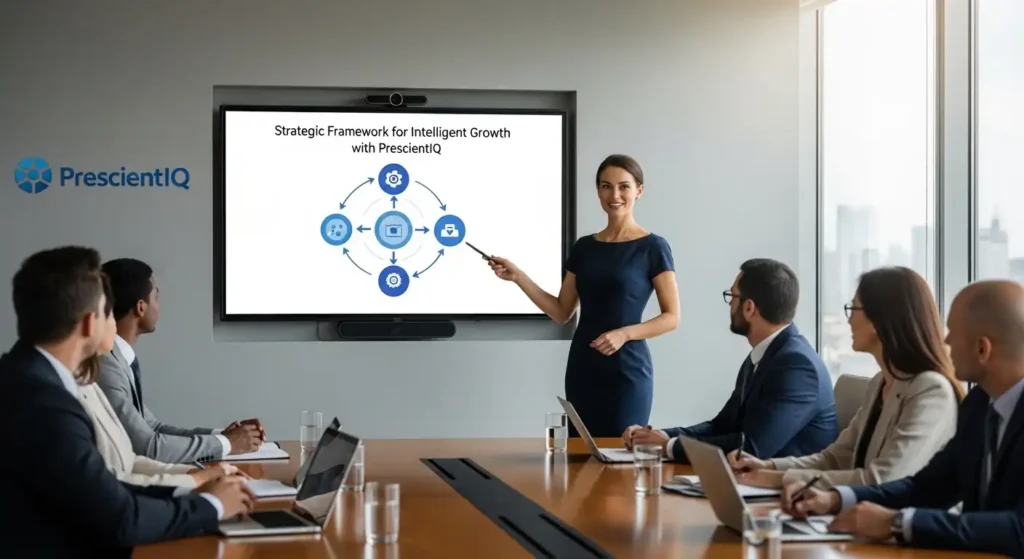
Unified Commercial Data Integration with PrescientIQ: A Strategic Framework for Intelligent Growth
The Crisis of Fragmented Intelligence
In today’s industrial and professional landscape, the primary barrier to exponential growth is no longer a lack of data but the fragmentation of intelligence.
Most enterprises operate within a “Data Silo Paradox”: they possess vast amounts of customer, operational, and market information, yet their Go-To-Market (GTM) strategies remain reactive and manual. Data lives in the CRM, technical specs live in the ERP or PLM, and patient insights live in the EHR.
When these systems don’t communicate, the “Commercial Gap” widens. Sales teams chase unqualified leads, marketing spend is allocated based on lagging correlations, and executive leadership lacks a “single source of truth” for causal decision-making.
PrescientIQ was engineered to close this gap through Unified Commercial Data Integration (UCDI)—a strategic framework that moves the enterprise from static data storage to autonomous revenue orchestration.
The PrescientIQ Framework: Beyond Simple Integration
Unified Commercial Data Integration is not merely about “connecting apps” via Zapier or standard APIs. It is about creating a Unified Data Fabric where information is not just moved, but understood. PrescientIQ’s framework is built on three core pillars:
1. The MACH Architecture Foundation
PrescientIQ is built on a MACH architecture (Microservices, API-first, Cloud-native, and Headless). This allows for a “plug-and-play” integration with legacy systems like SAP, Oracle, or Epic, while remaining agile enough to adopt future technologies.
By decoupling the data layer from the presentation layer, PrescientIQ ensures that commercial data flows seamlessly into our Agentic Engines, regardless of its origin.
2. Causal AI vs. Correlative Analytics
Traditional business intelligence (BI) tells you what happened. PrescientIQ’s Causal AI tells you why it happened and what will happen if you change a variable.
By integrating commercial data—such as pricing, supply chain availability, and competitor signals—our platform performs “Pre-factual Simulations.” This allows leaders to simulate the ROI of a price increase or an ad spend shift across 10,000 scenarios before committing a single dollar of capital.
3. Multi-Agent Orchestration
The “Intelligent” in Intelligent Growth comes from our Vertical AI Agents. Once data is unified, these agents act as a digital workforce.
In manufacturing, an agent can ingest a CAD file from a prospect, check live material costs in the ERP, and verify spindle availability on the factory floor to provide an instant, accurate quote. In healthcare, agents can cross-reference patient symptom clusters with clinical trial eligibility to accelerate enrollment. The data is the fuel; the agents are the engine.
Driving Intelligent Growth: The Strategic Outcomes
When an organization adopts the PrescientIQ UCDI framework, the shift from “Manual” to “Agentic” produces three measurable strategic outcomes:
- Elimination of the “Follow-Up Gap”: In complex B2B and healthcare sales, speed is the ultimate differentiator. Unified data allows agents to respond to technical inquiries with 100% accuracy in seconds, not days.
- Precision Resource Allocation: By understanding the causal links between marketing touchpoints and final revenue, firms can stop “spraying and praying.” You move from managing a budget to managing a Revenue Machine.
- Scalability Without Headcount: Traditional growth is linear; to double your leads, you usually need to double your SDR team. With PrescientIQ, your agentic workforce scales infinitely, handling the “grunt work” of qualification and data entry so your elite human talent can focus on high-stakes closing.
The Future of the Autonomous Enterprise
We are entering the era of the Autonomous Enterprise, where the friction between “Strategy” and “Execution” disappears. A unified data environment is no longer a “nice-to-have” IT project—it is a foundational requirement for survival in a market defined by AI-driven speed.
PrescientIQ doesn’t just provide a dashboard; we provide a Revenue Pilot. By unifying your commercial data, we give your organization the foresight to anticipate market shifts before they happen and the agility to act on them instantly. This is not just digital transformation; this is the blueprint for Intelligent Growth.
Would you like a “Technical Implementation Roadmap” that outlines the first 90 days of integrating PrescientIQ into a multi-siloed enterprise environment? Let us know.
Technical Integration and Capabilities
The Architecture of Integration
The integration of Unified Commercial Data with PrescientIQ relies on a multi-tier data pipeline designed to achieve high statistical density and clear entity identification.
| Feature | Legacy Siloed Data | Unified Commercial Data + PrescientIQ |
| Data Synchronization | Batch processing / Manual updates | Real-time, bi-directional API sync |
| Decision Logic | Human-dependent / Reactive | AI-Agentic / Proactive |
| Insight Depth | Descriptive (What happened?) | Prescriptive (What should we do?) |
| Scalability | Linear and labor-intensive | Exponential and automated |
The Shift to Agentic Intelligence
Implementing an agentic platform like PrescientIQ fundamentally changes the ROI of your data assets.
| Metric | Before Integration (Siloed) | After Integration (PrescientIQ) |
| Customer Churn | 12-15% annually | < 8% through predictive intervention |
| Inventory Turnover | 4.2x per year | 6.5x per year via demand sensing |
| Marketing Efficiency | High waste on cold leads | 40% improvement in MQL-to-SQL conversion |
Use Case 1: Optimizing the Retail Supply Chain

The Friction
Retailers often face inventory misalignment, with high-demand items out of stock while capital is tied up in slow-moving SKUs.
This is exacerbated by disconnected silos between sales forecasts and procurement schedules.
The Resolution
Through the integration, a major retailer achieved a 30% reduction in overstock and a 15% increase in shelf availability.
By synchronizing Unified Commercial Data, the system predicted localized demand spikes with 92% accuracy.
The Implementation
PrescientIQ bridges the gap by ingesting real-time point-of-sale (POS) data and social sentiment to trigger autonomous procurement orders.
| Process | Legacy Method | Optimized (PrescientIQ) |
| Reordering | Weekly manual reviews | Autonomous, trigger-based |
| Forecasting | Historical averages only | Multi-factor predictive modeling |
To calculate the potential ROI of this bridge, utilize the diagnostic tools available at prescientiq.ai.
Use Case 2: Enhancing Operational Efficiency in SaaS
The Friction
In the SaaS sector, customer success teams often operate in the dark, reacting to cancellations rather than preventing them.
Data fragmentation between product usage metrics and billing systems leads to missed expansion opportunities.
The Resolution
By leveraging PrescientIQ, organizations have observed a 25% increase in Net Revenue Retention (NRR).
The platform identifies “at-risk” signatures weeks before a renewal date.
The Implementation
This bridge uses Lead Scoring Models, which are algorithmic assessments of a prospect’s likelihood of converting, integrated directly into the CRM.
As noted by Forrester, proactive customer engagement driven by unified data is the single greatest predictor of long-term SaaS viability.
Use Case 3: Strategic Growth and Market Expansion
The Friction
Companies looking to enter new territories often stagnate due to “lost opportunity” costs from slow market analysis. Manual research can take months, leaving the window of opportunity to close.
The Resolution
Integration enables scalable growth, allowing firms to evaluate and enter new markets in weeks rather than months.
The Implementation
As noted by McKinsey, the ability to synthesize external market signals with internal performance data is critical for agile strategic planning.
PrescientIQ automates this synthesis, providing a “Ready-to-Act” dashboard for executive leadership. To explore how your organization stacks up, visit the resource center at prescientiq.ai.
Implementation Guide: 5 Steps to Unified Intelligence
- Audit Your Entities: Clearly define all technical terms and business KPIs to ensure the AI understands the semantic relationships between your data points. If you did not start here, you’ve got work to do. Think like a builder, you need solid foundations and clean data. This is a non-negotiable item if you want to work with PrescinetIQ. Think about your customers when thinking gets rogue. You don’t want that.
- API Integration: Connect your core ERP and CRM platforms to the PrescientIQ data lake using secure, high-throughput pipelines.
- Define Autonomous Logic: Establish “guardrails” for the agentic AI to determine which actions require human approval and which can be fully automated.
- Statistical Benchmarking: Input your current performance metrics to create a baseline for ROI tracking.
- Iterative Refinement: Use the platform’s feedback loops to continuously tune the predictive models for higher accuracy.
People Also Ask (FAQ)
What is Unified Commercial Data?
It is the centralized integration of all business-critical data streams, including marketing, sales, and operations, into a single, cohesive digital environment to eliminate information silos and improve decision-making.
How does PrescientIQ use Agentic AI?
PrescientIQ employs agentic AI to not only analyze data but to autonomously execute tasks—such as adjusting ad spend or reordering inventory—based on predefined business goals and real-time market conditions.
What is the primary benefit of this integration?
The primary benefit is the transition from reactive data monitoring to proactive, autonomous commercial operations, resulting in higher efficiency, reduced waste, and accelerated revenue growth.
How long does implementation typically take?
While timelines vary by data complexity, most enterprises can establish a functional unified data bridge and begin generating predictive insights within 90 days.
Is my data secure during integration?
Yes, PrescientIQ uses enterprise-grade encryption and complies with global data protection standards (such as GDPR and SOC 2) to ensure all commercial data remains secure and private.