

Unlock the power of a Unified Revenue Signal Platform to decode customer intent.
Learn how integrating RevOps data, AI, and buying signals maximizes conversion and efficiency in 2026.
Key Takeaways: Optimizing Your Revenue Stack
- Centralized Intelligence: A Unified Revenue Signal Platform eliminates data silos by merging marketing, sales, and customer success data into a single source of truth.
- Deciphering the Dark Funnel: These platforms utilize AI to identify “shadow” buying behaviors, such as anonymous website visits and third-party intent data, which traditional CRMs miss.
- Actionable AI: The core value lies not just in data collection, but in the generative interpretation of signals to prompt specific sales actions (e.g., “Call now because prospect viewed pricing page”).
- Predictive Accuracy: By analyzing historical win/loss data against current signals, these platforms significantly improve forecasting precision.
- GTM Alignment: It forces a structural alignment between sales and marketing, moving organizations from a lead-centric to an account-centric strategy.
What is a Unified Revenue Signal Platform?
A Unified Revenue Signal Platform is an integrated software ecosystem that aggregates, normalizes, and analyzes cross-channel data—from web behavior and CRM entries to conversational intelligence and third-party intent—to identify high-probability purchasing signals, thereby aligning Go-to-Market (GTM) teams for maximized revenue capture.
Why is the “Dark Funnel” Driving the Need for Unified Signals?
The Invisible Economy of B2B Buying
How does the dark funnel affect revenue prediction?
The dark funnel obscures revenue prediction because approximately 70% to 90% of the B2B buying journey occurs anonymously before a prospect ever speaks to a sales representative.
As noted by Forrester, B2B buyers now conduct the vast majority of their research independently online, leaving revenue teams reliant on lagging indicators rather than leading signals.
In the modern digital economy, your sales team is likely operating with a blindfold. Traditional Customer Relationship Management (CRM) systems act as passive repositories of data—places where records go to die.
They capture what happened after a meeting, but they fail to capture the subtle, digital body language that occurs before the handshake. This invisible activity is known as the Dark Funnel, and it is where your next quarter’s revenue is currently hiding.
Imagine a system that doesn’t just store data but actively listens. A Unified Revenue Signal Platform acts as a central nervous system for your organization. It connects the dots between a prospect reading a technical whitepaper, a sudden spike in G2 Crowd reviews for your category, and a specific company visiting your pricing page.
Separately, these are noise; together, they are a screaming signal of intent. Research by Gartner highlights that B2B sales organizations moving to data-driven decision-making will see a significant increase in conversion rates, yet many firms remain stuck in siloed operations.
By adopting a unified platform, you transition from reactive selling to proactive engagement. You gain the ability to see the entire account journey, not just the fragments captured in a form fill. This leads to Revenue Precision—the ability to know exactly who to call, when to call them, and exactly what to say based on their digital footprint.
As reported by McKinsey, companies that excel at personalization and signal interpretation generate 40% more revenue from those activities than average players. The desire here is simple: stop guessing and start knowing.
The shift is inevitable. To capture this value, you must audit your current tech stack, identify the disconnected silos between marketing automation and sales execution, and implement a Unified Revenue Signal Platform that serves as the “brain” of your Revenue Operations (RevOps) strategy.
Who, What, Where, When, and Why: Decoding the Platform

Who Needs a Unified Revenue Signal Platform?
Who benefits most from signal unification?
High-growth B2B organizations with distinct sales, marketing, and customer success departments benefit most, specifically Chief Revenue Officers (CROs) and RevOps leaders seeking alignment.
The primary users are revenue teams who are tired of conflict. Marketing claims they sent leads; Sales claims the leads were low-quality.
A unified platform resolves this by providing a shared reality. It serves the SDR (Sales Development Representative) by prioritizing their day based on engagement scores rather than alphabetical lists.
It serves the Customer Success Manager (CSM) by flagging churn risks based on usage drops or support ticket sentiment analysis.
As Salesforce highlighted in its State of Sales report, high-performing sales teams are 2.8 times more likely to use AI-powered signal tools than underperforming teams.

What Are the Core Components?
What constitutes a robust signal platform? A robust platform consists of three pillars: Data Ingestion (collecting signals), Intelligence Layer (AI/ML processing), and Activation Layer (pushing insights to workflow tools).
- First-Party Data: Website visits, email clicks, product usage logs.
- Second-Party Data: Partner ecosystem interactions.
- Third-Party Data: Intent data (e.g., Bombora or 6sense), job postings, and news alerts.
- Conversational Intelligence: Analyzing sales calls (Gong, Chorus) for keywords and sentiment.
Where Does this Technology Fit in the Stack?
Where does the platform sit in the architecture? It sits strictly between your systems of record (CRM like Salesforce or HubSpot) and your systems of engagement (Outreach, Salesloft, Slack).
It acts as the orchestration layer. It pulls data out of the CRM, enriches it with external signals, applies logic, and then pushes actionable tasks back into the CRM or engagement platforms.
This ensures that the “Where” is everywhere your team already works, preventing the need for them to learn yet another dashboard.
When Should You Implement This?
When is the right time to adopt signal unification?
The optimal time to implement is when your Customer Acquisition Cost (CAC) begins to rise disproportionately to your Customer Lifetime Value (CLTV) due to inefficient outbound targeting.
If your sales team is scaling but your revenue per rep is declining, you have a signal problem. Furthermore, the deprecation of third-party cookies by major browsers makes the capture of first-party signals urgent.
As reported by Google, the shift toward privacy-first browsing requires companies to own their signal infrastructure immediately to maintain visibility into buyer behavior.
Why is This Critical Now for the need of a Unified Revenue Signal Platform?
Why is immediate adoption necessary?
The explosion of unstructured data and the maturity of Large Language Models (LLMs) enable the interpretation of signals previously readable only by humans.
In the past, “intent” was a binary flag (Clicked/Didn’t Click).
Today, AI can analyze a recorded call, extract the pricing objection, correlate it with a competitor’s pricing page visit, and alert a manager. This depth of insight is the new competitive baseline.
Comparing Revenue Architectures
How does a Unified Platform differ from a traditional CRM?
A Unified Platform is active and predictive, whereas a traditional CRM is passive and historical.
| Feature | Traditional CRM (System of Record) | Unified Revenue Signal Platform (System of Intelligence) |
| Data Focus | Historical logs, contact info, notes. | Real-time behavioral signals, intent data, and sentiment. |
| Primary Function | Storage and Reporting. | Prediction and Action. |
| Data Structure | Siloed objects (Leads vs. Contacts). | Unified Account-Based View (leads mapped to accounts). |
| User Experience | Manual data entry required. | Automated data capture and enrichment. |
| Output | Dashboards of what happened. | Recommendations of what to do next. |
Top Trends and Research Insights
What Are Analysts Saying About Revenue Signals?
What is the consensus among top research firms?
Research firms like Gartner, Forrester, and Deloitte unanimously agree that the convergence of RevOps and AI-driven signal processing is the defining trend of modern sales strategy.
- Gartner’s Perspective: Gartner predicts that by 2026, 65% of B2B sales organizations will switch from intuition-based to data-driven decision-making, using technology that unites workflow, data, and analytics. They refer to this shift as “Algorithmic Sales Guidance.”
- Forrester’s Perspective: Forrester emphasizes the concept of “Revenue Operations and Intelligence (RO&I).” They state that organizations that deploy RO&I solutions effectively can achieve productivity gains of 10-20% across the GTM function. Their research highlights that the ability to aggregate signals from the “Dark Funnel” is a primary differentiator for market leaders.
- Deloitte’s Perspective: Deloitte reports that hyper-personalization, driven by unified data signals, is becoming a requirement rather than a luxury. They note that B2B buyers now expect the same level of anticipated needs that they experience in B2C consumer environments like Amazon or Netflix.

Strategic Use Cases:
Use Case 1: Pre-empting Customer Churn
How does signal unification prevent churn?
It detects subtle patterns of disengagement before a cancellation notice is ever sent.
- Your Customer Success team relies on quarterly business reviews (QBRs) to gauge health. A key account seems “fine” because they answer emails, but silently, their utilization of your core feature has dropped by 15%, and their champion just updated their LinkedIn profile to “Open to Work.” You are blindsided when the cancellation comes.
- The Unified Revenue Signal Platform simultaneously monitors utilization logs, LinkedIn job changes, and support ticket sentiment. It flags the account as “High Risk” three months before renewal. The system automatically triggers a playbook for the VP of Customer Success to reach out, while simultaneously alerting marketing to pause upsell campaigns.
- Predictive Health Score. By aggregating product telemetry (usage data) with external signals (job changes), the platform converts raw data into a “Save” opportunity, preserving revenue.
Use Case 2: De-Anonymizing the Buying Committee
How does the platform uncover hidden buyers? It maps anonymous IP addresses and third-party research activity to specific accounts within your CRM.
- Marketing runs a campaign. You see 5,000 impressions and 200 clicks, but only 5 form fills. You assume the other 195 clicks were a waste. Sales continues to use cold-calling lists purchased six months ago, unaware that a massive enterprise account is currently browsing your technical documentation.
- The platform identifies that those 195 clicks came from 12 distinct enterprise accounts. Specifically, it notices that 5 people from “Acme Corp” visited your “Enterprise Security” page. Even though they didn’t fill out a form, the platform signals the sales rep assigned to Acme Corp: “High Intent Detected: Security Focus.”
- Deanonymization and Account Mapping. The technology uses reverse IP lookups and cookieless identity graphs to link web traffic to corporate entities, turning “traffic” into “prospects.”
Use Case 3: Optimizing the Sales Pipeline
How does this technology fix pipeline forecasting?
It replaces “gut feel” probability with data-backed reality.
- A sales rep marks a deal as “Commit” (90% likely to close) after a good lunch with the prospect. However, the prospect hasn’t opened an email in two weeks and has stopped visiting the legal terms page. The deal slips, and the forecast misses.
- The platform analyzes the Digital Body Language. It recognizes the lack of engagement and the absence of legal document review. It overrides the rep’s optimism, flags the deal as “At Risk,” and lowers the forecast probability to 40%. It suggests a “Wake Up” campaign to re-engage stakeholders.
- Reality-Based Forecasting. By weighting actual behaviors (signals) heavier than human sentiment, the platform delivers a forecast accuracy that is statistically reliable.
Challenges and Risks of Implementation
The Data Hygiene Hurdle
What is the biggest barrier to success? The primary challenge is “Garbage In, Garbage Out,” where poor historical data quality corrupts the AI’s predictive models.
Challenge: If your CRM contains duplicates, outdated contacts, and inconsistent naming conventions, the Unified Revenue Signal Platform will struggle to map signals correctly.
As Dun & Bradstreet notes, 91% of companies suffer from common data errors, and implementing a signal platform on top of bad data only accelerates chaos rather than clarity.
Impact: The AI might flag the wrong account or fail to recognize that “IBM” and “International Business Machines” are the same entity, leading to embarrassing sales overlaps and fragmented insights.
The “Big Brother” Perception
How does internal culture impact adoption? Sales teams may view the platform as a surveillance tool rather than an enablement tool, which can lead to resistance.
Challenge: When a platform tracks every email, call, and click, sales reps can feel micromanaged. They may fear that the “Intelligence” layer will expose their lack of activity or override their judgment.
Impact: If the sales culture rejects the tool, they will ignore the “Recommended Actions.”
A tool that is ignored yields zero ROI. Management must frame the technology as a “Co-pilot” that eliminates admin work, rather than a “Manager” that dictates tasks.
Signal Noise and Alert Fatigue
Can there be too much data? Yes, an improperly tuned platform can flood revenue teams with low-quality alerts, causing them to tune out entirely.
Challenge: Not every website visit is a buying signal. Someone reading your blog might just be a student or a competitor. If the platform alerts a rep for every low-intent interaction, the rep will suffer from Alert Fatigue.
Impact: Important signals get lost in the noise. Research by TOPO (now Gartner) suggests that sales reps ignore over 70% of marketing-generated leads because of a history of low quality. The platform must be rigorously tuned to filter out noise and surface only the “Golden Signals.”
Step-by-Step Implementation Guide
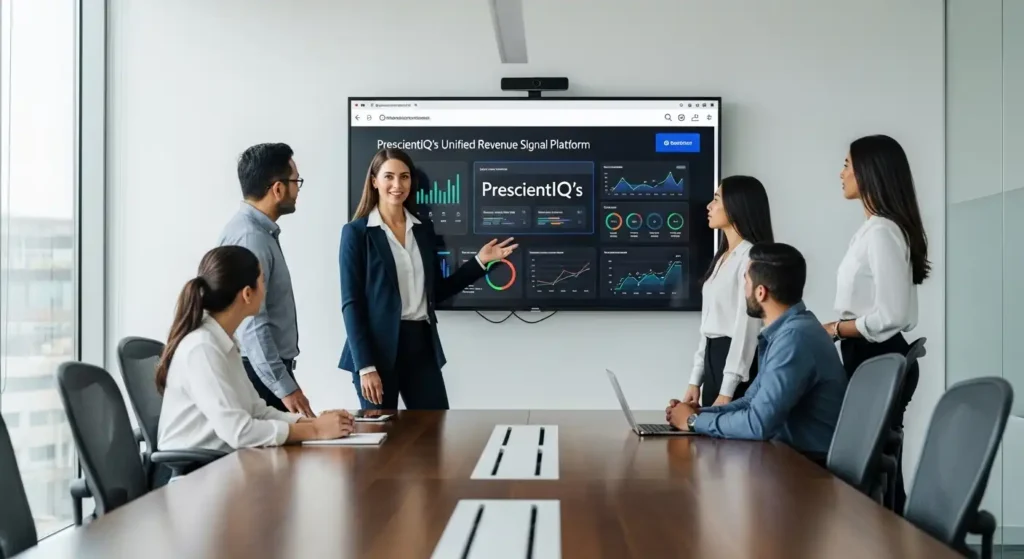
How do you deploy a Unified Revenue Signal Platform? Follow this structured roadmap to ensure technical integration and cultural adoption.
- Audit and Cleanse Data:
- Before purchasing software, conduct a data health audit. Deduplicate accounts in your CRM and standardize field values (e.g., Industry, Region).
- Tip: Use an automated data cleaning tool to establish a baseline of truth.
- Define Your “High-Intent” Signals:
- Gather Sales and Marketing leaders to agree on what constitutes a signal. Is visiting the pricing page a signal? Is reading three blog posts a signal?
- Metric: Create a scoring model (e.g., Pricing Page = 50 points, Blog = 5 points).
- Integrate the Tech Stack:
- Connect your Data Sources (Marketo, HubSpot, Google Analytics) to the Signal Platform (e.g., 6sense, Demandbase, Clari).
- Ensure bi-directional syncing: Data flows into the platform for analysis and back to the CRM for visibility.
- Configure Workflow Automation:
- Don’t just display data; trigger actions. Set up rules: “IF an account hits a score of 100 AND is in our Ideal Customer Profile (ICP), THEN create a task for the account owner in Salesforce AND add contacts to an Outreach sequence.”
- Train and Enable:
- Launch with a pilot group of high-performing sales reps. Show them how the signals help them close deals faster.
- Use their success stories to evangelize the platform to the rest of the organization.
Statistical & Expert Evidence
What data supports the shift to unified signals?
The following statistics and quotes validate the necessity of this technology.
- According to SiriusDecisions, 98% of marketing-qualified leads (MQLs) never result in closed business, indicating a massive failure in signal interpretation.
- LinkedIn reports that 59% of buyers prefer not to interact with a sales rep until they are ready to buy, reinforcing the need for digital signal tracking.
- Gartner states that by 2025, 80% of B2B sales interactions between suppliers and buyers will occur in digital channels.
- Companies that use revenue intelligence tools report a 10-20% increase in sales productivity (Forrester).
- 67% of the buyer’s journey is now done digitally (Gartner).
- High-performing sales teams are 1.5x more likely to forecast using data-driven insights than underperformers (Salesforce).
- Organizations with aligned Go-to-Market teams see 19% faster revenue growth and 15% higher profitability (SiriusDecisions).
- 62% of high-growth companies have invested in intent data solutions (Demand Gen Report).
- Personalized B2B marketing based on signals can lower acquisition costs by up to 50% (McKinsey).
- 90% of B2B buyers twist and turn through the sales funnel, looping back and repeating steps, making linear tracking impossible (Forrester).
Expert Perspectives about a Unified Revenue Signal Platform:
“The future of sales is not about who you know, but what you know about who you don’t know yet. Signal intelligence is the flashlight in the dark room of the market.” — Henry Schuck, CEO of ZoomInfo.
“We are moving from a world of ‘Spray and Pray’ to ‘Predict and Pivot.’ Revenue signals allow us to pivot resources to where the money actually is, not where we hope it is.” — Sangram Vajre, Co-founder of Terminus.
“Data without context is just noise. The unified platform provides the context that turns data into dollars.” — George Schildge, CEO of MatrixLabX.
“The biggest competitor today isn’t another company; it’s the status quo. Buying signals tell you when the status quo is cracking.” — Jill Rowley, GTM Advisor.
“Revenue Operations is the discipline; the Unified Signal Platform is the instrument. You cannot play the symphony of scale without both.” — George Schildge, MatrixLabx.
Conclusion: The Era of Precision Revenue with Unified Revenue Signal Platform
The adoption of a Unified Revenue Signal Platform is not merely an IT upgrade; it is a fundamental shift in business philosophy.
It represents the move from intuition-based selling to evidence-based revenue generation.
By aggregating the fragmented whispers of the market into a clear voice, organizations can operate with unprecedented speed and accuracy.
Key Learning Points:
- The “Dark Funnel” is where modern buying happens; ignoring it is a strategic risk.
- Data unification is a prerequisite for effective AI application in sales.
- Cultural adoption is just as important as technical implementation; sales teams must trust the signal.
- The ultimate ROI is efficiency: higher conversion rates, lower churn, and predictable growth.
Your Next Step:
Conduct a “Signal Gap Analysis” of your organization this week.
Map out your customer journey and identify exactly where you lose visibility (e.g., anonymous web traffic, unlogged sales calls). Once the gaps are identified, you can evaluate which Unified Revenue Signal Platform best addresses them.
FAQ for Unified Revenue Signal Platform
What is the difference between intent data and revenue signals?
Intent data usually refers specifically to third-party web consumption (e.g., reading articles on other sites), whereas revenue signals are a broader category including first-party data, CRM changes, and conversational intelligence. Intent is one type of signal.
How does AI improve revenue signal platforms?
AI processes vast amounts of unstructured data (e.g., emails, call transcripts, logs) to find patterns that humans miss. It assigns predictive scores and suggests next best actions, moving from simple reporting to prescriptive guidance.
Can small businesses use unified revenue platforms?
Yes, but they may not need enterprise-grade complexity. Smaller tools or integrated CRMs (like HubSpot’s Operations Hub) offer signal unification features suitable for smaller datasets and budgets.
What metrics improve after implementing a signal platform?
Key metrics include Conversion Rate (MQL to SQL), Pipeline Velocity (time to close), Win Rate, and Retention Rate. Forecast accuracy also typically improves significantly.
Is a Revenue Signal Platform a replacement for CRM?
No. It enhances the CRM. The CRM remains the database of record, while the signal platform serves as the intelligence layer, feeding clean, enriched, and prioritized data into the CRM.
References
- Gartner. (n.d.). The Future of Sales: 2025 and Beyond.
- Forrester. (n.d.). The Rise of Revenue Operations and Intelligence.
- McKinsey & Company. (n.d.). The B2B Growth Equation.
- Salesforce. (n.d.). State of Sales Report.
- Deloitte. (n.d.). The AI-Fueled Organization.
- SiriusDecisions. (n.d.). The B2B Buying Survey.
- ZoomInfo. (n.d.). Modern GTM Strategies.