
Learn how The Vertical Agentic Mandate: How to Orchestrate Outcomes in a Composable Reality.
Key Takeaways
- Kill the Silos: Organizations must abandon monolithic applications in favor of a universal, governed data layer, as the future is either composable or non-existent.
- Monetize the Abandoned: Agentic systems must be used to capture the middle 80% of actionable customer data signals that human teams are structurally unable to address.
- Deploy Expertise, Don’t Hire It: Autonomous agents deliver a 2,000% ROI by executing expertise at AI speed, transforming the bottleneck from hiring experts to deploying expertise.
- Causal or Casual: The shift is from relying on legacy predictive correlations to using Causal Intelligence to drive resolution paths and guarantee outcomes.
The Vertical Agentic Mandate is the fundamental survival mandate for enterprises to pivot from a rigid, monolithic “app-first” mindset to an “infrastructure-first” model. It represents the strategic choice to orchestrate outcomes by deploying autonomous expertise to capture the “middle 80%” of customer data signals that human teams cannot address.
The shift is from providing teams with “tools to work with” to giving them “autonomous outcomes to work from”.
Would you like me to elaborate on any of the core tenets of the mandate, such as “Kill the Silos” or “Deploy Expertise, Don’t Hire It”?
1. The Tectonic Shift: From Monolithic Apps to Composable Canvases

The “New Vertical Reality” marks the end of the application-centric era. For the last decade, enterprise value was captured within the application layer—organizations purchased monolithic platforms like AgentForce, ChurnZero, Gainsight, or Totango, configured them within rigid silos, and hired teams to manage the software.
Today, the “star” of the strategic stack has shifted.
We are moving toward a foundation built on a universal, governed data layer that transforms the martech stack into a “composable canvas” of data, compute, and AI.
This allows agencies to plug directly into a client’s governed infrastructure to build bespoke AI workflows rather than forcing the business into “cookie-cutter” templates.
| Dimension | Monolithic Legacy Systems | Composable Canvas Model |
| Operational Foundation | Siloed Application Layer | Universal Governed Data Layer |
| Flexibility | Rigid, configuration-based silos | Interoperable, “Plug-and-Play” Workflows |
| Industry Tailoring | Generic, “Cookie-Cutter” templates | Bespoke, infrastructure-first orchestration |
This transition is necessitated by a terminal “Scaling Bottleneck.” In traditional B2B SaaS, human teams are drowning in digital noise. While modern platforms generate hundreds of high-value signals daily, manual human bandwidth is structurally limited to addressing only the top 10% of those signals.
This leaves the “middle 80%” of actionable customer data abandoned. Adopting the composable model is the only path to capturing the competitive intelligence required to monetize these abandoned signals.
2. The Arbitrage Advantage: Engineering a Compound Return on Experience
Internal brand teams are structurally disadvantaged in the face of AI’s current pace. Because an internal team is localized to a single environment, it lacks the broad exposure needed to distinguish fleeting hype from durable utility.
Agentic service providers, however, benefit from an “Arbitrage Advantage”—a compounding return on experience that no single brand can replicate internally.
This advantage is deconstructed into three core pillars:
- Pattern Recognition: By orchestrating AI programs across a diverse portfolio of clients, agencies identify high-performance resolution paths and emerging technical failures far earlier than a siloed team would.
- Cross-Pollination: Innovative breakthroughs are transferred across industries; for instance, a sophisticated AI personalization strategy developed for a retail giant can be instantly adapted to solve a retention challenge for a financial services firm.
- Systematic Learning: Durable competitive advantage is forged through the formal capture of cross-client intelligence, transforming the agency into a high-velocity intelligence partner rather than a mere support vendor. This shift has given rise to the “Micro-Agency” revolution. AI has enabled nimble, four-person firms with deep domain expertise to rival legacy competitors. In this new paradigm, the strategic constraint has shifted from “Can we build it?” to “Can we imagine it?” The intellectual arbitrage of the agency model translates directly into the autonomous operational outcomes of the agentic layer.
3. Orchestrating Outcomes: PrescientIQ and the Agentic Solution
Strategic leadership is moving from “managing tools” to “orchestrating outcomes.” The catalyst for this is Causal Intelligence—the sophisticated successor to predictive logic.
While traditional systems rely on predictive correlation (“What might happen?”), Causal Intelligence identifies specific resolution paths (“What action will fix it?”).
The following table contrasts the limitations of legacy SaaS AI with the agentic capabilities of PrescientIQ.ai :
| Feature | Traditional SaaS AI (Gainsight, Totango) | PrescientIQ.ai (Agentic) |
| Operational Model | Human-in-the-Loop (HITL) | Autonomous / Agentic |
| Primary Logic | Predictive Correlation (Historical) | Causal Inference (Resolution Paths) |
| Action Trigger | Manual Playbooks (Requires a “Click”) | Self-Executing Agents |
| Implementation | 6–12 Months | 4–8 Weeks |
| Data Utilization | Structured CRM/SaaS Data | Unstructured Telemetry, IoT, & Bio-data |
This architecture functions as Context-as-a-Service. Instead of high-risk data migrations, PrescientIQ maps existing data—from Snowflake, Salesforce, and Product Logs—into a unified causal model.
This acts as an “Optimized Bypass,” allowing organizations to process high-volume customer telemetry and execute interventions without proportional human overhead.
4. The Economic Case: ROI, CAC Reduction, and Churn Mitigation
The move toward agentic consulting is not a “race to the bottom” on price; it is the dawn of an era of abundance.
By deploying coordinated “squads” of AI agents to manage labor-intensive segmentation and content generation, human talent is liberated to focus on high-level strategy and creative direction. The economic impact is realized through three primary financial levers:
- Efficiency Gains: Organizations can reclaim up to 85% of operational time, effectively bypassing the need for “Scaled CS” or operational hires.
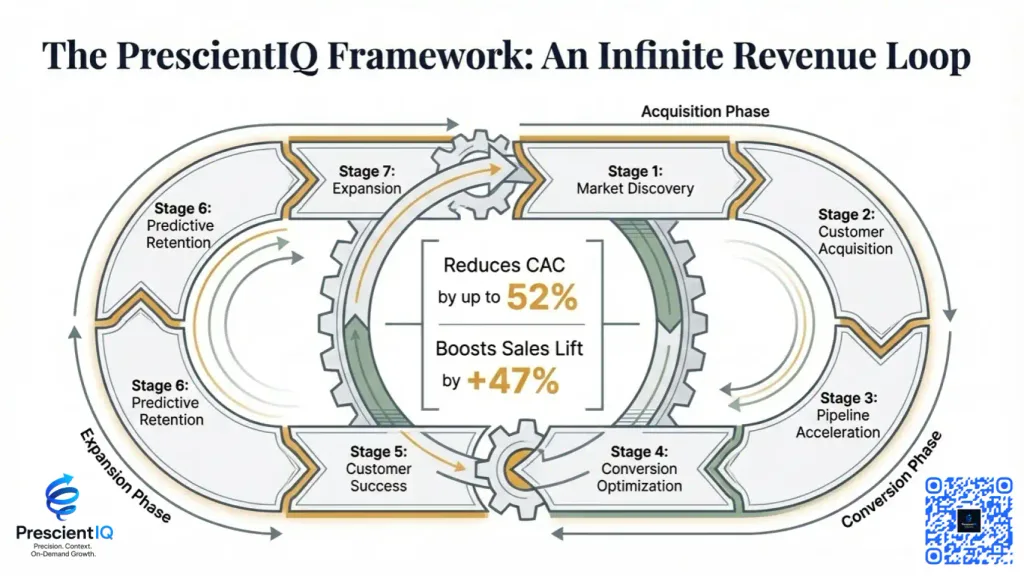
- CAC Reduction: Through automated lead routing and hyper-personalized outreach, Customer Acquisition Cost (CAC) is reduced by up to 52%.
- The 2,000% ROI Factor: By automating engagement for the “middle 80%” of ignored customer signals, this approach delivers immediate payback, often exceeding 2,000% annual ROI.
This mirrors the Desktop Publishing Analogy: just as the democratization of printing did not just make paper cheaper but also exploded the total market for communication.
Agentic consulting is expanding the Total Addressable Market (TAM) by making bespoke, complex solutions economically viable for the first time.
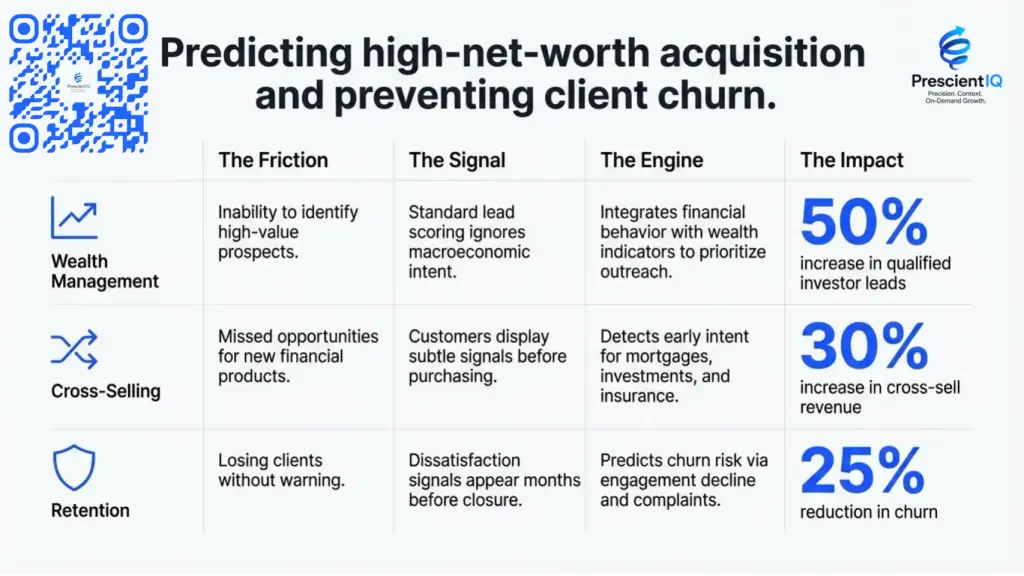
5. Vertical Deep Dives: B2B SaaS and Financial Services

Generic software fails in high-stakes environments where nuance and compliance are paramount.
B2B SaaS Customer Success and The Vertical Agentic Mandate
In SaaS, the focus is on breaking the scaling bottleneck. A 24-hour delay in responding to a “drop in usage” signal increases the probability of churn by 5%.
To counter this, we implement a context layer that maps Snowflake and Salesforce data into a causal model. This allows for the capture of the “middle 80%” of signals, moving from predictive “guesses” to autonomous execution, where agents trigger personalized training or offer the moment a signal is detected.
FinTech and Financial Services
In Financial Services, we operate under a “Zero-Compromise Privacy” mandate. Customer data is strictly isolated within VPC (Virtual Private Cloud) perimeters to secure PII and is never used to train base models. We provide 99.9% uptime SLAs to ensure continuous operations.
We utilize a Tri-Layer Architecture :
- Inbound: Real-time signal pulls via API (e.g., support sentiment).
- Intelligence: The PrescientIQ engine builds a “Unified Customer Context.”
- Outbound: Secure delivery through Safety Rail Filters (Sentiment & Tone Grading) to prevent “hallucinations.”We implement specific monetary thresholds: agents can autonomously resolve disputes up to $50, while amounts above this threshold are escalated to a human “Control Tower.” This architecture allows for Omnichannel Fluidity, where a customer can move from voice to chat without losing context, a shift that has been shown to increase application completion rates from 45% to over 90%.
6. Strategic Activation: The 90-Day Implementation Roadmap
Implementation is not a software purchase; it is a strategic partnership moving at AI speed.
- Phase 1: The Latency Audit (Days 1–15). Identify revenue-leaking delay points where human-led response times (e.g., churn alerts) are costing the firm money.
- Phase 2: Integration & Semantic Mapping (Days 16–45) Connect the agentic layer over the existing stack. Perform semantic mapping to ensure the AI understands complex vertical entities such as “Roth IRA limits” or “escrow analysis” without requiring massive data migration.
- Phase 3: The Shadow Forecast Pilot (Days 46–90) Launch a 30-day proof-of-concept. Agents monitor the “middle 80%” in shadow mode to measure efficiency and response rates before moving to full autonomous execution.
- Next Steps for Enterprises Executive leadership must pivot from an “app-first” mindset to an “infrastructure-first” mandate. The path forward requires auditing your latency points, deploying the agentic layer atop existing stacks, and validating the model through a high-value pilot.
The ultimate barrier to vertical transformation is not technology, but the shift from hiring experts to deploying expertise. The future belongs to those who move from giving their teams “tools to work with” to giving them “autonomous outcomes to work from.”
The Reckoning: Your Agentic Ultimatum
The era of the monolithic application is not merely ending; it is being dismantled. Organizations still clinging to rigid, siloed software are architecting their own obsolescence.
The Composable Canvas is the new reality, and PrescientIQ.ai is the engine that orchestrates it. You no longer have the luxury of human latency. Every moment you ignore the “middle 80%” of your customer signals, you are hemorrhaging market share to those who have already automated their intelligence.
This is not a software upgrade; it is a fundamental survival mandate. The choice is binary: orchestrate your outcomes with autonomous expertise or be flattened by the efficiency of those who do.
The Core Tenets of The Vertical Agentic Mandate
- Kill the Silos: Abandon monolithic apps for a universal, governed data layer. The future is composable, or it is non-existent.
- Monetize the Abandoned: Stop leaving the middle 80% of actionable data to rot. Use agentic systems to capture the signals human teams cannot see.
- Deploy Expertise, Don’t Hire It: Traditional hiring is a bottleneck for scaling. Autonomous agents deliver a 2,000% ROI by executing expertise at AI speed.
- Causal or Casual: Predictive guesses are for the legacy world. PrescientIQ.ai uses Causal Intelligence to force resolution paths and guaranteed outcomes.
What is the Vertical Agentic Mandate?
The Vertical Agentic Mandate is a fundamental survival requirement for enterprises to pivot from a rigid, “app-first” mindset to an “infrastructure-first” model. It involves orchestrating outcomes by deploying autonomous expertise to capture the “middle 80%” of customer data signals that human teams are structurally unable to address.
What is the “Middle 80%” and why does it matter?
Traditional human teams are bandwidth-limited and can typically address only the top 10% of high-value signals generated by modern platforms. This leaves the “middle 80%” of actionable customer data abandoned. Agentic systems are used to monetize these ignored signals, driving immediate payback and competitive intelligence.
How does “Causal Intelligence” differ from traditional AI?
Legacy SaaS AI relies on predictive correlation, which asks “What might happen?” based on historical data. In contrast, Causal Intelligence identifies specific resolution paths to answer “What action will fix it?” and guarantees outcomes
What are the financial benefits of adopting this mandate?
Organizations can realize significant economic impact through three primary levers: Efficiency Gains: Reclaiming up to 85% of operational time; CAC Reduction: Reducing Customer Acquisition Cost by up to 52% via automated routing and personalization; and high ROI: Delivering an annual ROI often exceeding 2,000% by automating engagement for abandoned signals.
What is the “Composable Canvas” model?
The Composable Canvas is the successor to monolithic application layers. It is built on a universal, governed data layer that enables “plug-and-play” interoperable workflows and bespoke orchestration, rather than “cookie-cutter” templates.
How long does it take to implement an agentic solution like PrescientIQ?
While traditional SaaS AI implementation can take 6–12 months, PrescientIQ can be implemented in 4–8 weeks. The strategic activation typically follows a 90-day roadmap: Days 1–15: Latency Audit to identify revenue leaks; Days 16–45: Integration and Semantic Mapping; and Days 46–90: Shadow Forecast Pilot to measure efficiency before full execution.
How is data security handled in high-stakes industries like FinTech?
For Financial Services, a “Zero-Compromise Privacy” mandate is used. Customer data is strictly isolated within Virtual Private Cloud (VPC) perimeters to secure PII and is never used to train base models. Additionally, agents operate with monetary thresholds (e.g., resolving disputes up to $50) before escalating to a human “Control Tower”.