

The Rainmaker’s Paradox: Solving the “Unscalable” Crisis in Management Consulting Firms with AI and Domain Expertise
Learn How to Solve the “Unscalable” Crisis in Management Consulting Firms with AI and Domain Expertise.
The Rainmaker’s Paradox: The definitive guide to Proprietary Context Seeding and the future of Partner-Led Growth.
In a hyper-competitive market, there is a rainmaker’s paradox where solving the “Unscalable” crisis in management consulting firms with AI and deep domain expertise.
Introduction: The Artisan in the Industrial Age
In the global professional services economy, a fundamental contradiction has long plagued the industry.
We call it the “Rainmaker’s Paradox.”
At the top of the food chain—in the rarefied air of strategy consulting, distress advisory, and turnaround services—value is not generated by algorithms or assembly lines.
The specific, idiosyncratic judgment of human experts generates it. A client does not hire a “firm” to save them from bankruptcy; they hire a person. They hire a reputation. They hire a voice.
This reliance on the individual creates a ceiling. While software companies scale infinitely with zero marginal cost of replication, high-end advisory remains stubbornly “unscalable”. The reason is simple mechanics: trust cannot be mass-produced.
For the last ten years, the industry has attempted to solve this with brute force.
They hired armies of junior associates. They implemented aggressive outbound sales teams. They purchased “best-in-class” CRM tools. And, almost without exception, they failed.
Why? Because in the world of high-stakes advisory, volume is the enemy of value.
This article explores the structural failure of traditional sales models in the B2B Professional Services sector, specifically within Management & Strategy Consulting.
It outlines the technological paradigm shift—Proprietary Context Seeding—that is finally allowing firms to clone the expertise of their top 1% without diluting their brand.
Our research and experience working with the B2B professional services market for midmarket companies in 2002, today’s CEOs and executives seek marketing solutions that directly align with business objectives and drive measurable growth.
Thought Leadership and High-Quality Content:
Executives want marketing that establishes the firm as a credible expert and trusted advisor.
They value resources such as white papers, case studies, and industry reports that demonstrate expertise and provide unique, data-backed insights into strategic challenges.
Data-Driven, Account-Based Marketing (ABM):
Midmarket companies are moving away from broad SEO tactics toward targeted, intent-based marketing.
Executives prioritize using data to identify high-value accounts and personalize outreach to key decision-makers.
The goal is to focus resources on accounts most likely to convert.
Measurable ROI and KPIs:
The C-suite is motivated by results and needs clear metrics to justify marketing spend.
They require solutions that demonstrate financial impact and showcase a clear return on investment (ROI). Focusing on metrics that reflect pipeline influence, high-fit leads, and conversion rates, rather than vanity metrics, is critical. This is leading to the crisis in Management Consulting Firms.
Strategic Integration and Automation:
Executives look for marketing solutions that streamline processes, enhance efficiency, and integrate with their existing tech stack, especially CRM systems.
Automated workflows help nurture leads more efficiently and deliver personalized messaging based on a prospect’s behavior and stage in the buying journey.
Multi-channel Engagement with Personalized Content:
Given that B2B buyers consume information across many platforms, executives need marketing that delivers consistent messaging across channels such as email, LinkedIn, and webinars.
The content must be interactive and personalized for the specific persona or buying stage to stand out.
Part I: The Fallacy of the SDR Model

To understand the solution, we must first autopsy the problem.
In the standard SaaS (Software as a Service) playbook, growth is a math equation. You hire young, hungry Sales Development Representatives (SDRs).
You give them a script. You buy them a list of 10,000 leads. If they send enough emails, the law of averages dictates they will book meetings.
When Specialized Advisory Boutiques try to adopt this model, the results are catastrophic.
The Brand Damage of “Generic Outreach”
Imagine a Senior Partner at a Turnaround & Restructuring Service. Their clients are CEOs of Fortune 500 companies facing imminent liquidity crises. In today’s hyper-competitive market, there is an “Unscalable” crisis in management consulting firms with AI and deep domain expertise.
These are high-stress, high-stakes environments.
Now, imagine that the CEO receives a templated email from a 23-year-old junior SDR that reads: “Hey! Just bumping this to the top of your inbox. Do you have 15 minutes to chat about restructuring?”
It is not just ineffective; it is insulting. It signals to the market that the firm does not understand the nuance of the client’s problem.
As noted in recent industry analysis, firms cannot hire junior SDRs because generic outreach actively damages the brand.
The Bandwidth Bottleneck
This leaves the burden of business development squarely on the Senior Partner’s shoulders. The Partner knows what to say.
They know the nuance.
They know how to whisper the right advice at the right moment.
But a Partner is also a practitioner. They are billing hours, managing teams, and putting out fires.
The physical limit of a Partner’s capacity to write high-quality, high-context, research-backed business development emails is shockingly low: approximately 5 emails per week.
Five.
This is the hard limit of the “trust” economy. Sales are driven by expertise, not volume. Adding to the crisis in Management Consulting Firms.
Until now, you could have expertise (the Partner) or you could have volume (the SDR), but you could never have both.
Part II: The Failure of “Generic AI”

When Generative AI (LLMs) entered the market, there was a collective gasp of optimism. Finally, the industry thought, we have a machine that can write.
But the optimism faded quickly. Firms realized that while standard AI is articulate, it is also dangerously average. It hallucinates. It speaks in “corporate drift.” It lacks the scars of experience.
If you ask a generic AI to write a note to a distressed CEO, it will write a generic note. It does not know how the Partner thinks. It does not know that in 2025, the Partner advised a similar logistics company to liquidate inventory rather than take on debt.
To solve the Rainmaker’s Paradox, we don’t need a text generator. We need a logic clone.
This specific requirement has given rise to a new technology category: Agent Calibration, which will reduce risk for the crisis in Management Consulting Firms.
Part III: The Mechanism of Agent Calibration
Agent Calibration is the process of decoupling the “voice” from the biological limit of the human. It is the bridge between the unscalable artisan and the scalable engine.
The document defining this shift outlines the process clearly:
“We ingest your past 12 months of call transcripts, emails, and case studies to clone the decision-making logic of your top 1% performers.”
This is a radical departure from standard “prompt engineering.” Prompt engineering is about telling the AI what to do. Agent Calibration is about teaching the AI who it is.
The “Context Engine”
The heart of this system is the Context Engine.
Think of the Context Engine as a digital apprentice that has read every file in the Partner’s office.
It utilizes a process called Context Engine Ingestion to consume the firm’s proprietary data layer.
This includes:
- The Partner’s Email History: To learn the syntax, tone, and brevity of how the Partner speaks.
- The Firm’s Past 50 Successful Case Studies: To understand the solutions the firm has actually delivered.
- Call Transcripts: To analyze how objections were handled in real-time.
Causal Model Training to Eliminate the Crisis in Management Consulting Firms.
The technical breakthrough here is Causal Model Training. The engine doesn’t just look for keywords; it looks for cause-and-effect. It learns why the Partner recommended Strategy A over Strategy B.
This leads to Decision Logic Tuning.
The AI is tuned to replicate the rainmaker’s specific strategic instincts. It creates a High-Fidelity Voice Replication that is indistinguishable from the human original because it is built from it.
Part IV: Proprietary Context Seeding
In an industry obsessed with intellectual property, the term “Artificial Intelligence” feels sterile and commoditized.
The more accurate and evocative term for this application is Proprietary Context Seeding.
This term does two things:
- It emphasizes ownership: it clarifies that the system’s value lies not in the algorithm but in the client’s data. The engine is useless without the “seed” of the Partner’s expertise.
- It justifies the “Platform Fee”: It reinforces that this is a capital asset being built for the firm, not a software subscription.
Proprietary Context Seeding turns the industry’s “unscalable” nature into a competitive moat.
The more unique the Partner’s voice, and the more complex their history, the harder it is for competitors to replicate their “Agent.”
Part V: Use Case — The “Turnaround” Scenario
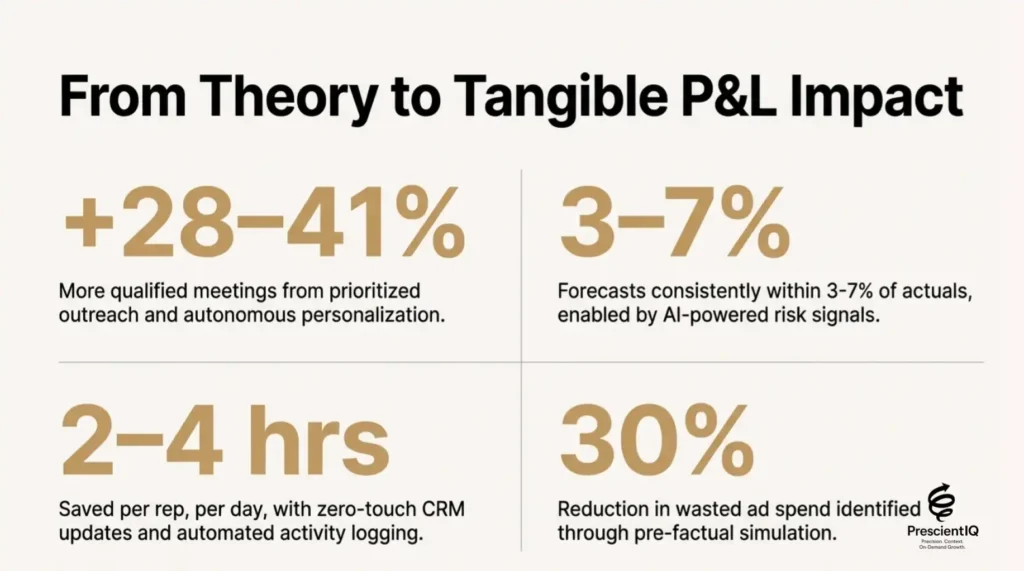
To see this in action, we must look at the Layer 4 Micro-Niche: Turnaround & Restructuring Services.
This is the hardest sector to sell into. You are selling to people who are failing. One wrong word, one tone-deaf phrase, and the door closes forever.
The Old Way (Manual)
A Partner spots a news alert: Beta Corp misses earnings by 15%.
The Partner knows he should reach out. He spends an hour digging through old files to find a relevant case study. He writes a draft.
He deletes it because it sounds too aggressive. He writes it again. He gets a phone call. He forgets about the draft. The opportunity dies.
The PrescientIQ Way (Calibrated)
The Context Engine is always on. It monitors the news autonomously for “distress signals”—such as missed earnings calls, executive departures, or credit downgrades.
- Detection: The engine spots the missed earnings call at Beta Corp.
- Retrieval: It instantly accesses the firm’s proprietary database. It cites a case study from three years ago in which the firm helped a similar manufacturer navigate a liquidity crunch.
- Synthesis: It pulls the Partner’s email history to see how he historically introduces himself to distressed CEOs.
- Execution: It drafts a hyper-personalized note.
The note is not generic. It says:
“Jim, I saw the earnings report this morning. It reminded me of the liquidity crunch we helped Bentix navigate in 2025. We found that inventory liquidation was more effective than debt restructuring in that specific cycle. If you’re seeing similar friction in the supply chain, we should talk.”
One-Click Approval

The Partner receives a notification. He sees the draft. It uses his voice. It cites his case study. It references the current news.
He does not need to write. He needs only to review. The process requires a one-click approval.
Suddenly, the Partner who could only write 5 emails a week is now approving 50. He has achieved “Warm Introduction” Scaling. He has cloned his expertise.
Conclusion: The New Era of Professional Services
The adoption of Proprietary Context Seeding represents a bifurcation point in the professional services industry. In today’s hyper-competitive market, there is an “Unscalable” crisis in management consulting firms that rely on AI and deep domain expertise.
Are you ready?
Eliminate the Crisis in Management Consulting Firms before it’s too late.
On the one hand, there will be firms that continue to rely on manual grinding by their partners, limited by the number of hours in a day.
On the other side, there will be firms that treat their expertise as a data asset—one that can be ingested, calibrated, and scaled.
The “Rainmaker” is no longer a bottleneck. With the right calibration, the Rainmaker is the seed for an infinite forest.
The future of advisory is not robot-led; it is Partner-Led, but AI-enabled. It preserves the sanctity of the “trusted advisor” while finally breaking the shackles of the clock.